How to Properly Squat and Lunge
Consult with your physician before starting an exercise program.

Chair squat
- Place a chair behind you, making sure it will not roll or slide. Stiffen your core and abdominal muscles to steady your spine. Keep your back flat during the exercise. Your feet should be shoulder-width apart and toes pointing forward.
- Slowly lower your body by bending your knees and driving your hips back. Keep your chest and head up.
- Touch the chair with your glutes (seat), then slowly rise back to the starting position.
- If you can't squat down far enough to reach the chair, you can do a mini-squat by lowering your body slightly and standing back up straight. Make sure you have a chair behind you in case you lose your balance.
- If you need additional support for your balance, you can have another chair or a steady piece of furniture beside you to hold on to as you squat down.

Bodyweight squat
- Stand with your feet slightly wider than hip-width apart. Stiffen your core and abdominal muscles to steady your spine. Hold your chest up and out. Tilt your head slightly up. Shift your weight back into your heels.
- Lower yourself until your thighs are parallel or almost parallel with the floor, until your heels begin to lift off the floor, or until your torso begins to round or flex forward. Monitor your feet, ankles and knees to ensure that your feet don't move, your ankles don't collapse in or out and your knees stay aligned over your second toe.
- While maintaining your back, chest and head-up position, exhale and extend your hips and knees by pushing your feet into the floor through your heels. Your hips and torso need to rise together while keeping your heels flat on the floor and knees aligned over the second toe.
- Continue extending until you reach your starting position.
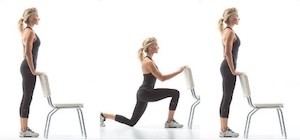
Assisted lunge with chair
Assisted lunges work all the muscles of the hips, glutes (seat) and thighs. This is a great way for beginners to practice lunges without losing their balance.
- Stand with your right foot forward and your left foot back, about three feet apart.
- Hold on to a chair or wall for balance.
- Bend the knees and lower them toward the floor until the back knee is a few inches from the floor and the front knee is at a right angle. Keep the front knee behind the toes and be sure to lower straight down rather than forward.
- Keep your torso straight and abs in as you push through the front heel and back to the starting position.
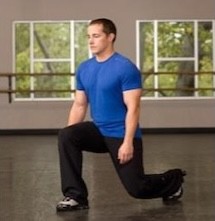
Forward lunge
- Stand with your feet together. Pull your shoulders down and back without arching your lower back. Stiffen your core and abdominal muscles to stabilize your spine.
- Slowly lift one foot off the floor, steadying your body on the supporting leg. Avoid any sideways tilting or swaying in your upper body.
- The raised leg should initiate contact with a heel strike first. Slowly transfer your bodyweight into the leading foot placed firmly on the floor.
- As you lunge forward, focus more on dropping your hips toward the floor rather than driving your hips forward. Lower your body to a comfortable position, or until your front thigh becomes parallel with the floor.
- Firmly push off with your front leg to return to your upright, starting position.