Virginia Big-eared Bat
Corynorhinus townsendii virginianus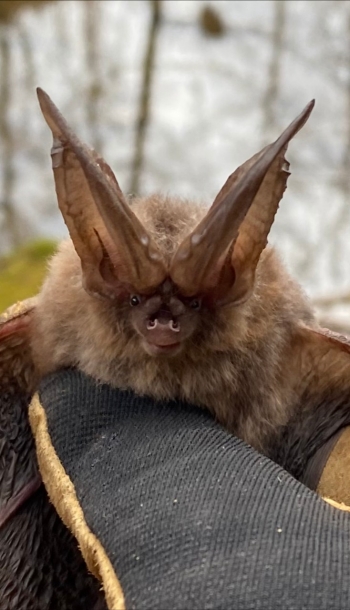
Description
The Virginia big-eared bat (Corynorhinus townsendii virginianus) is readily identified by its most striking feature: extraordinarily large ears that measure over 1.25 inches, often appearing nearly a third as long as its entire body. This medium-sized bat, weighing under half an ounce, possesses long, soft fur that is typically dark brown on the back and a lighter, buff-colored brown on its underside. A second defining characteristic is the presence of two prominent, fleshy glandular lumps on the sides of its muzzle, which give its face a distinctive, slightly bulbous profile. When at rest, the bat frequently curls its huge ears back against its head, resembling a pair of rams' horns, a behavior unique to this species.
It is a federally endangered species, non-migratory, and restricted to specific caves and karst regions of Virginia, West Virginia, Kentucky, and North Carolina, and has recently been found in Tennessee. Federally and State Endangered: The Virginia big-eared bat was listed as an Endangered Species by the U.S. Fish and Wildlife Service in 1979.
Length: 3.5 - 4.5 inches
Wingspan: 11 - 12 inches
Ears: 1.2 inches
Weight: 0.3 - 0.5 ounces
Similar Species: Rafinesque's Big-eared Bat
Habitat: The Virginia big-eared bat is an obligate cave-dweller, requiring undisturbed limestone karst systems year-round for survival. Its habitat must provide specific microclimates: cool, stable caves for hibernacula during winter, and separate, warmer cave rooms for maternity colonies during the summer months. These roosts must be closely associated with large areas of undisturbed mixed hardwood forests and open fields where the bat, a specialized predator, forages primarily for moths, typically within a few miles of its cave dwelling. This strict dependence on both specific cave architecture and surrounding forest quality makes its habitat exceptionally vulnerable to human disturbance and degradation.
Diet: The Virginia big-eared bat (Corynorhinus townsendii virginianus) is a specialized nocturnal insectivore whose diet is dominated by moths, constituting over 90% of its intake. It is an agile flyer that uses its large ears to help detect prey, primarily hunting moths in nearby open fields and through the forest canopy. This specialized, high-moth diet makes it a vital, natural pest control agent within its specific cave and forest ecosystem
Breeding information: The breeding cycle of the Virginia big-eared bat features delayed fertilization: mating occurs in fall or winter, but the female stores the sperm until spring when she leaves hibernation. Females then form maternity colonies in warm cave rooms, each giving birth to a single pup typically in May or June. The young mature quickly, achieving flight within about three weeks, after which the maternity colony disperses in late summer.
Status in Tennessee: The Virginia big-eared bat is actually a subspecies of Townsend's Big-eared Bat and its range does technically include a few isolated areas in East Tennessee (specifically Carter and Johnson counties)
Best places to see in Tennessee: Cave entrances in East Tennessee.

Fun Facts
- They Can Curl Their Ears: When the Virginia big-eared bat is hanging in its roost and settling in for a long rest, it can literally curl its massive ears back and tuck them against its head, making them look like a pair of tight little ram's horns.
- They Are a State Bat: The Virginia big-eared bat is the official state bat of Virginia, a distinction given due to its namesake and its federally endangered status, highlighting its importance to the state's natural heritage and conservation efforts.
