Agritourism
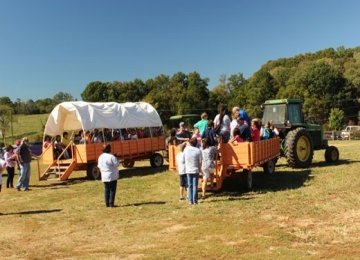
Tennessee Department of Agriculture supports established and developing agritourism operations through educational programming, marketing assistance, and grant funding. TDA works closely with UT/TSU Extension, the Center for Profitable Agriculture, the Tennessee Agritourism Association, and the Tennessee Farm and Agriculture Expo to offer workshops on marketing, business planning, safety, and regulatory topics. Through the Pick TN Products program, producers can access free marketing tools and online listings. TDA also administers agritourism related funding programs such as TAEP Producer Diversification, the Ag Enterprise Fund, and AgTrack.
For More Information Contact:
TDA Business Development Division
P.O. Box 40627
Nashville, TN 37204
615-837-5160
The term “agriculture” is defined in Tennessee Code Annotated §§ 1-3-105 and 43-1-113 as follows:
(A) “Agriculture” means:
(i) The land, buildings and machinery used in the commercial production of farm products and nursery stock;
(ii) The activity carried on in connection with the commercial production of farm products and nursery stock;
(iii) Recreational and educational activities on land used for the commercial production of farm products and nursery stock; and
(iv) Entertainment activities conducted in conjunction with, but secondary to, commercial production of farm products and nursery stock, when such activities occur on land used for the commercial production of farm products and nursery stock;
(B) As used in this definition of agriculture, the term “farm products” means forage and sod crops; grains and feed crops; dairy and dairy products; poultry and poultry products; livestock, including breeding and grazing; fruits; vegetables; flowers; seeds; grasses; forestry products; fish and other aquatic animals used for food; bees; equine; and all other plants and animals that produce food, feed, fiber or fur;
(C) As used in this definition of agriculture, the term “nursery stock” means all trees, shrubs, or other plants, or parts of such trees, shrubs or other plants, grown or kept for, or capable of, propagation, distribution or sale on a commercial basis.
Agritourism offers valuable benefits for both new and established farms, creating opportunities to diversify income, share your farm’s story, and build stronger connections with the community. Many operators find that welcoming visitors adds energy and enjoyment to their business.
Before getting started, think about the time, staffing, and financial resources you can commit, along with your comfort level in hosting guests. Agritourism often involves weekend hours, seasonal workers, updated insurance, and additional safety practices. Even with these added responsibilities, many farms discover that agritourism becomes one of the most satisfying and successful parts of their operation.
To the farm — Agritourism can diversify income, create new markets for farm products, improve cash flow, and increase community visibility.
To the community — It supports rural economies, attracts visitors, encourages local spending, and strengthens connections between residents and agriculture.
A strong business plan helps outline goals, budgets, staffing needs, marketing activities, and risk management strategies.
- External resource:
Small Business Administration business plan templates
Producers should understand signage requirements, immunity provisions, and general responsibilities related to visitor safety.
TAEP Producer Diversification, Ag Enterprise Fund, and AgTrack provide funding opportunities for agritourism development and expansion.
TAEP Producer Diversification – Agritourism
For the purposes of TAEP, an eligible Agritourism working farm offers on-the-farm experiences relating to production agriculture of food and/or fiber for a fee and is aimed at increasing the profitability of the operation.
Examples of projects funded through TAEP for agritourism include but are not limited to retail structures, restrooms, educational pavilions, Handicap Accessible areas, Parking lots, and signage.
Priority is given to projects focusing on long-term public use considerations, which increase opportunities for profitability and focus on agricultural education/ production over agricultural entertainment.
- Learn more at TAEP Producer Diversification – Agritourism
AEF
The AEF awards grants to starting or expanding agricultural, food, and forestry businesses; nonprofits, local governments, and other entities in Tennessee, or those whose project will be located in Tennessee. The program focuses on value-added and processing projects that benefit other producers or forest landowners.
Project must fall into one or more of the following categories:
- Increase in Farm Income
- Increase Access to Markets
- Increased Capacity
- Agricultural Innovation
- Promotion of Tennessee Agriculture
- Industry-specific research studies and market exploration.
- Learn more at Ag Enterprise Fund
AgTrack
The AgTrack awards grants to starting or expanding agricultural, food, and forestry businesses; nonprofits, local governments, and other entities in Tennessee, or those whose project will be located in Tennessee. The program focuses on value-added and processing projects that benefit other producers or forest landowners.
Project must fall into one or more of the following categories:
- Increase in Farm Income
- Increase Access to Markets
- Increased Capacity
- Agricultural Innovation
- Promotion of Tennessee Agriculture
- Industry-specific research studies and market exploration.
- Learn more at AgTrack
Tourism
Working with tourism offices can help promote events and listings.
- External resource:
Tennessee Tourism industry portal
TDEC – Small Business Environmental Assistance Program
Helps businesses understand environmental permits and requirements.
- External Resource:
Small Business Environmental Assistance Program
Labor and Workforce Development
Covers wage laws, staffing rules, and workplace safety requirements.
Amusement devices may need permitting
- External Resources:
Tennessee Amusement Device Unit
Revenue
Guides sales tax requirements for admissions, merchandise, and food sales.
- External Resource:
TN Agricultural Tax Manual (Chapter 7 Agritourism)
Health
Petting zoo safety to help reduce the risk of disease spread from animals to people.
Connect with your local county health department about concession stand requirements.
Guidance for Organized Camps and Day Camps
- External Resources
Practices for Zoonotic Disease Prevention
Find your local health department
Transportation
Tourist Oriented Directional Signs (TODS) are placed along state highways to direct tourists in Tennessee to local attractions, services, and businesses located off the state system of highways.
The Logo Sign Program is intended to provide the traveling public with business identification and directional information for essential motorist services. Logo signs are located prior to each interchange ramp on rural interstate highways where motorist services are provided. There are five different types of logo signs that direct the motorist to a specific type of service, including gas, food, lodging, camping, and attractions.
- External Resources:
Tourist Oriented Directional Signage Program
USDA
An Animal Exhibitor License may be required depending on the type of animal you have available to for viewing.
- External Resource:
Apply for an Animal Welfare License or Registration
TWRA
Contact TWRA to learn how to offer Fee Fishing on your farm.
Provides educational content for agritourism and other value-added enterprises.
Exploring Agritourism for Your Farm webinar series YouTube Link
Provides education and networking across the state.
Provides education and networking across the country and beyond.