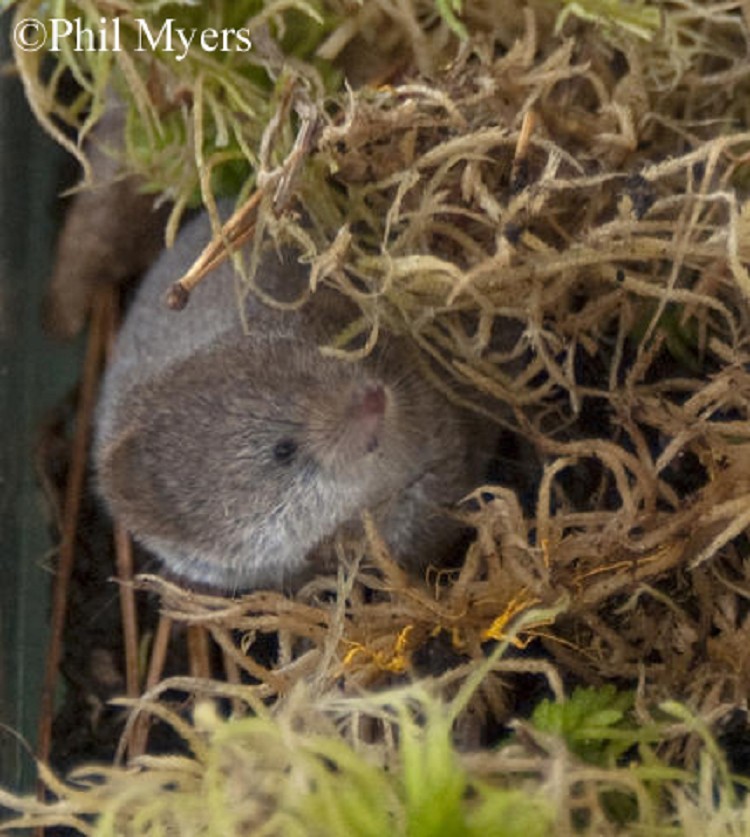
Smoky Shrew
sorex fumeus
Description
The Smoky Shrew, known for its 2 color molts, occurs in middle and eastern Tennessee. It is a very small mammal with a cone-shaped nose, tiny eyes, a cylindrical body, and short, slender legs. Their short, dense fur is brownish in the summer and dark gray to blackish-gray in the winter; the belly is lighter in both coats. The long tail is distinctly bi-colored, grayish-brown above and yellowish or tan below.
Length: 4.3 - 5.0 inches
Tail: 1.5 - 2.0 inches
Weight: 0.25 - 0.33 ounces
Similar Species: Cinereus Shrew is browner, has a smaller body, and has a relatively longer tail. The American Water Shrew is much larger. American Pygmy Shrew and Southeastern Shrew are smaller. Long-tailed Shrew has a longer, thicker tail with more hair and is dark gray all year. North American Least Shrew, Northern Short-tailed Shrew, and Southern Short-tailed Shrew have shorter tails.
Habitat: Smoky Shrews prefer moist hardwood forests with decaying logs, thick leaf litter, and moss-covered rocks; frequently found in higher elevations.
Diet: Consumes a wide variety of insects; also eats spiders, earthworms, and centipedes.
Breeding information: Mating season begins in March, and by the end of the breeding season in October, they can have up to 3 litters. Nests of leaf litter are constructed in hollow logs or under rocks prior to the birth of the blind and furless young. Females deliver 2-8 (average 6) young after a gestation period of less than 3 weeks. The pair mates again as soon as the first litter is born.
Status in Tennessee: Smoky Shrews are deemed in Need of Management by both TWRA and the Tennessee Department of Environment and Conservation. They are uncommon in the state, but can be abundant in some areas.
Best places to see in Tennessee: Moist woods with deep leaf litter and moss-covered rocks in the Appalachian Mountains.

Fun Facts
- Smoky Shrews were named for their slate-gray or blackish-gray winter coat, which develops by the end of October.
Photos