Trout


Brook Trout are Tennessee’s only native trout species, which have been found to be genetically distinct from Brook Trout native to more northern parts of its range.
At one time, all wild trout water in Tennessee was inhabited by Brook Trout. However, in the late 1800s, many populations were lost due to primitive logging techniques and the stocking of non-native Rainbow Trout. Wild populations can now only be found in the coldest and cleanest headwater streams in the mountains of eastern Tennessee at elevations greater than 3,000 feet where water temperatures are typically below 68° F. TWRA biologists, in cooperation with the US Forest Service, Great Smoky Mountain National Park, Tennessee Aquarium and Trout Unlimited have recently worked to expand the range of Brook Trout by stocking native strains back into their native waters.
Today, we have about 150 streams that support wild Brook Trout. For additional information on TWRA’s efforts to restore native Southern Appalachian Brook Trout populations across East Tennessee, check out this episode of Tennessee’s Wild Side.
Additional Information
Identification: Yellow or reddish-orange spots on sides and belly. Light wormlike markings on the upper body. The leading edge of the lower fins is white with a black stripe.
Angler Recognition Program: minimum 10 inches
Fishing Tips: Brook Trout are aggressive feeders, eating insects, crayfish, salamanders, and other fish. Food is typically in short supply in headwater streams, so Brook Trout rely heavily on prey that falls into the stream (e.g., ants, caterpillars, inchworms).
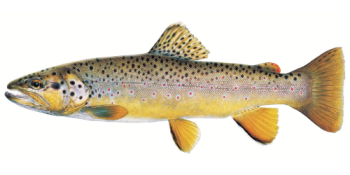
Brown Trout are native to Europe and Asia and, like Rainbows, became naturalized in Tennessee through stocking. They are typically found in lower elevation streams, often coexisting with Rainbow Trout.
They spawn in the fall between October and November, and juveniles emerge in February or March. Common in about 25 wild streams, Brown Trout offers the best opportunity to catch a trophy trout in Tennessee. Tennessee’s wild Brown Trout can live twice as long and attain much greater sizes than either Rainbow or Brook trout.
Additional Information
Identification: Brown to yellowish body color. Large dark spots and reddish dots, many having halos. Slightly forked tail with no spots.
Angler Recognition Program: minimum 26 inches
Fishing Tips: Young Brown Trout feed mostly on aquatic insects, small crayfish, and minnows. Adults will feed on fish, crayfish, rodents, and salamanders. Large browns tend to feed during low-light conditions and after dark. Typical trout baits and lures work for Brown Trout, but a slightly larger tackle may help catch trophy-sized fish.
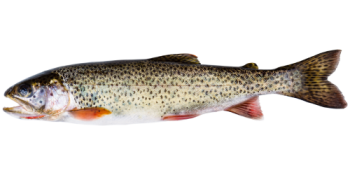
Cutthroat Trout are native to the western United States. They were originally stocked in a few of Tennessee’s tailwaters in the 1950s through the early 1960s with little success due to poor water quality prior to the Clean Water Act.
TWRA has recently partnered with the United States Fish and Wildlife Service to begin stocking Cutthroat Trout in Tennessee to provide a unique fishing opportunity in some of Tennessee’s tailwater fisheries. In 2021, Cutthroat Trout were added to the stocking list in the Tims Ford Tailwater (Elk River), Appalachia Tailwater (Hiwassee River), and Boone Tailwater (Holston River) to diversify the trout fishing experience below these dams. Evaluations will be ongoing.
Additional Information
Identification: Similar in appearance to Rainbow Trout. Body coloration can vary from olive to silver. Small black spots throughout the body. A key identification of Cutthroat Trout is the bright orange or red coloration that appears as “slashes” or “cuts” on the underside of the jaw.
Angler Recognition Program: Currently not recognized
Fishing Tips: Cutthroat Trout are known to be fairly aggressive and are usually willing to bite a fly, lure, or bait. Typical trout baits and lures for other species will work well for Cutthroat Trout. Check out the Tailwater Trout Fishing Forecast for specific information regarding fishing tips in the tailwaters you can find Cutthroat Trout.
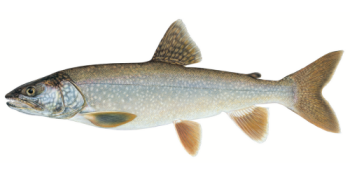
Lake trout are the third non-native trout species found in Tennessee, and are stocked in South Holston and Watauga reservoirs in the eastern part of the state.
They are usually found in the deeper and colder depths of these reservoirs. The diet of lake trout varies with the age and size of the fish, but mainly consists of aquatic insects, snails, and fish. Lake trout caught by anglers in Tennessee usually range from about 3-10 pounds. The state record is 22 pounds, 2 ounces.
Additional Information
Angler Recognition Program: minimum 28 inches

Rainbow Trout are native to the Pacific drainages of the western United States, but through extensive trout management during much of the 20th century, have become the most widely distributed and abundant trout species in Tennessee.
Rainbows were originally introduced into Tennessee in the late 1880s when logging practices destroyed the native Brook Trout's habitat.
Wild populations are now found in about 300 streams across East Tennessee. Rainbow Trout spawn in late winter, and their juvenile hatch out in early spring. They can tolerate temperatures slightly warmer than Brook Trout, preferring water temperatures below 70° F.
Additional Information
Identification: Body olive to silver in color. Small black spots throughout the body extend into the bottom of the tail. Pink streak along the middle of the body.
Angler Recognition Program: minimum 24 inches
Fishing Tips: Rainbow Trout eat insects, crayfish, fish, and fish eggs. They are susceptible to a wide variety of tackle. Fly-fishing with streamers and wet and dry flies can be effective. Spinning and baitcasting tackle includes small spinners, spoons, worms, and hellgrammites.
