Deer Carcass Transport & Disposal + Baiting & Feeding


CWD Management Zone for Carcass Transport Regulations
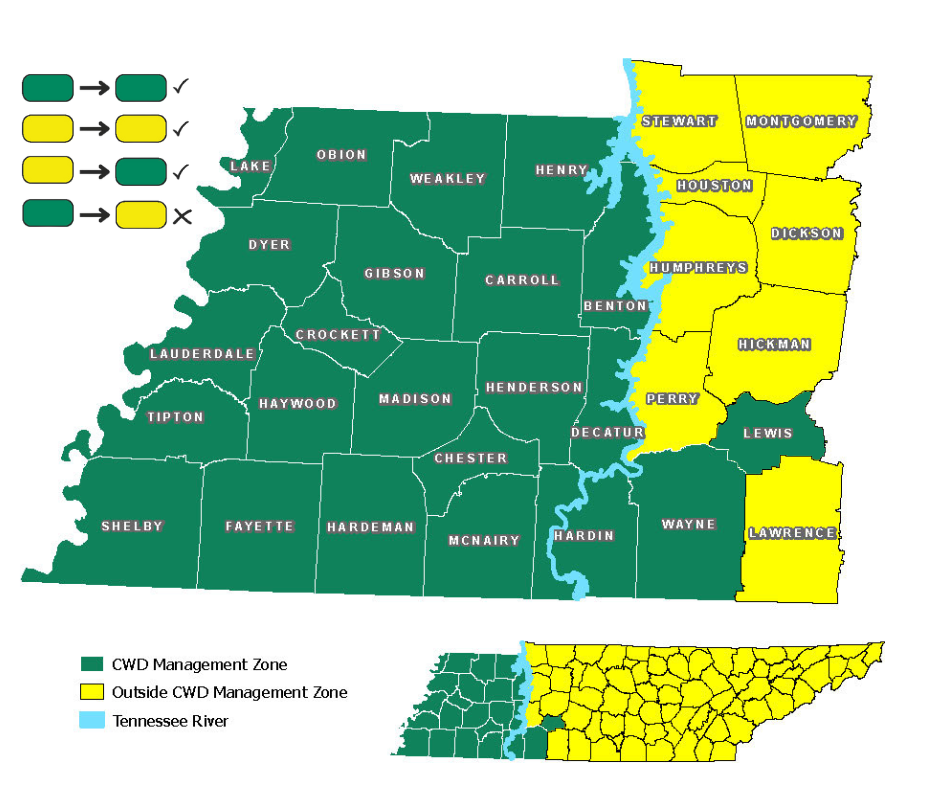
These restrictions have been put in place to reduce the spread of chronic wasting disease to areas outside of the primary affected region. Restricting wide-ranging carcass movement can lower the risk of an infected deer carcass becoming a source of infection in a new area.
Deer carcass transportation restrictions apply to the CWD Management Zone, and only approved parts may be moved out of the CWD Management Zone. All other regulations (e.g., DMU, season dates, bag limits, etc.) remain the same unless changed bt the TFWC.
The CWD Management Zone includes Benton, Carroll, Chester, Crockett, Decatur, Dyer, Fayette, Gibson, Hardeman, Hardin, Haywood, Henderson, Henry, Madison, McNairy, Lake, Lauderdale, Obion, Shelby, Tipton, and Weakley Counties.
- Deer carcasses can be moved within and between counties in the CWD Management Zone.
- Once a carcass is brought into the CWD Management Zone, it cannot be moved out of the zone.
- Approved parts (listed below) are free to be transported anywhere statewide.
- Also remember, only approved parts can be transported into Tennessee from another state.
Approved Parts
These parts have a low risk of spreading CWD.
- Deboned meat
- Antlers, antlers attached to cleaned skull plates, cleaned skulls (where no meat or tissues are attached to the skull)
- Cleaned teeth
- Finished taxidermy and antler products
- Hides and tanned products
Examples of Unapproved Parts
These parts have high risk of spreading CWD.
- Whole and field-dressed carcasses
- Organs, guts
- Uncleaned (meat and/or tissue are present) heads/skulls/skull caps
- Non-muscle tissues
Statewide Carcass Importation Restrictions
If you harvest a deer, elk, or moose from anywhere outside the state, it must be properly processed before bringing it into the state of Tennessee.
No person may import, transport, or possess in Tennessee a cervid carcass or carcass part from anywhere outside state except as provided herein:
(a) Meat that has bones removed
(b) Antlers, antlers attached to cleaned skull plates, or cleaned skulls (where no meat or tissues are attached to the skull.)
(c) Cleaned teeth
(d) Finished taxidermy and antler products
(e) Hides (tanned or green) and tanned products
Best Practices for Carcass Disposal
Deer carcass and carcass parts from infected deer pose a significant threat to preventing the spread of CWD. If not managed appropriately, carcasses of CWD-infected deer can pass the infectious material (prions) into the environment, which can then infect other deer. CWD is not known to affect humans, pets, or livestock.
As such, TWRA recommends the following best practices for disposal of unused deer parts, including gut material from field dressing a deer:
- Leave unused parts at harvest location. Burial can also further minimize possible spread.
- Double bag and dispose of as you would with your regular houshold garbage.
- Use a commercial meat processor for disposal.
Deer Baiting and Wildlife Feeding
Deer baiting and wildlife feeding is not allowed within the CWD Management Zone or in a CWD-positive county (not allowed in Benton, Carroll, Chester, Crockett, Decatur, Dickson, Dyer, Fayette, Gibson, Hardeman, Hardin, Haywood, Henderson, Henry, Humphreys, Lake, Lauderdale, Lewis, Madison, McNairy, Obion, Shelby, Tipton, Wayne, Weakley, and Williamson Counties).
Deer Bait Privilege License
This license (available August 1, 2026, on GoOutDoorsTennessee.com) allows hunting over bait only for white-tailed deer on privately owned or leased properties. It must be purchased annually by any individual hunting over bait. There will be no exemption for any hunter regardless of age or licenses exempt status.
Bait Type Specifics
- Allowed: Corn, wheat, grains, natural food substances, or any product exclusively produced or marketed for feeding deer.
- Not allowed: Any processed foods or enhanced/modified products not categorized above (Ex: sugar, honey, syrups, pastries, candies, peanut butter, etc.).
- Scented sprays, powders and salt blocks are not considered bait.
Baiting Methods
- Properties five (5) acres or less can only have one (1) bait site.
- Larger properties can have one (1) bait site per five (5) acres and must be at least 500 yards apart.
- No more than five (5) gallons or twenty-five (25) pounds of bait may be available for consumption at a single bait site during a 24-hour period.
- No open trough style feeders can be used.
- Bait shall be scattered across the ground and not piled.
Other Considerations
- Baiting is prohibited on all public lands, private inholdings bound on all sides by WMAs or PHAs, and within the proclaimed No Feeding Zone in Gatlinburg.
- No other big game species can be harvested within two hundred fifty (250) yards of a bait site. The same applies to deer if you did not purchase a baiting license.
- If baiting creates a public safety concern by concentrating and/or habituating wildlife, the agency can revoke a license.
- Baiting licenses will be valid for the duration of the deer season, even if a new county becomes CWD-positive during the deer season.
- Hunting over normal agricultural practices or wildlife food plots is not considered baiting.
Baiting Considerations and Best Practices
The unnatural congregation of animals through baiting or feeding can have several unintended consequences.
Feeding or baiting can also attract non-target species, causing nuisance issues. Higher raccoon concentrations around bait sites can increase predation risk of nearby turkey nests. Where present, feral hogs can outcompete deer for feed and degrade local habitat. Black bears are actively expanding across the state and will also be attracted to deer bait sites. Unfortunately, this often results in damage to feeders, trail cameras, and blinds. Some hunters may even “discover” that they also have feral hogs and bears in the area once they begin baiting.
Higher rates of direct contact between animals and soil contamination around bait sites increase the risk of disease transmission. This should be strongly considered regarding the spread of chronic wasting disease in deer. Bait sites can also propagate the spread of other diseases, such as bovine tuberculosis and brucellosis, which can be transmitted to humans, livestock, and pets.
Feed quality should also be considered, as grains can be contaminated by a fungus byproduct called aflatoxins, which can be harmful or lethal to wildlife. Wild turkey poults and bobwhite quail are particularly at risk. Grains, especially corn, stored for an extended period or piled in warm, moist conditions, can produce high concentrations of these toxins.
Some use artificial feed during the winter to try to supplement deer nutrition. However, a sudden shift to a high-carb diet, such as grain feed, during this time of year can disrupt their digestive system and cause fatal acidosis.
Responsible baiting practices:
- Regularly clean feeders by removing old food and wiping with a bleach solution.
- Avoid storing feed for extended periods.
- Keep feed as dry as possible and replace it if there is any moisture.
- Avoid placing feed/bait during warm and moist environmental conditions.
- Utilize spread-type feeders.
- Reduce the length of time bait/feed is on the landscape.
- Only use USDA-approved feed that has been tested for aflatoxins. Feed found unfit for livestock due to high levels of aflatoxins is often advertised for wildlife use.
- Do not use grains that are clumping, damaged, or have visible molds.
- Stop baiting or feeding if you see sick or oddly behaving wildlife.
CWD Wildlife Feeding Restrictions
Within the CWD Management Zone and any other CWD-positive county, there can be no placement of grain, salt products, minerals, or other consumable natural and manufactured products for general wildlife consumption unless feed and minerals are:
- Placed within one hundred (100) feet of any residence or occupied building.
- Placed in such a manner to reasonably exclude access by deer.
- Placed as part of a wild hog management effort authorized by the agency.
- Present from normal agricultural practices, normal forest management practices, or crop and wildlife food production practices.
Hunting over feed is not allowed under any of these circumstances.
