Milksnake
Lampropeltis triangulum
Description
Three subspecies of this brightly colored and strongly patterned snake occur in Tennessee: Eastern Milksnake (L. t. triangulum) occurs in upper East Tennessee, Red Milksnake (L. t. syspila) is distributed across most of West Tennessee, and Scarlet Kingsnake (L. t. elapsoides) extends from southern Land Between the Lakes southward along the Tennessee River to the Mississippi/Alabama border. The ranges for all 3 subspecies overlap in Middle and lower East Tennessee.
It is a slender, medium-sized, shiny snake (24.0 to 36.0 inches in length for Eastern; 21.0 to 28.0 for Red; 14.0 to 20.0 for Scarlet Kingsnake) with bright colors or strong patterns. The Eastern Milksnake has a gray or tan body with irregular brownish or reddish-brown, black-bordered blotches down the back; it sometimes has a pale "Y" or "V" shaped mark on the back of the head. Smaller, similar blotches also extend along the lower sides.
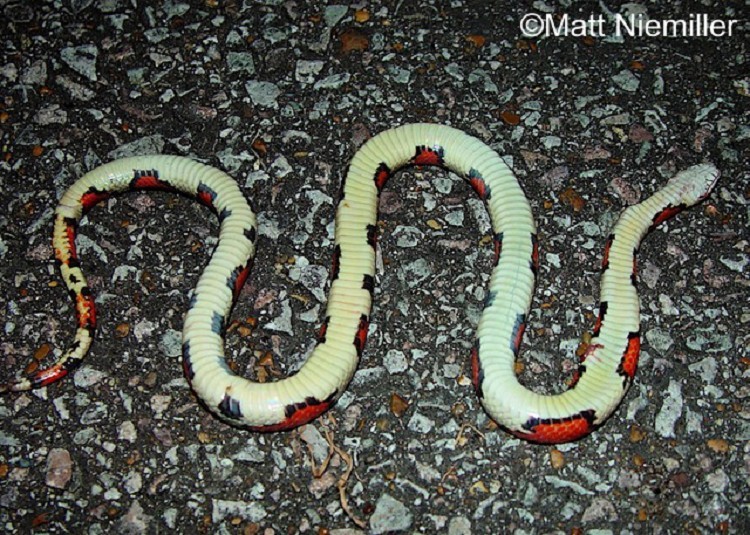
The Red Milksnake has a white or yellow body with red, reddish-brown, or orange-red, black-bordered blotches on the back. It has small, black markings along the sides. The Scarlet Kingsnake has a red snout and alternating bands of red, black, and yellow for the length of the body, with red touches. The belly is marked with a black and white checkerboard pattern, except the dorsal pattern on the Scarlet Kingsnake continues onto the belly.
Similar Species: Scarletsnake has a plain white belly. Prairie Kingsnake has brown blotches on the back and belly are brown or yellowish-brown. Red Cornsnake has a spearpoint pattern between the eyes, and the underside of the tail is striped. Dark markings on the back of the Mole Kingsnake are well separated. North American Racers and Gray Ratsnakes have divided anal scales. Copperhead has a copper-colored, unmarked head and triangular shapes on the side of the body. Watersnakes have keeled scales and divided anal scales.
Habitat: Milksnakes are found in a variety of habitats, but generally prefer pine or hardwood forests with rock outcroppings. They also live under rocks or logs in other habitats, including fields, savannahs, agricultural, suburban, wetlands, and forest edges.
Diet: Prefers mice, shrews, and voles, but also eats lizards, snakes, birds, and eggs.
Breeding information: Adults breed in the spring. Females choose nest sites under rocks, logs, or rotten stumps that are warm and humid. Females lay a clutch of 2-17 elliptical eggs about 30-40 days after breeding. Eggs typically hatch in late summer.
Status in Tennessee: Milksnakes are secretive, but widespread across the state. Populations are not protected in Tennessee.
Best places to see in Tennessee: Pine or hardwood forests at Land Between the Lakes or in the Unaka Mountains.

Fun Facts
- The name comes from the old wives' tale, which incorrectly thought that these snakes could milk cows.
- Scarlet Kingsnakes are the most strikingly colored snake in our region.
Photos




Sick and Injured Wildlife
