North American Deermouse
Peromyscus maniculatus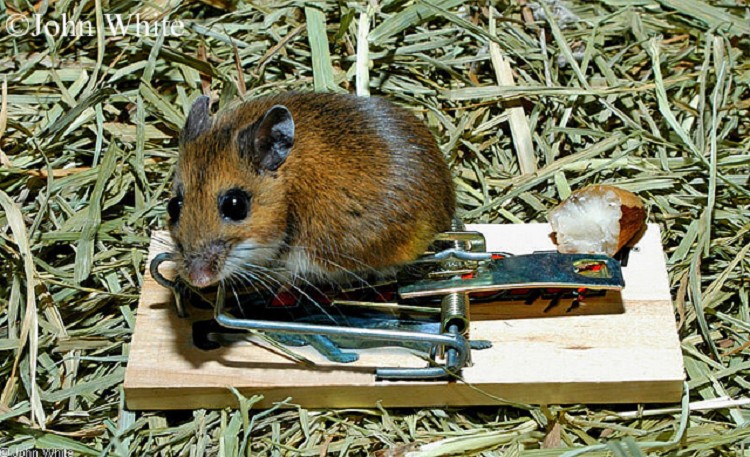
Description
The North American Deermouse is found statewide in two different forms. The short-tailed form (P. m. bardii) occurs in West Tennessee, while the long-tailed form (P. m. nubiterrae) lives in the eastern part of the state. It is a small rodent with large, black eyes, large ears, and long, coarse whiskers. Although color varies among individuals, most are grayish to reddish-brown above, often with a darker band down the center of the back. The feet, lower part of the face, and the undersides are white, which sharply contrasts with the upper color. Well-furred tails are distinctly bi-colored in most specimens, with the top darker and the bottom white; they have a slight tuft of hair at the tip and are from 1/3 to less than 1/2 the total body length.
Length: 4.4 - 8.0 inches
Tail: 1.6 - 3.9 inches
Ears: 0.5 - 0.9 inches
Weight: 0.33 - 1.0 ounces
Similar Species: North American Deermouse cannot reliably be separated from White-footed Deermouse and Cotton Deermouse without detailed analysis of skull and dental formations, and possibly an expert.
Habitat: The short-tailed form (P. m. bardii) occurs primarily in early successional habitats, such as prairies, pastures, and fencerows. The long-tailed form (P. m. nubiterrae) lives in a woodland habitat.
Diet: Primarily feeds on insects, seeds, nuts, fruits, berries, fungi, and domestic grains.
Breeding information: They generally mate twice a year, during fall and spring. Females may have 4 or more litters per year. Gestation lasts 21-23 days, and typically 1-9 young (average 3-4) are born per litter. Females nurse the blind, flesh-colored, naked newborns until they are weaned at 2-3 weeks old.
Status in Tennessee: Neither of the two forms is protected in the state. Deermice are common in their preferred habitat.
Best places to see in Tennessee: Open and edge habitats in the western part of the state and forests in eastern Tennessee.

Fun Facts
The genus name Peromyscus means "pouched little mouse," referring to the small cheek pouches of these field mice.
Sick and Injured Wildlife
