Nine-Banded Armadillo
Dasypus novemcinctus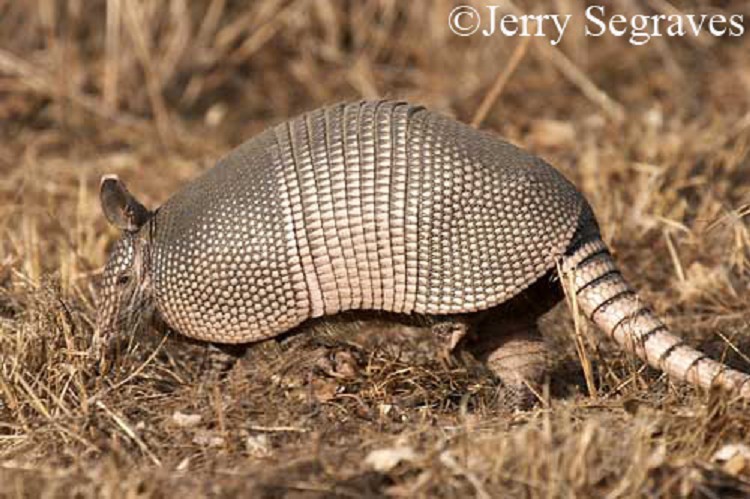
Description
The Nine-Banded Armadillo is an unusual-looking animal and has only reached Tennessee in the last thirty years or so, but their range continues to expand from west to east Tennessee. Its closest relative is the anteater, which has a similar shape, long tail, and snout. Heavily armored, the only exposed skin is on the underbelly, which is protected when the animal curls into a tight ball (when threatened). In between the two large body plates are nine "bands", hence the common name. The short legs have well-developed claws (4 toes on the front feet, 5 on the rear), which are used for digging burrows and searching for food.
Length: 28 - 33 inches
Tail: 9.5 - 14.5 inches
Ears: 1.5 inches
Weight: 6.6 - 11.0 pounds
Similar Species: None.
Habitat: Generally prefer forests of mature shortleaf pine, oak, and hickory.
Diet: Consists almost entirely of animal origin- ants, flies, mature and larval beetles, earthworms, and even small reptiles. On occasion, fruits are also eaten, such as persimmons.
Breeding information: Occurs in summer, and four same-sex quadruplets are born approximately 7 months later. Though they do not have a shell when born, they become mature by 12 to 15 months.
Status in Tennessee: Population seems to be increasing and spreading from west to east.
Best places to see in Tennessee: Much more common in the southern and western regions. Unfortunately, armadillos are most commonly spotted along roadsides after being hit by motor vehicles.

Fun Facts
- Armadillos and humans are the only known mammals to develop leprosy.
Photos


