Prairie Vole
Microtus ochrogaster
Description
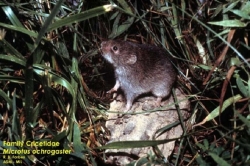
The Prairie Vole has a very fitting name, as it describes the grassy habitat in which they are typically found. They range throughout Tennessee, except in the extreme eastern portion of the state. It is a small, stocky rodent with short legs, a large head, and small eyes and ears. The short, moderately furred tail is slightly less than twice the length of the hind foot. Their fur is grayish to blackish-brown mixed with whitish, yellowish, or rusty, and the base of the hairs is dark gray. The grizzled fur is paler on the sides. Belly is tan to grayish; hairs are dark at the base.
Length: 4.6 - 7.0 inches
Tail: 0.9 - 1.9 inches
Ears: 0.5 - 0.6 inches
Weight: 0.75 - 2.0 ounces
Similar Species: Woodland Voles have shorter tails, and Meadow Voles have longer tails. A detailed analysis of dental formations, and possibly an expert, would be needed to distinguish it from the Southern Bog Lemming.
Habitat: Their name describes their habitat very well, as they prefer open grassy fields such as prairies, pastures, weedy fields, and fallow fields. Also, they will occur in hayfields and along fence rows. Voles use a system of runways on top of the ground and underground tunnels, where they spend most of their time.
Diet: Prairie Voles are mostly vegetarians, eating stems, leaves, roots, tubers, flowers, seeds, and fruits of grasses, sedges, and other plants. They will occasionally eat insects, snails, and crayfish.
Breeding information: The prolific Prairie Voles can produce many litters per year and may breed almost the entire year, but peak in spring and fall. The gestation period is 21 days, resulting in 1-7 (usually 3-5) young per litter. The tiny newborns are pink and hairless, but have fur within 5 days. Weaning occurs at 2-3 weeks, and they are adult size after 3 months.
Status in Tennessee: There are no conservation concerns for the Prairie Vole, as they may be plentiful.
Best places to see in Tennessee: Grassy fields.

Fun Facts
- Like other voles, Prairie Voles are subject to cyclical population fluctuations. Populations will flourish in abundance about every 4 years due to increased reproductive output, and then subsequently decline due to weather, predation, disease, or other factors.
Photos
Sick and Injured Wildlife
