Black-necked Stilt
Himantopus mexicanus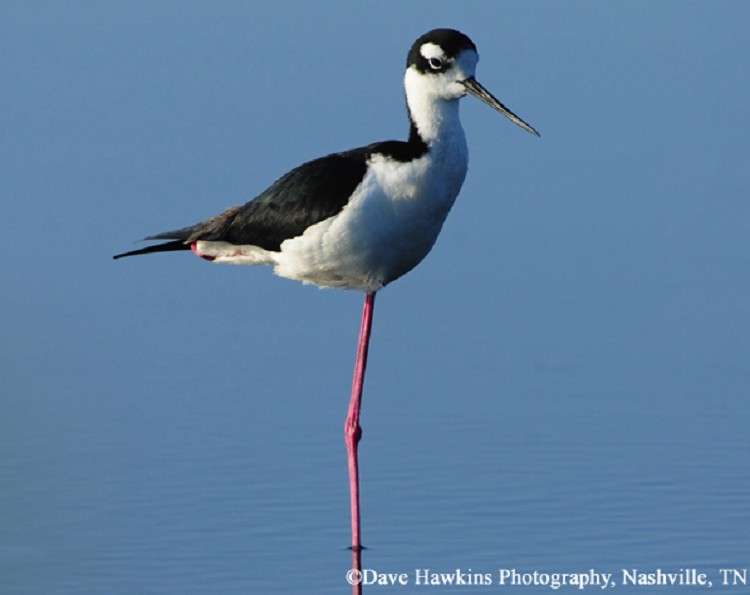
Description:
The Black-necked Stilt is an elegant black-and-white shorebird with a long neck and long red legs. It only started nesting in Tennessee in the early 1980s, and nesting is still restricted to the southwestern corner of the state. It is found around lakes and shorelines, and breeds in California and some western states, along the Gulf and Atlantic coasts, and south into Mexico and parts of South America; during the winter, it retreats from the northern parts of the range to join birds in Mexico, southern Florida, and the Caribbean.
Stilts have been expanding their breeding range up the Mississippi River to Missouri over the last 30 years and are now fairly common nesting birds. Black-necked Stilts are present in Tennessee from early April through late September. A large shorebird with a long neck, a long, straight, black bill, and long, thin, red legs. The top of the head, back of the neck, back, and wings are black, contrasting with the white face, throat, and underparts. Male, female, and juvenile are similar, but the female's back is actually dark brown, and juvenile back feathers have buff margins.
Average length is 14"
Wingspan is 29"
Weight is 6 oz.
Voice: A very vocal species with a loud, sharp taawh or pleek, which is often incessantly repeated.
Similar Species: American Avocet also has a long neck, long bill, and long legs, but the head and neck are pale, the legs are bluish-gray, and the bill is obviously upturned.
Habitat: In Tennessee, shallow freshwater wetlands, including rice fields, shallow lagoons, and sewage ponds.
Diet: Aquatic invertebrates.
Nesting and reproduction: Black-necked Stilts typically nest in loose colonies and defend an area of about 50' around the nest. The first nest in Tennessee was in 1982 at the Ensley Bottoms, where they still nest today.
Clutch Size: 4 eggs, occasionally 3-5
Incubation: Both adults incubate for 25 days
Fledging: Precocial young leave the nest within hours of hatching, but are closely protected for 4 to 5 weeks until independent.
Nest: In Tennessee, nests are usually placed on a small raised hummock with some vegetation.
Status in Tennessee: Rare away from the Mississippi River counties. Found in summer in suitable habitat from Shelby Co. north to Lake Co. around Reelfoot Lake. Sightings away from the Mississippi River typically occur after hurricanes and severe storms.
Best places to see in Tennessee: The TVA Lakes area is one of the places in Shelby Co where they can be found nesting as the Ensley Bottoms (aka the Pits) is not being managed with shallow water habitat anymore.

Fun Facts:
- Only flamingos have proportionately longer legs than do Black-necked Stilts.
- Obsolete English Names: lawyer
Photos:


Sick and Injured Wildlife
