County Health Councils
County Health Councils (CHC) have been active in Tennessee counties over the last 20 years. These councils are made up of local collaborators who work together to improve public health in their communities.Changing Public Health at the Local Level
County Health Councils (CHC) have been active in Tennessee counties over the last 20 years. These councils are made up of local collaborators who work together to improve public health in their communities.
While the membership, mission, and structure of County Health Councils may vary from county to county, typical sectors represented include education, planning, local government, healthcare, mental health, juvenile justice, local non-profits, social service organizations, and community members. By bringing together partners from multiple sectors and representing the communities they serve, CHCs are uniquely positioned to identify local health priorities and develop solutions that address each community’s specific needs.
How We Support County Health Councils
The Office of Community Collaboration and Impact, within the Division of Strategic Initiatives, directly supports councils in 89 rural counties and collaborates with partners in the 6 metro counties.
Our office aims to strengthen the impact of CHCs in improving community health and addressing health disparities. We provide the following support strategies:
- Community of Practice - A statewide network that fosters connection, collaboration, and shared learning
- Community Health Improvement Process (CHA/CHIP) - Guidance and technical assistance for Community Health Assessment (CHA) and Community Health Improvement Plans (CHIP)
- Community Development - resources and support to build CHCs capacity to seek and manage funding
- Data and Evaluation - Support to use data to inform decision-making, storytelling, and action.
- Tennessee Vitality Toolkit - A framework to help CHCs transition from assessment to collective action.
Together, these efforts help councils plan, implement, and sustain effective public health strategies at the local level.
Get Connected
For more information about County Health Councils, send an email to health.councils@tn.gov.
Sign up for the County Health Council newsletter here to receive monthly updates, resources, funding opportunities, and training information.
Program Connections
Empowering Communities
The Community Development Team (CDT) is committed to equipping communities across Tennessee with the tools and support they need to lead lasting change, strengthen capacity, and center community voice. With a focus on equity, collaboration, and sustainability, we provide hands-on, grant-oriented assistance to county health councils and the small community-based organizations they often partner with. Our goal is to strengthen their capacity, expand access to funding, and help sustain local impact.
From grant readiness and funding strategies to tailored trainings, personalized coaching, and community engagement, our services are designed to meet groups where they are and walk alongside them as they grow. Whether you're preparing your first grant application or enhancing your ability to manage and leverage funding, we’re here to support your vision and goals.
Together, we’re advancing community-led solutions to public health challenges—because the most effective change begins within the communities themselves.
Community Development Team Services
1. Grant Readiness Support
Hands-on, step-by-step guidance to prepare organizations for successful grant applications. This service focuses on immediate needs like developing competitive proposals, meeting funder requirements, and strengthening grant management practices to secure funding.
2. Training & Capacity Building
Helping organizations identify and engage with external partners and funders to build strategic relationships that expand funding opportunities. This service focuses on developing collaborative projects, fundraising strategies, and strengthening relationships with foundations, corporations, and community funders.
3. Personalized Coaching & Monitoring
One-on-one coaching and mentoring to support leaders in strengthening organizational strategy, leadership skills, and operational efficiency. This service focuses on strategic growth, leadership structure, board development, and internal decision-making, not just project-specific tasks.
4. Partnership & Donor Engagement
Helping organizations identify and engaging with external partners, donors, and funders to build strategic relationships that expand funding opportunities. This service focuses on developing collaborative projects, fundraising strategies, and strengthen relationships with foundations, corporations, and community funders.
5. Service TDH Partners & Promoting Community Resilience
Collaborating with TDH staff and regional teams to support statewide public health initiatives. This service focuses on alighning efforts with TDH priorities, providing grant-related support, and strengthening community resilience through state-led partnerships.
6. Localized Community Support
Providing consistent on-the-ground support by actively participating in health council meetings and engaging with local partners. This service ensures timely, tailored assistance for community-driven projects, grant support, and resource connections to meet local needs.
Contacts
Margaret Taylor, West Region, Community Impact Consultant, margaret.taylor@tn.gov
Darla Sampson, Mid-Cumberland and South Central Regions, Community Impact Consultant, darla.sampson@tn.gov
Kia Ruffin, Upper Cumberland and Southeast Regions, Community Impact Consultant, kia.ruffin@tn.gov
Emily Mathews, East and Northeast Regions, Community Impact Consultant, emily.mathews@tn.gov
Click here for a map and more information of Tennessee's Health Regions.
County Health Assessment
The County Health Improvement process, including both the County Health Assessment (CHA) and the Community Health Improvement Plan (CHIP), aims to increase the impact of Health Councils by providing a framework for councils to conduct a locally-led needs assessment and action planning process. The CHA guides Health Council members through data collection to determine up to three priorities for the council to address through cross-sector collaboration and community-driven action plans. County Health Councils lead this five-phase process, with administrative and facilitative support from their respective county health departments. In addition, regional health departments and the Office of Strategic Initiatives provide support through technical assistance, resource sharing and shared-learning opportunities.
Goal-Setting for County Health Assessments
The worksheets, guides, data packages, and other resources guide County Health Councils step-by-step through the phases of the County Health Improvement Process, in achieving the following goals:
- Increase overall stakeholder engagement and participation in Health Council meetings/activities
- Support local leadership by providing County Health Councils with structure, support, and resources aimed at identifying and addressing common priorities
- Facilitate the development of 3-year action plans for each Health Council participating in the CHA process
- Provide a platform to integrate and align local and state-level strategic planning
County Health Improvement Process
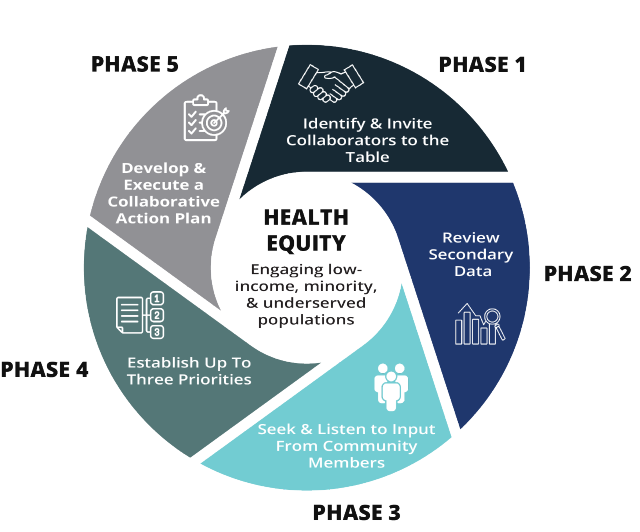
Description: The graphic above is a circular flow chart illustrating the five phases or steps of the Community Health Assessment (CHA) cycle, with a focus on engaging low-income, minority, and underserved populations. From the top, moving clockwise, the steps include: Phase 1 identifying and inviting collaborators to the table; Phase 2 reviewing secondary data; Phase 3 seeking and listening to input from community members; Phase 4 establishing up to three priorities; and Phase 5 developing and executing a collaborative action plan. The circular design reinforces the CHA cycle is a continuous and collaborative process for improving community health.
Worksheets & Guides
Use the worksheets and guides below as your Health Council works through the five phases of the County Health Improvement Process.
For more information or support for CHA and CHIP, contact Aubrenie Jones at Aubrenie.Jones@tn.gov.
PHASE 1 - Identify & Invite Collaborators to the Table
Establish your Point of Contact
PHASE 3 - Seek & Listen to Input from Community Members
PHASE 4 - Establish Up to Three Priorities
PHASE 5 - Develop & Execute a Collaborative Action Plan
What is a Community of Practice?
“Groups of people who share a concern or passion for something they do and learn how to do it better as they interact regularly.” – Étienne Wenger
The Health Council Community of Practice (CoP) supports local and regional TDH staff and community members who are involved in County Health Council work. With a focus on equity and community engagement, the Community of Practice provides a structured space to celebrate successes, share best practices, build skills, and foster connections that cultivate leadership among County Health Council participants and support staff.
The CoP meets online every month to spotlight Health Council work, network, and share resources. If you would like to attend these meetings and receive updates specific to the CoP, please join the mailing list here.
Monthly Networking Calls
October 2023 (McMinn County Health Council Spotlight): Slides
December 2023 (Cocke County Health Council Spotlight): Slides
January 2024 (Tennessee Vitality Toolkit Launch): Slides
February 2024 (Trousdale County Health Council Spotlight): Slides
March 2024 (Campbell County Health Council Spotlight): Slides
April 2024 (CoP Feedback Activities): Slides
May 2024 (Spring Summit Recap): Slides
June 2024 (Healthcare Resiliency Program Funding Opportunity): Slides
July 2024 (Centerstone Partner Spotlight): Slides
August 2024 (Carter County Collaborative Health Council Spotlight): Slides
September 2024 (Peer Problem-Solving): Slides and Breakout Group Miro Board
October 2024 (TPHA Recap and Updated Logic Model): Slides
November 2024 (Hickman County Health Council Spotlight): Slides,and Q&A document
December 2024 (Wayne County Health Council Spotlight): Slides
January 2025 (Human Trafficking Awareness): Meeting Slides,
February 2025 (rescheduled to May 2025 due to weather)
March 2025 (TN Community Compass): Slides
April 2025 (Mental Health Resources with NAMI) Slides
May 2025 (Lincoln County Health Council Spotlight) Slides.
Spring Summits 2025
The Community of Practice gathered in-person for our third series of spring events across the state. We met in Greeneville, Cookeville, and Jackson to network with other Health Council members and gain tools and resources to support our Health Council work. The program featured opening remarks from Dr. Monty Burks, Deputy Director of the Governor’s Faith-Based and Community Initiative, a Health Council leadership panel, and breakout sessions on meeting facilitation, grant readiness, faith-based partnerships, and disability inclusion in the CHIP.
Contact
For more information on the CoP, please email Atlee Tyree, Community Engagement Strategist, at atlee.tyree@tn.gov.
Sign up for the monthly County Health Council newsletter here.
Annual County Data Packages and Priorities
Evaluation & Reports
2023 Community Health Assessment Report
Tennessee’s County Health Councils play a vital role in improving community health by completing a community health improvement process, in collaboration with the local and regional health departments and the Office of Strategic Initiatives (OSI). This includes a Community Health Assessment (CHA) to identify health priorities and a Community Health Improvement Plan (CHIP) to outline strategies for improvement.
The 2023 Community Health Assessment Report details the evaluation results for the 18 County Health Councils that completed the CHA in 2023. The report highlights the experiences, successes, and lessons learned from the Councils during the CHA process, as well as resources and next steps provided by OSI to further support Councils in their community health improvement efforts.
Previous Reports
Tennessee Vitality Toolkit
The Tennessee Vitality Toolkit is a hands-on guide for County Health Councils and their partners to improve health and well-being in communities across Tennessee. It’s based on data and shaped by the voices of people across the state, focusing on key social drivers of health like housing, jobs, education, and transportation.
Now managed by East Tennessee State University, the Tennessee Vitality Toolkit is accessibie at a new location.
The toolkit helps councils move from their Community Health Assessment (CHA) and Community Health Improvement Plan (CHIP) to action, turning local priorities into strategies that strengthen community health. The toolkit provides guidance, tools, and resources that help communities create lasting, positive change.
Resources in the toolkit are organized into three focus areas: caring and connected communities, basic needs and the built environment, and strong starts for children. These practical tools help councils support Tennesseans of all ages and build thriving communities.
This Page Last Updated: September 18, 2026 at 12:44 PM