Non-TDEC PFAS Sampling Efforts
EPA's Unregulated Contaminant Monitoring Rule (UCMR)
A requirement of the 1996 Safe Drinking Water Act (SDWA) amendments, the Unregulated Contaminant Monitoring Rule (UCMR) provides EPA authority to collect data on unregulated contaminants that are suspected of being present in drinking water and do not have health-based standards under the SDWA.
View more information about UCMR, including reports and raw data
UCMR 5: EPA's Fifth Unregulated Contaminant Monitoring Rule (UCMR 5) requires sampling collection from 2023-2025 for 30 chemical contaminants (29 PFAS and lithium) to improve understanding of contamination in drinking water systems. The resulting data will help EPA make determinations on future regulations and other actions to protect public health under the SDWA. EPA has begun releasing data and additional resources under UCMR 5 and TDEC will continue to update this page as we learn more.
Other Sampling Efforts
Outside of TDEC's sampling and the UCMR sampling efforts, the U.S. Department of Defense (DOD), U.S. Environmental Protection Agency (EPA), and some localities have conducted their own sampling for various PFAS constituents in Tennessee. See the archived content below on other state, local, and federal agencies' PFAS Sampling efforts.
Archived Information on Non-TDEC PFAS Sampling Efforts
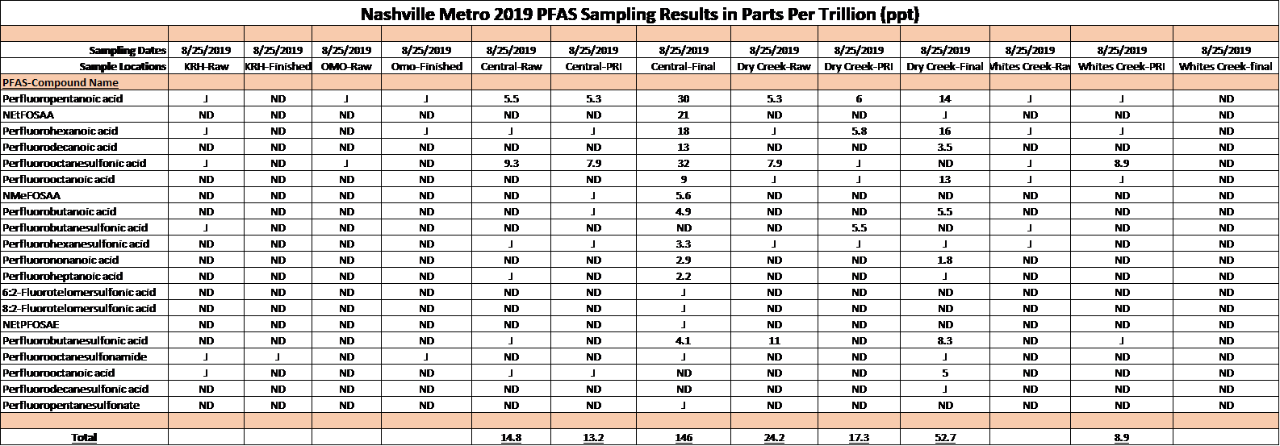
In 2019, Metro Water Services conducted a voluntary sampling of Nashville’s drinking water systems for PFAS. Their stated goal was to go above and beyond current federal and state monitoring requirements to understand the potential presence of PFAS in Nashville’s drinking water. The results of the sampling effort are displayed in the archived table below.
U.S. Department of Defense (DOD) sites have been found, in some instances, to have elevated levels of PFAS associated with legacy use of aqueous film-forming foam (AFFF) for fire fighting efforts. Due to the widespread use of AFFF at some sites, the U.S. DOD has been engaging in sampling for PFAS both on-base and off-base at locations across the country, including in Tennessee. DOD makes PFAS sampling reports available to TDEC as they are finalized. As mentioned above, TDEC has attempted to summarize this sampling data via our PFAS map, but there are challenges with communicating all information via this approach. DOD sampling reports submitted to TDEC are provided in full below:
Since 2008, EPA has conducted a series of three fish contamination studies as part of the Agency’s National Rivers and Streams Assessments (NRSA) that occur in five-year cycles. The NRSA is one of four statistical surveys that make up the National Aquatic Resource Surveys). The EPA describes the NRSA as a collaborative survey that provides information on the ecological condition of the nation’s rivers and streams and the key stressors that affect them, both on a national and an ecoregional scale.
Surveys have been conducted in 2008-2009, 2013-2014, and 2018-2019 and includes fish tissue sampling for various contaminants, including PFAS. Data from these surveys are not immediately available; currently, only data from the 2008-2009 and 2013-2014 surveys are available. Research has found PFOS to be one of the most common PFAS found in freshwater fish tissue. PFOS was detected in multiple fish species (e.g., largemouth bass) in several of the State’s rivers, including the Tennessee, Cumberland, Wolf and Mississippi Rivers.
View more information about these studies, including the final reports and raw data.