Rare Species Data
Publicly Available Natural Heritage Data
Search and download data by County, Quadrangle, Watershed, or MS4 using our Rare Species Data Viewer.
Submit Rare Species Data
Our agency relies on information gathered from a variety of sources to facilitate conservation efforts. You may be able to help provide such information. Do you know the location of an exemplary or relatively undisturbed natural community? Do you have site information for a particular rare species? Once we receive your information, it will be verified and entered into our database. The information will be used to update species range maps, identify and develop recommendations for the protection of species that could be impacted by development, and for general conservation planning purposes.
Providing rare taxa element occurrence (EO) data in a spreadsheet, database table or KML file can greatly speed up our work in converting it to an EO record (EOR) and getting it into our database. Electronic submission of data is especially helpful for large data sets. Please use the Excel spreadsheet to submit your data, including data collected under a scientific collecting permit.
Tennessee Rare Plant List
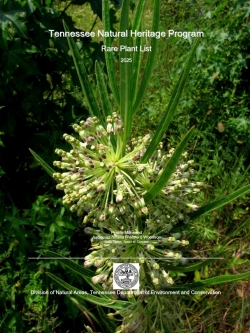
Federal, state, and private agencies, organizations, and individuals use rare species lists produced by the Division of Natural Areas (DNA) Natural Heritage Program for environmental review and land management decisions. Currently 558 rare plant species are tracked by the state, including 217 listed as state-endangered. DNA encourages individuals and organizations to assist staff biologists in determining accurate plant list contents and ranking information
The latest version of the Tennessee Rare Plant List is now available
Plants listed in Tennessee are protected by the Rare Plant Protection and Conservation Act of 1985. The Tennessee Rare Plant Scientific Advisory Committee consists of twelve botanists who are knowledgeable of the state’s flora. This committee is required to meet at least once every three years in order to review the list and make recommendations to modify the list as needed. The criteria for listing a rare plant as endangered, threatened, or special concern, include but are not limited to the following:
- Distribution of the species in Tennessee and throughout its range.
- Number of populations in Tennessee and throughout the species’ range.
- Size of populations relative to estimates of minimal viable populations for the species.
- Habitat specificity.
- Known or perceived threats to the species and its habitats.
- Number of protected populations.
- Difficulty of adequately protecting or managing habitats for the species’ survival.
- Biological factors including the species’ ability to reproduce, respond to disturbance, or its dependence on other species that may also be in jeopardy.
Any interested person may nominate a plant species for listing or recommend changes in status or removal of species from the current rare plant list promulgated under the act. More information is available in The Rare Plant Protection and Conservation Act of 1985 (TCA §§70-8-301 – 314) and the associated rules (Chap. 0400-06-02).