Hazardous Waste Determination Matrix
TN Rule 0400-12-01-.03(1)(b) requires that a person who generates a solid waste must determine if that waste is a hazardous waste. The method to use in making the determination is outlined in that same rule.
This Hazardous Waste Determination Matrix is an assistance tool which will guide you through questions and regulatory citations associated with the determination process.
Waste generators are responsible for the complete and accurate evaluation of generated waste streams. Use/evaluation through the Matrix is not all inclusive and is NOT a substitution for review and evaluation of compliance with all applicable laws and regulations. Hazardous waste determinations can be complex. In order to correctly evaluate a waste stream, generators must be knowledgeable regarding chemical characteristics of the waste, chemicals used in the process, the process generating the waste, point of waste generation, contaminates, and any other situations that could cause the waste to be hazardous as defined by the TN Regulations. A hazardous waste determination must be made at the point of generation before any dilution, mixing, or other alteration of the waste occurs. When a waste must be sampled, generators much ensure that all samples are representative of the waste stream and that appropriate test methods are followed.
(b) Hazardous Waste Determination and recordkeeping [40 CFR 262.11]
A person who generates a solid waste, as defined in subparagraph (1)(b) of Rule 0400-12-01-.02, must make an accurate determination as to whether that waste is a hazardous waste in order to ensure wastes are properly managed according to applicable hazardous waste management regulations. A hazardous waste determination is made using the following steps:
1. The hazardous waste determination for each solid waste must be made at the point of waste generation, before any dilution, mixing, or other alteration of the waste occurs, and at any time in the course of its management that it has, or may have, changed its properties as a result of exposure to the environment or other factors that may change the properties of the waste such that the hazardous waste management regulatory classification of the waste may change.
2. A person must determine whether the solid waste is excluded from regulation under subparagraph (1)(d) of Rule 0400-12-01-.02.
3. If the waste is not excluded under subparagraph (1)(d) of Rule 0400-12-01-.02, the person must then use knowledge of the waste to determine whether the waste meets any of the listing descriptions under paragraph (4) of Rule 0400-12-01-.02. Acceptable knowledge that may be used in making an accurate determination as to whether the waste is listed may include waste origin, composition, the process producing the waste, feedstock, and other reliable and relevant information. If the waste is listed, the person may file a delisting petition under 40 CFR 260.20 and 260.22 to demonstrate to the EPA Administrator that the waste from this particular site or operation is not a hazardous waste.
4. The person then must determine whether the waste exhibits one or more hazardous characteristics as identified in paragraph (3) of Rule 0400-12-01-.02 by following the procedures in subpart (i) or (ii) of this part, or a combination of both.
(i) The person must apply knowledge of the hazard characteristic of the waste in light of the materials or the processes used to generate the waste. Acceptable knowledge may include process knowledge (e.g., information about chemical feedstocks and other inputs to the production process); knowledge of products, by-products, and intermediates produced by the manufacturing process; chemical or physical characterization of wastes; information on the chemical and physical properties of the chemicals used or produced by the process or otherwise contained in the waste; testing that illustrates the properties of the waste; or other reliable and relevant information about the properties of the waste or its constituents. A test other than a test method set forth in paragraph (3) of Rule 0400-12-01-.02, or an equivalent test method approved by the EPA Administrator under 40 CFR 260.21, may be used as part of a person's knowledge to determine whether a solid waste exhibits a characteristic of hazardous waste. However, such tests do not, by themselves, provide definitive results. Persons testing their waste must obtain a representative sample of the waste for the testing, as defined at subparagraph (2)(a) of Rule 0400-12-01-.01.
(ii) When available knowledge is inadequate to make an accurate determination, the person must test the waste according to the applicable methods set forth in paragraph (3) of Rule 0400-12-01-.02 or according to an equivalent method approved by the EPA Administrator under 40 CFR 260.21 and in accordance with the following:
(I) Persons testing their waste must obtain a representative sample of the waste for the testing, as defined at subparagraph (2)(a) of Rule 0400-12-01-.01.
(II) Where a test method is specified in paragraph (3) of Rule 0400-12-01-.02, the results of the regulatory test, when properly performed, are definitive for determining the regulatory status of the waste.
5. If the waste is determined to be hazardous, the generator must refer to Rules 0400-12-01-.02, 0400-12-01-.05, 0400-12-01-.06, 0400-12-01-.09, 0400-12-01-.10, and 0400-12-01-.12 for possible exclusions or restrictions pertaining to management of the specific waste.
6. Recordkeeping for small and large quantity generators. A small or large quantity generator must maintain records supporting its hazardous waste determinations, including records that identify whether a solid waste is a hazardous waste, as defined by subparagraph (1)(c) of Rule 0400-12-01-.02. Records must be maintained for at least three years from the date that the waste was last sent to on-site or off-site treatment, storage, or disposal. These records must comprise the generator's knowledge of the waste and support the generator's determination, as described in parts 3 and 4 of this subparagraph. The records must include, but are not limited to, the following types of information: the results of any tests, sampling, waste analyses, or other determinations made in accordance with this subparagraph; records documenting the tests, sampling, and analytical methods used to demonstrate the validity and relevance of such tests; records consulted in order to determine the process by which the waste was generated, the composition of the waste, and the properties of the waste; and records which explain the knowledge basis for the generator's determination, as described at subpart (4)(i) of this subparagraph. The periods of record retention referred to in this part are extended automatically during the course of any unresolved enforcement action regarding the regulated activity or as requested by the Commissioner.
7. Identifying hazardous waste numbers for small and large quantity generators. If the waste is determined to be hazardous, small quantity generators and large quantity generators must identify all applicable hazardous waste numbers (EPA hazardous waste codes) in paragraphs (3) and (4) of Rule 0400-12-01-.02. Prior to shipping the waste off site, the generator also must mark its containers with all applicable hazardous waste numbers (EPA hazardous waste codes) according to subparagraph (4)(c) of this rule.
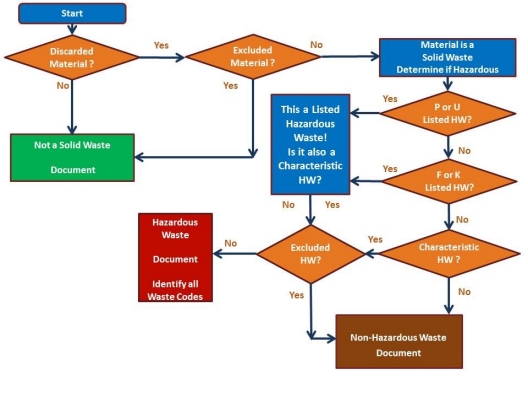

Step 1: Determine if the Material is a Solid Waste
The first step is to determine if the material being evaluated is classified as a solid waste. If the material is NOT a solid waste, it cannot be a hazardous waste.
Solid Waste is defined in Rule 0400-12-01-.02(1)(b):
"A “solid waste” is any discarded material that is not excluded by part (d)1 of this paragraph or that is not excluded by variance granted under subparagraphs (4)(b) and (c) of Rule 0400-12-01-.01 or that is not excluded by a non-waste determination under subparagraphs (4)(b) and (e) of Rule 0400-12-01-.01."
Note:
The definition of solid waste is not limited to physically solid wastes. Many solid wastes are liquid, semi-solid, or contained gaseous material.
Continue to Step 1A below.
Step 1A: Does the Material Meet the Regulatory Definition of Discarded Material?
"Discarded Material" is any material that is:
0400-12-01-.02(1)(b)2. Materials are solid waste if they are “abandoned” by being:
(i) Disposed of; or
(ii) Burned or incinerated; or
(iii) Accumulated, stored, or treated (but not recycled) before or in lieu of being abandoned by being disposed of, burned, or incinerated; or
(iv) Sham recycled, as explained in part 7 of this subparagraph.
0400-12-01-.02(1)(b)7. Sham recycling.
A hazardous secondary material found to be sham recycled is considered discarded and a solid waste. Sham recycling is recycling that is not legitimate recycling as defined in subparagraph (5)(d) of Rule 0400-12-01-.01.
0400-12-01-.02(1)(b)3. Materials are solid wastes if they are “recycled” – or accumulated, stored, or treated before recycling – as specified in subparts (i) through (iv) of this part:
(i) “Used in a manner constituting disposal”.
I) Materials noted with a “*” in Column 1 of Table 1 are solid wastes when they are:
I. Applied to or placed on the land in a manner that constitutes disposal; or
II. Used to produce products that are applied to or placed on the land or are otherwise contained in products that are applied to or placed on the land (in which cases the product itself remains a solid waste).
(II) However, commercial chemical products listed in subparagraph (4)(d) of this rule are not solid wastes if they are applied to the land and that is their ordinary manner of use.
(ii) “Burning for energy recovery”
(I) Materials noted with a “*” in column 2 of Table 1 are solid wastes when they are:
I. Burned to recover energy;
II. Used to produce a fuel or are otherwise contained in fuels (in which cases the fuel itself remains a solid waste).
(II) However, commercial chemical products listed in subparagraph (4)(d) of this rule are not solid wastes if they are themselves fuels.
(iii) “Reclaimed”
Materials noted with a “---” in column 3 of Table 1 are not solid wastes when reclaimed. Materials noted with a “*” in column 3 of Table 1 are solid wastes when reclaimed unless they meet the requirements of subparts (d)1(xvii), (xxiii), (xxiv) or (xxvii) of this paragraph.
(iv) “Accumulated speculatively”
Materials noted with a “*” in column 4 of Table 1 are solid wastes when accumulated speculatively.
| Use constituting disposal (subpart (1)(b)3(i) of this rule) | Energy recovery/fuel (subpart (1)(b)3(ii) of this rule) | Reclamation (subpart (1)(b)3(iii) of this rule) except as provided in subpart (1)(d)1(xvii), (xxiii), (xxiv) or (xxvii) of this rule | Speculative accumulation (subpart (1)(b)3(iv) of this rule) | |
|---|---|---|---|---|
| (1) | (2) | (3) | (4) | |
| Spent Materials | (*) | (*) | (*) | (*) |
| Sludges [listed in Rule 0400-12-01- .02(4)(b) or (c)] | (*) | (*) | (*) | (*) |
| Sludges exhibiting a characteristic of hazardous waste | (*) | (*) | - | (*) |
| By-products [listed in Rule 0400-12- 01-.02(4)(b) or (c)] | (*) | (*) | (*) | (*) |
| By-products exhibiting a characteristic of hazardous waste | (*) | (*) | - | (*) |
| Commercial chemical products listed in Rule 0400-12-01-.02(4)(d) | (*) | (*) | - | - |
| Scrap metal that is not excluded under Rule 0400-12-01- .02(1)(d)1(xiii) | (*) | (*) | (*) | (*) |
(Note: The terms “spent materials”, “sludges”, “by-products”, “scrap metal” and “processed scrap metal” are defined in part (1)(a)3 of this rule.)
(Note: Unused commercial chemical products and unused manufactured articles, which are not listed in subparagraph (4)(d) of this rule, that exhibit a characteristic of hazardous waste in accordance with paragraph (3) of this rule shall have the same status as commercial chemical products listed in subparagraph (4)(d) of this rule when reclaimed. These non-listed commercial chemical products or manufactured articles are not solid waste when legitimately recycled except when they are recycled in ways that differ from their normal manner of use.)
0400-12-01-.02(1)(b)5. “Materials that are not solid waste when recycled”
(i) Materials are not solid wastes when they can be shown to be recycled by being:
(I) Used or reused as ingredients in an industrial process to make a product, provided the materials are not being reclaimed; or
(II) Used or reused as effective substitutes for commercial products; or
(III) Returned to the original process from which they are generated, without first being reclaimed or land disposed. The material must be returned as a substitute for feedstock materials. In cases where the original process to which the material is returned is a secondary process, the materials must be managed such that there is no placement on the land. In cases where the materials are generated and reclaimed within the primary mineral processing industry, the conditions of the exclusion found at subpart (d)1(xvii) of this
paragraph apply rather than this item.
(ii) The following materials are solid wastes, even if the recycling involves use, reuse, or return to the original process (described in items (i)(I) through (III) of this part):
(I) Materials used in a manner constituting disposal, or used to produce products that are applied to the land; or
(II) Materials burned for energy recovery, used to produce a fuel, or contained in fuels; or
(III) Materials accumulated speculatively; or
(IV) Materials listed in subparts 4(i) and 4(ii) of this subparagraph.
0400-12-01-.02(1)(b)6. “Documentation of claims that materials are not solid wastes or are conditionally exempt from regulation”.
Respondents in actions to enforce regulations implementing the Act and Chapter 0400-12-01 who raise a claim that a certain material is not a solid waste, or is conditionally exempt from regulation, must demonstrate that there is a known market or disposition for the material, and that they meet the terms of the exclusion or exemption. In doing so, they must provide appropriate documentation (such as contracts showing that a second person uses the material as an ingredient in a production process) to demonstrate that the material is not a waste, or is exempt from regulation. In addition, owners or operators of facilities claiming that they actually are recycling materials must show that they have the necessary equipment to do so.
0400-12-01-.02(1)(b)7. Sham recycling.
A hazardous secondary material found to be sham recycled is considered discarded and a solid waste. Sham recycling is recycling that is not legitimate recycling as defined in subparagraph (5)(d) of Rule 0400-12-01-.01.
0400-12-01-.01(5)(d) Legitimate recycling of hazardous secondary materials [40 CFR 260.43]
1. Recycling of hazardous secondary materials for the purpose of the exclusions or exemptions from the hazardous waste regulations must be legitimate. Hazardous secondary material that is not legitimately recycled is discarded material and is a solid waste. In determining if their recycling is legitimate, all persons must address the requirements of part 2 of this subparagraph and persons regulated under part (4)(c)3 and subparagraph (4)(e) of this rule and subparts (1)(d)1(xxiii) and (xxiv) of rule 0400-12-01-.02 must address the requirements of part 3 of this subparagraph.
2. Requirements that must be addressed by all persons recycling hazardous secondary materials:
(i) Legitimate recycling must involve a hazardous secondary material that provides a useful contribution to the recycling process or to a product or intermediate of the recycling process. The hazardous secondary material provides a useful contribution if it:
(I) Contributes valuable ingredients to a product or intermediate; or
(II) Replaces a catalyst or carrier in the recycling process; or
(III) Is the source of a valuable constituent recovered in the recycling process; or
(IV) Is recovered or regenerated by the recycling process; or
(V) Is used as an effective substitute for a commercial product.
(ii) The recycling process must produce a valuable product or intermediate. The product or intermediate is valuable if it is:
(I) Sold to a third party; or
(II) Used by the recycler or the generator as an effective substitute for a commercial product or as an ingredient or intermediate in an industrial process.
(iii) The generator and the recycler must manage the hazardous secondary material as a valuable commodity when it is under their control. Where there is an analogous raw material, the hazardous secondary material must be managed, at a minimum, in a manner consistent with the management of the raw material or in an equally protective manner. Where there is no analogous raw material, the hazardous secondary material must be contained. Hazardous secondary materials that are released to the environment and are not recovered immediately are discarded.
3. Requirements that must be addressed by persons regulated under part (4)(c)3 and subparagraph (4)(e) of this rule and subparts (1)(d)1(xxiii) and (xxiv) of Rule 0400-12-01-.02.
(i) The product of the recycling process must be comparable to a legitimate product or intermediate:
(I) Where there is an analogous product or intermediate, the product of the recycling process is comparable to a legitimate product or intermediate if:
I. The product of the recycling process does not exhibit a hazardous characteristic (as defined in paragraph (3) of Rule 0400-12-01-.02) that analogous products do not exhibit, and
II. The concentrations of any hazardous constituents found in appendix VIII of paragraph (30) of Rule 0400-12-01-.02 that are in the product or intermediate are at levels that are comparable to or lower than those found in analogous products or at levels that meet widely-recognized commodity standards and specifications, in the case where the commodity standards and specifications include levels that specifically address those hazardous constituents.
(II) Where there is no analogous product, the product of the recycling process is comparable to a legitimate product or intermediate if:
I. The product of the recycling process is a commodity that meets widely recognized commodity standards and specifications (e.g., commodity specification grades for common metals), or (Note: For specialty products such as specialty batch chemicals or specialty metal alloys, customer specifications would be sufficient.)
II. The hazardous secondary materials being recycled are returned to the original process or processes from which they were generated to be reused (e.g., closed loop recycling). (Note: There is no analogous product when the hazardous secondary material is recycled by being returned to the original production process or processes. Production process or processes includes those activities that tie directly into the manufacturing operation or those activities that are the primary operation at an establishment.)
(III) If the product of the recycling process has levels of hazardous constituents that are not comparable to or unable to be compared to a legitimate product or intermediate per item (I) or (II) of this subpart, the recycling still may be shown to be legitimate, if it meets the following specified requirements. The person performing the recycling must conduct the necessary assessment and prepare documentation showing why the recycling is, in fact, still legitimate. The recycling can be shown to be legitimate based on lack of exposure from toxics in the product, lack of the bioavailability of the toxics in the product, or other relevant considerations which show that the product made using recycled material does not contain levels of hazardous constituents that pose a significant human health or environmental risk. The documentation must include a certification statement that the recycling is legitimate and must be maintained onsite for three years after the recycling operation has ceased. The person performing the recycling must notify the Commissioner of this activity using forms provided by the department. (Note: To comply with the requirements of this subpart, a generator of the hazardous secondary material, product or intermediate may use its knowledge of the materials it recycles and of the recycling process to make legitimacy determinations.)
(ii) Reserved.
(Note: A person who meets the specific provisions included in 0400-12-01-.02(1)(b)3 Table 1, 0400-12-01-.02(1)(b)5, 0400-12-01-.02(1)(d)1(vi) through (xxii), 0400-12-01-.02(1)(f)1(ii)(III) and (IV), and 0400-12-01-.02(1)(f)1(iii)(I), are presumed to conduct legitimate recycling.)
0400-12-01-.02(1)(b)4. “Inherently waste-like materials”
The following materials are solid wastes when they are recycled in any manner:
(i) Hazardous Waste Codes F020, F021 (unless used as an ingredient to make a product at the site of generation), F022, F023, F026, and F028.
(ii) Secondary materials fed to a halogen acid furnace that exhibit a characteristic of a hazardous waste or are listed as a hazardous waste as defined in paragraph (3) or (4) of this rule, except for brominated material that meets the following criteria:
(I) The material must contain a bromine concentration of at least 45%; and
(II) The material must contain less than a total of 1% of toxic organic compounds listed in paragraph (30) Appendix VIII of this rule; and
(III) The material is processed continually on-site in the halogen acid furnace via direct conveyance (hard piping).
(iii) The Board will use the following criteria to add wastes to that list:
(I)
I. The materials are ordinarily disposed of, burned, or incinerated; or
II. The materials contain toxic constituents listed in paragraph (30) Appendix VIII of this rule and these constituents are not ordinarily found in raw materials or products for which the materials substitute (or are found in raw materials or products in smaller concentrations) and are not used or reused during the recycling process; and
(II) The material may pose a substantial hazard to human health and the environment when recycled.
0400-12-01-.09(13)(c) Definition of Solid Waste [40 CFR 266.202]
1. A military munition is not a solid waste when:
(i) Used for its intended purpose, including:
(I) Use in training military personnel or explosives and munitions emergency response specialists (including training in proper destruction of unused propellant or other munitions); or
(II) Use in research, development, testing, and evaluation of military munitions, weapons, or weapon systems; or
(III) Recovery, collection, and on-range destruction of unexploded ordnance and munitions fragments during range clearance activities at active or inactive ranges. However, “use for intended purpose” does not include the on-range disposal or burial of unexploded ordnance and contaminants when the burial is not a result of product use.
(ii) An unused munition, or component thereof, is being repaired, reused, recycled, reclaimed, disassembled, reconfigured, or otherwise subjected to materials recovery activities, unless such activities involve use constituting disposal as defined in Rule 0400-12-01-.02(1)(b)3(i), or burning for energy recovery as defined in Rule 0400-12-01-.02(1)(b)3(ii).
2. An unused military munition is a solid waste when any of the following occurs:
(i) The munition is abandoned by being disposed of, burned, detonated (except during intended use as specified in part 1 of this subparagraph), incinerated, or treated prior to disposal; or
(ii) The munition is removed from storage in a military magazine or other storage area for the purpose of being disposed of, burned, or incinerated, or treated prior to disposal; or
(iii) The munition is deteriorated or damaged (e.g., the integrity of the munition is compromised by cracks, leaks, or other damage) to the point that it cannot be put into serviceable condition, and cannot reasonably be recycled or used for other purposes; or
(iv) The munition has been declared a solid waste by an authorized military official.
3. A used or fired military munition is a solid waste:
(i) When transported off range or from the site of use, where the site of use is not a range, for the purposes of storage, reclamation, treatment, disposal, or treatment prior to disposal; or
(ii) If recovered, collected, and then disposed of by burial, or landfilling either on or off a range.
4. For purposes of Tennessee Code Annotated (T.C.A.) § 68-212-104(17), a used or fired military munition is a solid waste, and, therefore, is potentially subject to corrective action authorities under T.C.A. §§ 68-212-108(l), and 68-212-111, or imminent and substantial endangerment authorities under T.C.A. § 68-212-105, T.C.A. § 68-212-111, T.C.A. § 68-212-114, and T.C.A. § 68-212-115, if the munition lands off-range and is not promptly rendered safe and/or retrieved. Any imminent and substantial threats associated with any remaining material must be addressed. If remedial action is infeasible, the operator of the range must maintain a record of the event for as long as any threat remains. The record must include the type of munition and its location (to the extent the location is known).
Is this a Discarded Material?
Note: If this material is destined for processing and/or disposal in Tennessee, Special Waste Evaluation may be required.
Evaluate Solid Waste Exclusions:
Excluded from the Definition as a Solid Waste
(d) Exclusions [40 CFR 261.4] & [40 CFR 262.70]
1. Materials which are not solid wastes. The following materials are not solid wastes for the purpose of this rule:
(i) (I) Domestic sewage; and
II) Any mixture of domestic sewage and other wastes that passes through a sewer system to a publicly-owned treatment works (POTW) for treatment, except as prohibited by subparagraph (16)(f) of Rule 0400-12-01-.09 and Clean Water Act requirements at 40 CFR 403.5(b). “Domestic sewage” means untreated sanitary wastes that pass through a sewer system.
(Comment: This exclusion does not exclude waste/wastewaters while they are being generated, collected, stored, or treated before entering the sewer system. This exclusion applies when the material enters the sewer system where it will mix with sanitary wastes at any point before reaching the POTW whereupon this material is regulated under water pollution statutes and regulations. This material is subject to all applicable reporting, monitoring, and permitting requirements of the T.C.A. §§ 68-221-101, 69-3-101, et seq. 69-3-101 to -148 and the associated regulations. Management of this material must be in compliance with all applicable authorization (permits, etc.) associated with disposal into a POTW for subsequent treatment.)
(ii) Industrial wastewater discharges that are point source discharges subject to regulation under section 402 of the Clean Water Act, as amended or under the Water Quality Control Act.
(Comment: This exclusion applies only to the actual point source discharge. It does not exclude industrial wastewaters while they are being collected, stored or treated before discharge, nor does it exclude sludges that are generated by industrial wastewater treatment.)
(iii) Irrigation return flows.
(iv) Source, special nuclear or by-product material as defined by the Atomic Energy Act of 1954, as amended, 42 U.S.C. 2011 et seq.
(v) Materials subjected to in-situ mining techniques which are not removed from the ground as part of the extraction process.
(vi) Pulping liquors (i.e., black liquor) that are reclaimed in a pulping liquor recovery furnace and then reused in the pulping process, unless it is accumulated speculatively as defined in subpart (a)3(viii) of this paragraph.
(vii) Spent sulfuric acid used to produce virgin sulfuric acid, provided it is not accumulated speculatively as defined in subpart (a)3(viii) of this paragraph.
(viii) Secondary materials that are reclaimed and returned to the original process or processes in which they were generated where they are reused
in the production process provided:
(I) Only tank storage is involved, and the entire process through completion of reclamation is closed by being entirely connected with pipes or other comparable enclosed means of conveyance;
(II) Reclamation does not involve controlled flame combustion (such as occurs in boilers, industrial furnaces, or incinerators);
(III) The secondary materials are never accumulated in such tanks for over twelve months without being reclaimed; and
(IV) The reclaimed material is not used to produce a fuel, or used to produce products that are used in a manner constituting disposal.
(Note: As used in this subpart, “production process” includes those activities that tie directly into the manufacturing operation or those activities that are the primary operation at an establishment.)
(ix) (I) Spent wood preserving solutions that have been reclaimed and are reused for their original intended purpose;
(II) Wastewaters from the wood preserving process that have been reclaimed and are reused to treat wood; and
(III) Prior to reuse, the wood preserving wastewaters and spent wood preserving solutions described in item (I) and (II) of this subpart, so long as they meet all of the following conditions:
I. The wood preserving wastewaters and spent wood preserving solutions are reused on-site at water borne plants in the production process for their original intended purpose;
II. Prior to reuse, the wastewaters and spent wood preserving solutions are managed to prevent release to either land or groundwater or both;
III. Any unit used to manage wastewaters and/or spent wood preserving solutions prior to reuse can be visually or otherwise determined to prevent such releases;
IV. Any drip pad used to manage the wastewaters and/or spent wood preserving solutions prior to reuse complies with the standards in Rule 0400-12-01-.05(23), regardless of whether the plant generates a total of less than 100 kg/month of hazardous waste; and
V. Prior to operating pursuant to this exclusion, the plant owner or operator prepares and submits to the Commissioner a one‑time notification stating that the plant intends to claim the exclusion, giving the date on which the plant intends to begin operating under the exclusion, and containing the following language: "I have read the applicable regulation establishing an exclusion for wood preserving wastewaters and spent wood preserving solutions and understand it requires me to comply at all times with the conditions set out in the regulation." The plant must maintain a copy of that document in its on-site records until closure of the facility. The exclusion applies only so long as the plant meets all of the conditions. If the plant goes out of compliance with any condition, it may apply to the Commissioner for reinstatement. The Commissioner may reinstate the exclusion upon finding that the plant has returned to compliance with all conditions and that violations are not likely to recur.
(x) Hazardous Waste Codes K060, K087, K141, K142, K143, K144, K145, K147, and K148, and any wastes from the coke by-products processes that are hazardous only because they exhibit the Toxicity Characteristic (TC) specified in subparagraph (3)(e) of this rule when, subsequent to generation, these materials are recycled to coke ovens, to the tar recovery process as a feedstock to produce coal tar, or mixed with coal tar prior to the tar’s sale or refining. This exclusion is conditioned on there being no land disposal of the wastes from the point they are generated to the point they are recycled to coke ovens or tar recovery or refining processes, or mixed with coal tar.
(xi) Non-wastewater splash condenser dross residue from the treatment of K061 in high temperature metals recovery units, provided it is shipped in drums (if shipped) and not land disposed before recovery.
(xii)
(I) Oil-bearing hazardous secondary materials (i.e., sludges, byproducts, or spent materials) that are generated at a petroleum refinery (SIC code 2911) and are inserted into the petroleum refining process (SIC code 2911 - including, but not limited to distillation, catalytic cracking, fractionation, or thermal cracking units (i.e., cokers)) unless the material is placed on the land, or speculatively accumulated before being so recycled. Materials inserted into thermal cracking units are excluded under this item provided that the coke product also does not exhibit a characteristic of hazardous waste. Oil-bearing hazardous secondary materials may be inserted into the same petroleum refinery where they are generated, or sent directly to another petroleum refinery, and still be excluded under this provision. Except as provided in item (II) of this subpart, oil-bearing hazardous secondary materials generated elsewhere in the petroleum industry (i.e., from sources other than petroleum refineries) are not excluded under this subpart. Residuals generated from processing or recycling materials excluded under this item, where such materials as generated would have otherwise met a listing under paragraph (4) of this rule, are designated as F037 listed wastes when disposed of or intended for disposal.
(II) Recovered oil that is recycled in the same manner and with the same conditions as described in item (I) of this subpart. Recovered oil is oil that has been reclaimed from secondary materials (including wastewater generated from normal petroleum industry practices, including refining, exploration and production, bulk storage, and transportation incident thereto (SIC codes 1311, 1321, 1381, 1382, 1389, 2911, 4612, 4613, 4922, 4923, 4789, 5171, and 5172). Recovered oil does not include oil-bearing hazardous wastes listed in paragraph (4) of this rule; however, oil recovered from such wastes may be considered recovered oil. Recovered oil does not include used oil as defined in subparagraph (1)(a) of Rule 0400-12-01-.11.
(xiii) Excluded scrap metal (processed scrap metal, unprocessed home scrap metal, and unprocessed prompt scrap metal) being recycled.
(xiv) Shredded circuit boards being recycled provided that they are:
(I) Stored in containers sufficient to prevent a release to the environment prior to recovery; and
(II) Free of mercury switches, mercury relays and nickel-cadium batteries and lithium batteries.
(xv) Condensates derived from the overhead gases from kraft mill steam strippers that are used to comply with 40 CFR 63.446(e). The exemption applies only to combustion at the mill generating the condensates.
(xvi) Reserved.
(xvii) Spent materials (as defined in subparagraph (a) of this paragraph) (other than hazardous wastes listed in paragraph (4) of this rule) generated within the primary mineral processing industry from which minerals, acids, cyanide, water or other values are recovered by mineral processing or by beneficiation, provided that:
(I) The spent material is legitimately recycled to recover minerals, acids, cyanide, water or other values.
(II) The spent material is not accumulated speculatively.
(III) Except as provided in item (IV) of this subpart, the spent material is stored in tanks, containers, or buildings meeting the following minimum integrity standards: a building must be an engineered structure with a floor, walls, and a roof all of which are made of non-earthen materials providing structural support (except smelter buildings may have partially earthen floors provided the secondary material is stored on the non-earthen portion), and have a roof suitable for diverting rainwater away from the foundation; a tank must be free standing, not be a surface impoundment (as defined in subparagraph (2)(a) of Rule 0400-12-01-.01), and be manufactured of a material suitable for containment of its contents; a container must be free standing and be manufactured of a material suitable for containment of its contents. If tanks or containers contain any particulate which may be subject to wind dispersal, the owner/operator must operate these units in a manner which controls fugitive dust. Tanks, containers, and buildings must be designed, constructed and operated to prevent significant releases to the environment of these materials.
(IV) The Commissioner may make a site-specific determination, after public review and comment, that only solid mineral processing spent materials may be placed on pads, rather than in tanks, containers, or buildings. Solid mineral processing spent materials do not contain any free liquid. The decision-maker must affirm that pads are designed, constructed and operated to prevent significant releases of the spent material into the environment. Pads must provide the same degree of containment afforded by the tanks, containers and buildings eligible for exclusion as provided in item (III) of this subpart.
I. The decision-maker must also consider if storage on pads poses the potential for significant releases via groundwater, surface water, and air exposure pathways. Factors to be considered for assessing the groundwater, surface water, air exposure pathways are: the volume and physical and chemical properties of the spent material, including its potential for migration off the pad; the potential for human or environmental exposure to hazardous constituents migrating from the pad via each exposure pathway, and the possibility and extent of harm to human and environmental receptors via each exposure pathway.
II. Pads must meet the following minimum standards: be designed of non-earthen material that is compatible with the chemical nature of the mineral processing spent material, capable of withstanding physical stresses associated with placement and removal, have run-on/runoff controls, be operated in a manner which controls fugitive dust, and have integrity assurance through inspections and maintenance programs.
III. Before making a determination under this subpart, the Commissioner must provide public notice and the opportunity for comment to all persons potentially interested in the determination. This shall be accomplished by the owner or operator placing a notice as prepared and required by the Commissioner, of this action in local newspapers, or broadcasting notice over local radio stations. The owner or operator shall provide proof of the completion of all notice requirements to the Commissioner within ten days following conclusion of the public notice procedures.
(V) The owner or operator provides notice to the Commissioner, providing the following information: the types of materials to be recycled; the type and location of the storage units and recycling
processes; and the annual quantities expected to be placed in land-based units. This notification must be updated when there is a change in the type of materials recycled or the location of the
recycling process.
(VI) For purposes of subpart 2(vii) of this subparagraph, mineral processing spent materials must be the result of mineral processing and may not include any listed hazardous wastes. Listed hazardous wastes and characteristic hazardous wastes generated by nonmineral processing industries are not eligible for the conditional exclusion from the definition of solid waste.
(xviii) Petrochemical recovered oil from an associated organic chemical manufacturing facility, where the oil is to be inserted into the petroleum refining process (SIC code 2911) along with normal petroleum refinery process streams, provided:
(I) The oil is hazardous only because it exhibits the characteristic of ignitability (as defined in subparagraph (3)(b) of this rule) and/or toxicity for benzene (subparagraph (3)(e) of this rule, waste code
D018); and
(II) The oil generated by the organic chemical manufacturing facility is not placed on the land, or speculatively accumulated before being recycled into the petroleum refining process. An “associated organic chemical manufacturing facility” is a facility where the primary SIC code is 2869, but where operations may also include SIC codes 2821, 2822, and 2865; and is physically co-located with a petroleum refinery; and where the petroleum refinery to which the oil being recycled is returned also provides hydrocarbon feedstocks to the organic chemical manufacturing facility. “Petrochemical recovered oil” is oil that has been reclaimed from secondary materials (i.e., sludges, byproducts, or spent materials, including wastewater) from normal organic chemical manufacturing operations, as well as oil recovered from organic chemical manufacturing processes.
(xix) Spent caustic solutions from petroleum refining liquid treating processes used as a feedstock to produce cresylic or naphthenic acid unless the material is placed on the land, or accumulated peculatively as defined in subpart (1)(a)3(viii) of this rule.
(xx) Hazardous secondary materials used to make zinc fertilizers, provided that the conditions specified below are satisfied:
(I) Hazardous secondary materials used to make zinc micronutrient fertilizers must not be accumulated speculatively, as defined in subpart (1)(a)3(viii) of this rule.
(II) Generators and intermediate handlers of zinc-bearing hazardous secondary materials that are to be incorporated into zinc fertilizers must:
I. Submit a one-time notice to the Commissioner which contains the name, address and installation identification number of the generator or intermediate handler facility, provides a brief description of the secondary material that will be subject to the exclusion, and identifies when the manufacturer intends to begin managing excluded, zinc-bearing hazardous secondary materials under the conditions specified in this subpart.
II. Store the excluded secondary material in tanks, containers, or buildings that are constructed and maintained in a way that prevents releases of the secondary materials into the environment. At a minimum, any building used for this purpose must be an engineered structure made of non-earthen materials that provide structural support, and must have a floor, walls and a roof that prevent wind dispersal and contact with rainwater. Tanks used for this purpose must be structurally sound and, if outdoors, must have roofs or covers that prevent contact with wind and rain. Containers used for this purpose must be kept closed except when it is necessary to add or remove material, and must be in sound condition. Containers that are stored outdoors must be managed within storage areas that:
A. Have containment structures or systems sufficiently impervious to contain leaks, spills and accumulated precipitation; and
B. Provide for effective drainage and removal of leaks, spills and accumulated precipitation; and
C. Prevent run-on into the containment system.
III. With each off-site shipment of excluded hazardous secondary materials, provide written notice to the receiving facility that the material is subject to the conditions of this subpart.
IV. Maintain at the generator’s or intermediate handler’s facility for no less than three years records of all shipments of excluded hazardous secondary materials. For each shipment these records must at a minimum contain the following information:
A. Name of the transporter and date of the shipment;
B. Name and address of the facility that received the excluded material, and documentation confirming receipt of the shipment; and
C. Type and quantity of excluded secondary material in each shipment.
(III) Manufacturers of zinc fertilizers or zinc fertilizer ingredients made from excluded hazardous secondary materials must:
I. Store excluded hazardous secondary materials in accordance with the storage requirements for generators and intermediate handlers, as specified in subitem (II)II of this subpart.
II. Submit a one-time notification to the Commissioner that, at a minimum, specifies the name, address and installation identification number of the manufacturing facility, and identifies when the manufacturer intends to begin managing excluded, zinc-bearing hazardous secondary materials under the conditions specified in this subpart.
III. Maintain for a minimum of three (3) years records of all shipments of excluded hazardous secondary materials received by the manufacturer, which must at a minimum identify for each shipment the name and address of the generating facility, name of the transporter and the date the materials were received, the quantity received, and a brief description of the industrial process that generated the material.
IV. Submit to the Commissioner an annual report that identifies the total quantities of all excluded hazardous secondary materials that were used to manufacture zinc fertilizers or zinc fertilizer ingredients in the previous year, the name and address of each generating facility, and the industrial process(es) from which they were generated.
(IV) Nothing in this subpart preempts, overrides or otherwise negates the provision in subparagraph (1)(b) of Rule 0400-12-01-.03 which requires any person who generates a solid waste to determine if that waste is a hazardous waste.
(V) Interim status and permitted storage units that have been used to store only zinc-bearing hazardous wastes prior to the submission of the one-time notice described in subitem (II)I of this subpart, and that afterward will be used only to store hazardous secondary materials excluded under this subpart, are not subject to the closure requirements of Rules 0400-12-01-.05 and .06.
(xxi) Zinc fertilizers made from hazardous wastes, or hazardous secondary materials that are excluded under subpart (xx) of this part, provided that:
(I) The fertilizers meet the following contaminate limits:
I. For metal contaminants:
Maximum Allowable Total Concentration in Fertilizer, per Unit (1%) of Zinc (ppm)
Arsenic 0.3
Cadmium 1.4
Chromium 0.6
Lead 2.8
Mercury 0.3
II. For dioxin contaminants the fertilizer must contain no more than eight (8) parts per trillion of dioxin, measured as toxic equivalent (TEQ).
(II) The manufacturer performs sampling and analysis of the fertilizer product to determine compliance with the contaminant limits for metals no less than every six months, and for dioxins no less than every twelve months. Testing must also be performed whenever changes occur to manufacturing processes or ingredients that could significantly affect the amounts of contaminants in the fertilizer product. The manufacturer may use any reliable analytical method to demonstrate that no constituent of concern is present in the product at concentrations above the applicable limits. It is the responsibility of the manufacturer to ensure that the sampling and analysis are unbiased, precise, and representative of the product(s) introduced into commerce.
(III) The manufacturer maintains for no less than three years records of all sampling and analyses performed for purposes of determining compliance with the requirements of item (II) of this subpart. Such records must at a minimum include:
I. The dates and times product samples were taken, and the dates the samples were analyzed;
II. The names and qualifications of the person(s) taking the samples;
III. A description of the methods and equipment used to take the samples;
IV. The name and address of the laboratory facility at which analyses of the samples were performed;
V. A description of the analytical methods used, including any cleanup and sample preparation methods; and
VI. All laboratory analytical results used to determine compliance with the contaminant limits specified in this subpart.
(xxii) Used cathode ray tubes (CRTs)
(I) Used, intact CRTs as defined in subparagraph (2)(a) of Rule 0400-12-01-.01 are not solid wastes within the United States unless they are disposed, or unless they are speculatively accumulated as defined in subpart (1)(a)3(viii) of this rule by CRT collectors or glass processors.
(II) Used, intact CRTs as defined in subparagraph (2)(a) of Rule 0400-12-01-.01 are not solid wastes when exported for recycling provided that they meet the requirements of subparagraph (5)(c) of this rule.
(III) Used, broken CRTs as defined in subparagraph (2)(a) of Rule 0400-12-01-.01 are not solid wastes provided that they meet the requirements of subparagraph (5)(b) of this rule.
(IV) Glass removed from CRTs is not a solid waste provided that it meets the requirements of part (5)(b)3 of this rule.
(xxiii) Hazardous secondary material generated and legitimately reclaimed within the United States or its territories and under the control of the generator, provided that the material complies with items (I) and (II) of this subpart:
(I)
I. The hazardous secondary material is generated and reclaimed at the generating facility (for purposes of this definition, generating facility means all contiguous property owned, leased, or otherwise controlled by the hazardous secondary material generator); or
II. The hazardous secondary material is generated and reclaimed at different facilities, if the reclaiming facility is controlled by the generator or if both the generating facility and the reclaiming facility are controlled by a person as defined in subparagraph (2)(a) of Rule 0400-12-01-.01, and if the generator provides one of the following certifications: “on behalf of [insert generator facility name], I certify that this facility will send the indicated hazardous secondary material to [insert reclaimer facility name], which is controlled by [insert generator facility name] and that [insert name of either facility] has acknowledged full responsibility for the safe management of the hazardous secondary material; and as specified in Tennessee Code Annotated Section 39-16-702(a)(4), this declaration is made under penalty of perjury,” or “on behalf of [insert generator facility name], I certify that this facility will send the indicated hazardous secondary material to [insert reclaimer facility name], that both facilities are under common control, and that [insert name of either facility] has acknowledged full responsibility for the safe management of the hazardous secondary material; and as specified in Tennessee Code Annotated Section 39-16-702(a)(4), this declaration is made under penalty of perjury.” For purposes of this subitem, “control” means the power to direct the policies of the facility, whether by the ownership of stock, voting rights, or otherwise, except that contractors who operate facilities on behalf of a different person as defined in subparagraph (2)(a) of Rule 0400-12-01-.01 shall not be deemed to “control” such facilities. The generating and receiving facilities must both maintain at their facilities for no less than three years records of hazardous secondary materials sent or received under this exclusion. In both cases, the records must contain the name of the transporter, the date of the shipment, and the type and quantity of the hazardous secondary material shipped or received under the exclusion. These requirements may be satisfied by routine business records (e.g., financial records, bills of lading, copies of DOT shipping papers, or electronic confirmations); or
III. The hazardous secondary material is generated pursuant to a written contract between a tolling contractor and a toll manufacturer and is reclaimed by the tolling contractor, if the tolling contractor certifies the following: “On behalf of [insert tolling contractor name], I certify that [insert tolling contractor name] has a written contract with [insert toll manufacturer name] to manufacture [insert name of product or intermediate] which is made from specified unused materials, and that [insert tolling contractor name] will reclaim the hazardous secondary materials generated during this manufacture. On behalf of [insert tolling contractor name], I also certify that [insert tolling contractor name] retains ownership of, and responsibility for, the hazardous secondary materials that are generated during the course of the manufacture, including any releases of hazardous secondary materials that occur during the manufacturing process. As specified in Tennessee Code Annotated Section 39-16-702(a)(4), this declaration is made under penalty of perjury.” The tolling contractor must maintain at its facility for no less than three years records of hazardous secondary materials received pursuant to its written contract with the tolling manufacturer, and the tolling manufacturer must maintain at its facility for no less than three years records of hazardous secondary materials shipped pursuant to its written contract with the tolling contractor. In both cases, the records must contain the name of the transporter, the date of the shipment, and the type and quantity of the hazardous secondary material shipped or received pursuant to the written contract. These requirements may be satisfied by routine business records (e.g., financial records, bills of lading, copies of DOT shipping papers, or electronic confirmations). For purposes of this subitem, tolling contractor means a person who arranges for the production of a product or intermediate made from specified unused materials through a written contract with a toll manufacturer. Toll manufacturer means a person who produces a product or intermediate made from specified unused materials pursuant to a written contract with a tolling contractor.
(II)
I. The hazardous secondary material is contained as defined in subparagraph (2)(a) of Rule 0400-12-01-.01. A hazardous secondary material released to the environment is discarded and a solid waste unless it is immediately recovered for the purpose of reclamation. Hazardous secondary material managed in a unit with leaks or other continuing or intermittent unpermitted releases is discarded and a solid waste.
II. The hazardous secondary material is not speculatively accumulated, as described in subpart (a)3(viii) of this paragraph.
III. Notice is provided as required by subparagraph (5)(c) of Rule 0400-12-01-.01.
IV. The material is not otherwise subject to material-specific management conditions under part 1 of this subparagraph when reclaimed, and it is not a spent lead-acid battery (see subparagraph (7)(a) of Rule 0400-12-01-.09 and subparagraph (1)(d) of Rule 0400-12-01-.12).
V. Persons performing the recycling of hazardous secondary materials under this exclusion must maintain documentation of their legitimacy determination on-site. Documentation must be a written description of how the recycling meets all four factors in part (5)(d)1 of Rule 0400-12-01-.01. Documentation must be maintained for three years after the recycling operation has ceased.
VI. The emergency preparedness and response requirements found in paragraph (13) of this rule are met.
(xxiv) Hazardous secondary material that is generated and then transferred to a person for the purpose of reclamation is not a solid waste, provided that:
(I) The material is not speculatively accumulated, as defined in subpart (a)3(viii) of this paragraph;
(II) The material is not handled by any person or facility other than the hazardous secondary material generator, the transporter, an intermediate facility or a reclaimer, and, while in transport, is not
stored for more than ten (10) days at a transfer facility, as defined in subparagraph (2)(a) of Rule 0400-12-01-.01, and is packaged according to applicable Department of Transportation regulations at 49 CFR parts 173, 178, and 179 while in transport;
(III) The material is not otherwise subject to material-specific management conditions under part 1 of this subparagraph when reclaimed, and it is not a spent lead-acid battery (see subparagraph
(7)(a) of Rule 0400-12-01-.09 and subparagraph (1)(d) of Rule 0400-12-01-.12), and it does not meet the listing description for K171 or K172 in subparagraph (4)(c) of this rule;
(IV) The reclamation of the material is legitimate, as specified under subparagraph (5)(d) of Rule 0400-12-01-.01;
(V) The hazardous secondary material generator satisfies all of the following conditions:
I. The material must be contained as defined in subparagraph (2)(a) of Rule 0400-12-01-.01. A hazardous secondary material released to the environment is discarded and a solid waste unless it is immediately recovered for the purpose of recycling. Hazardous secondary material managed in a unit with leaks or other continuing releases is discarded and a solid waste.
II. Prior to arranging for transport of hazardous secondary materials to a reclamation facility (or facilities) where the management of the hazardous secondary materials is not addressed under a Part B permit issued under Rule 0400-12-01-.07 or interim status standards under Rule 0400-12-01-.05 or, if not in Tennessee, not addressed under a RCRA Part B permit or interim status standards in another state, the hazardous secondary material generator must make reasonable efforts to ensure that each reclaimer intends to properly and legitimately reclaim the hazardous secondary material and not discard it, and that each reclaimer will manage the hazardous secondary material in a manner that is protective of human health and the environment. If the hazardous secondary material will be passing through an intermediate facility where the management of the hazardous secondary materials is not addressed under a Part B permit issued under Rule 0400-12-01-.07 or interim status standards under Rule 0400-12-01-.05, or, if not in Tennessee, not addressed under a RCRA Part B permit or interim status standards in another state, the hazardous secondary material generator must make contractual arrangements with the intermediate facility to ensure that the hazardous secondary material is sent to the reclamation facility identified by the hazardous secondary material generator, and the hazardous secondary material generator must perform reasonable efforts to ensure that the intermediate facility will manage the hazardous secondary material in a manner that is protective of human health and the environment. Reasonable efforts must be repeated at a minimum of every three (3) years for the hazardous secondary material generator to claim the exclusion and to send the hazardous secondary materials to each reclaimer and any intermediate facility. In making these reasonable efforts, the generator may use any credible evidence available, including information gathered by the hazardous secondary material generator, provided by the reclaimer or intermediate facility, and/or provided by a third party. The hazardous secondary material generator must affirmatively answer all of the following questions for each reclamation facility and any intermediate facility:
A. Does the available information indicate that the reclamation process is legitimate pursuant to subparagraph (5)(d) of Rule 0400-12-01-.01? In answering this question, the hazardous secondary material generator can rely on their existing knowledge of the physical and chemical properties of the hazardous secondary material, as well as information from other sources (e.g., the reclamation facility, audit reports, etc.) about the reclamation process. (By responding to this question, the hazardous secondary material generator has also satisfied its requirement in subparagraph (5)(d) of Rule 0400-12-01-.01 to be able to demonstrate that the recycling is legitimate).
B. Does the publicly available information indicate that the reclamation facility and any intermediate facility that is used by the hazardous secondary material generator notified the appropriate authorities of hazardous secondary materials reclamation activities pursuant to subparagraph (5)(c) of Rule 0400-12-01-.01 and have they notified the appropriate authorities that the financial assurance condition is satisfied per item (VI)VI of this subpart? In answering these questions, the hazardous secondary material generator can rely on the available information documenting the reclamation facility’s and any intermediate facility’s compliance with the notification requirements per subparagraph (5)(c) of Rule 0400-12-01-.01, including the requirement in subpart (5)(c)1(v) of Rule 0400-12-01-.01 to notify the appropriate authorities whether the reclaimer or intermediate facility has financial assurance.
C. Does publicly available information indicate that the reclamation facility or any intermediate facility that is used by the hazardous secondary material generator has not had any formal enforcement actions taken against the facility in the previous three (3) years for violations of the RCRA hazardous waste regulations and has not been classified as a significant non-complier with RCRA Subtitle C? In answering this question, the hazardous secondary material generator can rely on the publicly available information from EPA or the Department. If the reclamation facility or any intermediate facility that is used by the hazardous secondary material generator has had a formal enforcement action taken against the facility in the previous three (3) years for violations of the RCRA hazardous waste regulations and has been classified as a significant non-complier with RCRA Subtitle C, does the hazardous secondary material generator have credible evidence that the facilities will manage the hazardous secondary materials properly? In answering this question, the hazardous secondary material generator can obtain additional information from EPA, the Department, or the facility itself that the facility has addressed the violations, taken remedial steps to address the violations and prevent future violations, or that the violations are not relevant to the proper management of the hazardous secondary materials.
D. Does the available information indicate that the reclamation facility and any intermediate facility that is used by the hazardous secondary material generator have the equipment and trained personnel to safely recycle the hazardous secondary material? In answering this question, the generator may rely on a description by the reclamation facility or by an independent third party of the equipment and trained personnel to be used to recycle the generator’s hazardous secondary material.
E. If residuals are generated from the reclamation of the excluded hazardous secondary materials, does the reclamation facility have the permits required (if any) to manage the residuals? If not, does the reclamation facility have a contract with an appropriately permitted facility to dispose of the residuals? If not, does the hazardous secondary material generator have credible evidence that the residuals will be managed in a manner that is protective of human health and the environment? In answering these questions, the hazardous secondary material generator can rely on publicly available information from EPA or the Department, or information provided by the facility itself.
III. The hazardous secondary material generator must maintain for a minimum of three (3) years documentation and certification that reasonable efforts were made for each reclamation facility and, if applicable, intermediate facility where the management of the hazardous secondary materials is not addressed under a Part B permit issued under Rule 0400-12-01-.07 or interim status standards under Rule 0400-12-01-.05, or, if not in Tennessee, not addressed under a RCRA Part B permit or interim status standards in another state prior to transferring hazardous secondary material. Documentation and certification must be made available upon request by the Commissioner within seventy two (72) hours, or within a longer period of time as specified by the Commissioner. The certification statement must:
A. Include the printed name and official title of an authorized representative of the hazardous secondary material generator company, the authorized representative’s signature, and the date signed;
B. Incorporate the following language: “I hereby certify in good faith and to the best of my knowledge that, prior to arranging for transport of excluded hazardous secondary materials to [insert name(s) of reclamation facility and any intermediate facility], reasonable efforts were made in accordance with subitem (1)(d)1(xxiv)(V)II of Rule 0400-12-01-.02 to ensure that the hazardous secondary materials would be recycled legitimately, and otherwise managed in a manner that is protective of human health and the environment, and that such efforts were based on current and accurate information.”.
IV. The hazardous secondary material generator must maintain at the generating facility for no less than three (3) years records of all off-site shipments of hazardous secondary materials. For each shipment, these records must, at a minimum, contain the following information:
A. Name of the transporter and date of the shipment;
B. Name and address of each reclaimer and, if applicable, the name and address of each intermediate facility to which the hazardous secondary material was sent; and
C. The type and quantity of hazardous secondary material in the shipment.
V. The hazardous secondary material generator must maintain at the generating facility for no less than three (3) years confirmations of receipt from each reclaimer and, if applicable, each intermediate facility for all off-site shipments of hazardous secondary materials. Confirmations of receipt must include the name and address of the reclaimer (or intermediate facility), the type and quantity of the hazardous secondary materials received and the date which the hazardous secondary materials were received. This requirement may be satisfied by routine business records (e.g., financial records, bills of lading, copies of DOT shipping papers, or electronic confirmations of receipt);
VI. The hazardous secondary material generator must comply with the emergency preparedness and response conditions in paragraph (13) of this rule.
(VI) Reclaimers of hazardous secondary material excluded from regulation under this exclusion and intermediate facilities, as defined in subparagraph (2)(a) of Rule 0400-12-01-.01, satisfy all of the following conditions:
I. The reclaimer and intermediate facility must maintain at its facility for no less than three (3) years records of all shipments of hazardous secondary material that were received at the facility and, if applicable, for all shipments of hazardous secondary materials that were received and subsequently sent off-site from the facility for further reclamation. For each shipment, these records must at a minimum contain the following information:
A. Name of the transporter and date of the shipment;
B. Name and address of the hazardous secondary material generator and, if applicable, the name and address of the reclaimer or intermediate facility which the hazardous secondary materials were received from;
C. The type and quantity of hazardous secondary material in the shipment; and
D. For hazardous secondary materials that, after being received by the reclaimer or intermediate facility, were subsequently transferred off-site for further reclamation, the name and address of the (subsequent) reclaimer and, if applicable, the name and address of each intermediate facility to which the hazardous secondary material was sent.
II. The intermediate facility must send the hazardous secondary material to the reclaimer(s) designated by the hazardous secondary materials generator.
III. The reclaimer and intermediate facility must send to the hazardous secondary material generator confirmations of receipt for all off-site shipments of hazardous secondary materials, within thirty (30) days of receipt. Confirmations of receipt must include the name and address of the reclaimer (or intermediate facility), the type and quantity of the hazardous secondary materials received and the date which the hazardous secondary materials were received. This requirement may be satisfied by routine business records (e.g., financial records, bills of lading, copies of DOT shipping papers, or electronic confirmations of receipt).
IV. The reclaimer and intermediate facility must manage the hazardous secondary material in a manner that is at least as protective as that employed for analogous raw material and must be contained. An “analogous raw material”‘ is a raw material for which a hazardous secondary material is a substitute and serves the same function and has similar physical and chemical properties as the hazardous secondary material.
V. The intermediate or reclamation facility must have the equipment and trained personnel needed to safely manage the hazardous secondary material and must meet emergency preparedness and response requirements under paragraph (13) of this rule.
VI. Any residuals that are generated from reclamation processes will be managed in a manner that is protective of human health and the environment. If any residuals exhibit a hazardous characteristic according to paragraph (3) of this rule, or if they themselves are specifically listed in paragraph (4) of this rule, such residuals are hazardous wastes and must be managed in accordance with the applicable requirements of Rules 0400-12-01-.01 through 0400-12-01-.10.
VII. The reclaimer and intermediate facility have financial assurance as required under paragraph (8) of this rule.
(VII) In addition, all persons claiming the exclusion under this subpart must provide notification as required under subparagraph (5)(c) of Rule 0400-12-01-.01.
(xxv) Hazardous secondary material that is exported from the United States and reclaimed at a reclamation facility located in a foreign country is not a solid waste, provided that the hazardous secondary material generator complies with the applicable requirements of 40 CFR § 261.4(a)(24)(i)-(v) (excepting 40 CFR § 261.4(a)(24)(v)(B)(2) for foreign reclaimers and foreign intermediate facilities), and that the hazardous secondary material generator also complies with the following requirements:
(I) Notify EPA of an intended export before the hazardous secondary material is scheduled to leave the United States. A complete notification must be submitted at least 60 days before the initial shipment is intended to be shipped off-site. This notification may cover export activities extending over a 12-month or lesser period. The notification must be in writing, signed by the hazardous secondary material generator, and include the following information:
I. Name, mailing address, telephone number and EPA ID number (if applicable) of the hazardous secondary material generator;
II. A description of the hazardous secondary material and the EPA hazardous waste number that would apply if the hazardous secondary material was managed as hazardous waste and the U.S. DOT proper shipping name, hazard class and ID number (UN/NA) for each hazardous secondary material as identified in 49 CFR parts 171 through 177;
III. The estimated frequency or rate at which the hazardous secondary material is to be exported and the period of time over which the hazardous secondary material is to be exported;
IV. The estimated total quantity of hazardous secondary material;
V. All points of entry to and departure from each foreign country through which the hazardous secondary material will pass;
VI. A description of the means by which each shipment of the hazardous secondary material will be transported (e.g., mode of transportation vehicle (air, highway, rail, water, etc.), type(s) of container (drums, boxes, tanks, etc.));
VII. A description of the manner in which the hazardous secondary material will be reclaimed in the country of import;
VIII. The name and address of the reclaimer, any intermediate facility and any alternate reclaimer and intermediate facilities; and
IX. The name of any countries of transit through which the hazardous secondary material will be sent and a description of the approximate length of time it will remain in such countries and the nature of its handling while there (for purposes of this subpart, the terms “EPA Acknowledgement of Consent”, “country of import”, and“country of transit” are used as defined in 40 CFR 262.81 with the exception that the terms in this subpart refer to hazardous secondary materials, rather than hazardous waste).
(II) Notifications must be submitted electronically using EPA's Waste Import Export Tracking System (WIETS), or its successor system.
(III) Except for changes to the telephone number in subitem (I)I of this subpart and decreases in the quantity of hazardous secondary material indicated pursuant to subitem (I)IV of this subpart, when the conditions specified on the original notification change (including any exceedance of the estimate of the quantity of hazardous secondary material specified in the original notification), the hazardous secondary material generator must provide EPA with a written re-notification of the change. The shipment cannot take place until consent of the country of import to the changes (except for changes to subitem (I)IX of this subpart and in the ports of entry to and departure from countries of transit pursuant to subitem (I)V of this subpart) has been obtained and the hazardous secondary material generator receives from EPA an EPA Acknowledgment of Consent reflecting the country of import's consent to the changes.
(IV) Upon request by EPA, the hazardous secondary material generator shall furnish to EPA any additional information which a country of import requests in order to respond to a notification.
(V) EPA will provide a complete notification to the country of import and any countries of transit. A notification is complete when EPA receives a notification which EPA determines satisfies the requirements of item (I) of this subpart. Where a claim of confidentiality is asserted with respect to any notification information required by item (I) of this subpart, EPA may find the notification not complete until any such claim is resolved in accordance with 40 CFR 260.2.
(VI) The export of hazardous secondary material under this subpart is prohibited unless the country of import consents to the intended export. When the country of import consents in writing to the receipt of the hazardous secondary material, EPA will send an EPA Acknowledgment of Consent to the hazardous secondary material generator. Where the country of import objects to receipt of the hazardous secondary material or withdraws a prior consent, EPA will notify the hazardous secondary material generator in writing. EPA will also notify the hazardous secondary material generator of any responses from countries of transit.
(VII) For exports to OECD Member countries, the receiving country may respond to the notification using tacit consent. If no objection has been lodged by any country of import or countries of ransit to a notification provided pursuant to item (I) of this subpart within 30 days after the date of issuance of the acknowledgement of receipt of notification by the competent authority of the country of import, the transboundary movement may commence. In such cases, EPA will send an EPA Acknowledgment of Consent to inform the hazardous secondary material generator that the country of import and any relevant countries of transit have not objected to the shipment, and are thus presumed to have consented tacitly. Tacit consent expires one calendar year after the close of the 30-day period; re-notification and renewal of all consents is required for exports after that date.
(VIII) A copy of the EPA Acknowledgment of Consent must accompany the shipment. The shipment must conform to the terms of the EPA Acknowledgment of Consent.
(IX) If a shipment cannot be delivered for any reason to the reclaimed, intermediate facility or the alternate reclaimer or alternate intermediate facility, the hazardous secondary material generator must re-notify EPA of a change in the conditions of the original notification to allow shipment to a new reclaimer in accordance with item (III) of this subpart and obtain another EPA Acknowledgment of Consent.
(X) Hazardous secondary material generators must keep a copy of each notification of intent to export and each EPA Acknowledgment of Consent for a period of three years following receipt of the EPA Acknowledgment of Consent. They may satisfy this recordkeeping requirement by retaining electronically submitted notifications or electronically generated Acknowledgements in their account on EPA's Waste Import Export Tracking System (WIETS), or its successor system, provided that such copies are readily available for viewing and production if requested by any EPA or department inspector. No hazardous secondary material generator may be held liable for the inability to produce a notification or Acknowledgement for inspection under this subpart if they can demonstrate that the inability to produce such copies are due exclusively to technical difficulty with EPA's Waste Import Export Tracking System (WIETS), or its successor system for which the hazardous secondary material generator bears no responsibility.
(XI) Hazardous secondary material generators must file with the Administrator no later than March 1 of each year, a report summarizing the types, quantities, frequency and ultimate destination of all hazardous secondary materials exported during the previous calendar year. Annual reports must be submitted electronically using EPA's Waste Import Export Tracking System (WIETS), or its successor system. Such reports must include the following information:
I. Name, mailing and site address, and EPA ID number (if applicable) of the hazardous secondary material generator;
II. The calendar year covered by the report;
III. The name and site address of each reclaimer and intermediate facility;
IV. By reclaimer and intermediate facility, for each hazardous secondary material exported, a description of the hazardous secondary material and the EPA hazardous waste number that would apply if the hazardous secondary material was managed as hazardous waste, the DOT hazard class, the name and U.S. EPA ID number (where applicable) for each transporter used, the total amount of hazardous secondary material shipped and the number of shipments pursuant to each notification;
V. A certification signed by the hazardous secondary material generator which states: “I certify under penalty of law that I have personally examined and am familiar with the information submitted in this and all attached documents, and that based on my inquiry of those individuals immediately responsible for obtaining the information, I believe that the submitted information is true, accurate, and complete. I am aware that there are significant penalties for submitting false information including the possibility of fine and imprisonment.”
(XII) All persons claiming an exclusion under this subpart must provide notification as required by 40 CFR 260.42.
(xxvi) Solvent-contaminated wipes that are sent for cleaning and reuse are not solid wastes from the point of generation, provided that:
(I) The solvent-contaminated wipes, when accumulated, stored, and transported, are contained in non-leaking, closed containers that are labeled “Excluded Solvent-Contaminated Wipes.” The containers shall be able to contain free liquids, should free liquids occur. During accumulation, a container is considered closed when there is complete contact between the fitted lid and the rim, except when it is necessary to add or remove solvent-contaminated wipes. When the container is full, or when the solvent-contaminated wipes are no longer being accumulated, or when the container is being transported, the container shall be sealed with all lids properly and securely affixed to the container and all openings tightly bound or closed sufficiently to prevent leaks and emissions;
(II) The solvent-contaminated wipes are accumulated by the generator for no more than 180 days from the start date of accumulation foreach container prior to being sent for cleaning;
(III) At the point of being sent for cleaning on-site or at the point of being transported off-site for cleaning, the solvent-contaminated wipes must contain no free liquids as defined in paragraph (2) of Rule 0400-12-01-.01;
(IV) Free liquids removed from the solvent-contaminated wipes or from the container holding the wipes shall be managed according to the applicable regulations found in Rules 0400-12-01-.01 through 0400-12-01-.12;
(V) Generators shall maintain at their site the following documentation:
I. Name and address of the laundry or dry cleaner that is receiving the solvent-contaminated wipes;
II. Documentation that the 180-day accumulation time limit in item (II) of this subpart is being met;
III. Description of the process the generator is using to ensure the solvent-contaminated wipes contain no free liquids at the point of being laundered or dry cleaned on-site or at the point of being transported off-site for laundering or dry cleaning; and
(VI) The solvent-contaminated wipes are sent to a laundry or dry cleaner whose discharge, if any, is regulated under T.C.A. §§ 69-3-101 et seq., or sections 301 and 402 or section 307 of the Clean Water Act.
(xxvii) Hazardous secondary material that is generated and then transferred to another person for the purpose of remanufacturing is not a solid waste, provided that:
(I) The hazardous secondary material consists of one or more of the following spent solvents: Toluene, xylenes, ethylbenzene, 1,2,4-trimethylbenzene, chlorobenzene, n-hexane, cyclohexane, methyl tert-butyl ether, acetonitrile, chloroform, chloromethane, dichloromethane, methyl isobutyl ketone, NN-dimethylformamide, tetrahydrofuran, n-butyl alcohol, ethanol, and/or methanol;
(II) The hazardous secondary material originated from using one or more of the solvents listed in item (I) of this subpart in a commercial grade for reacting, extracting, purifying, or blending chemicals (or for rinsing out the process lines associated with these functions) in the pharmaceutical manufacturing (NAICS 325412), basic organic chemical manufacturing (NAICS 325199), plastics and resins manufacturing (NAICS 325211), and/or the paints and coatings manufacturing sectors (NAICS 325510).
(III) The hazardous secondary material generator sends the hazardous secondary material spent solvents listed in item (I) of this subpart to a remanufacturer in the pharmaceutical manufacturing (NAICS 325412), basic organic chemical manufacturing (NAICS 325199), plastics and resins manufacturing (NAICS 325211), and/or the paints and coatings manufacturing sectors (NAICS 325510).
(IV) After remanufacturing one or more of the solvents listed in item (I) of this subpart, the use of the remanufactured solvent shall be limited to reacting, extracting, purifying, or blending chemicals (or for rinsing out the process lines associated with these functions) in the pharmaceutical manufacturing (NAICS 325412), basic organic chemical manufacturing (NAICS 325199), plastics and resins
manufacturing (NAICS 325211), and the paints and coatings manufacturing sectors (NAICS 325510) or to using them as ingredients in a product. These allowed uses correspond to chemical functional uses enumerated under the Chemical Data Reporting Rule of the Toxic Substances Control Act (40 CFR parts 704, 710-711), including Industrial Function Codes U015 (solvents consumed in a reaction to produce other chemicals) and U030 (solvents become part of the mixture);
(V) After remanufacturing one or more of the solvents listed in item (I) of this subpart, the use of the remanufactured solvent does not involve cleaning or degreasing oil, grease, or similar material from textiles, glassware, metal surfaces, or other articles. (These disallowed continuing uses correspond to chemical functional uses in Industrial Function Code U029 under the Chemical Data Reporting Rule of the Toxics Substances Control Act.); and
(VI) Both the hazardous secondary material generator and the remanufacturer must:
I. Notify EPA or the State Director, if the state is authorized for the program, and update the notification every two years per subparagraph (5)(c) of Rule 0400-12-01-.01;
II. Develop and maintain an up-to-date remanufacturing plan which identifies:
A. The name, address and EPA ID number of the generator(s) and the remanufacturer(s);
B. The types and estimated annual volumes of spent solvents to be remanufactured;
C. The processes and industry sectors that generate the spent solvents;
D. The specific uses and industry sectors for the remanufactured solvents; and
E. A certification from the remanufacturer stating “on behalf of [insert remanufacturer facility name], I certify that this facility is a remanufacturer under pharmaceutical manufacturing (NAICS 325412), basic organic chemical manufacturing (NAICS 325199), plastics and resins manufacturing (NAICS 325211), and/or the paints and coatings manufacturing sectors (NAICS 325510), and will accept the spent solvent(s) for the sole purpose of remanufacturing into commercial-grade solvent(s) that will be used for reacting, extracting, purifying, or blending chemicals (or for rinsing out the process lines associated with these functions) or for use as product ingredient(s). I also certify that the remanufacturing equipment, vents, and tanks are equipped with and are operating air emission controls in compliance with the appropriate Tennessee Air Quality Act regulations under Rule Division 1200-03, or, absent such Air Quality Act standards for the particular operation or piece of equipment covered by the remanufacturing exclusion, are in compliance with the appropriate standards in paragraphs (27) (vents), (28) (equipment) and (29) (tank storage).”;
III. Maintain records of shipments and confirmations of receipts for a period of three years from the dates of the shipments;
IV. Prior to remanufacturing, store the hazardous spent solvents in tanks or containers that meet technical standards found in paragraphs (9) and (10) of this rule, with the tanks and containers being labeled or otherwise having an immediately available record of the material being stored;
V. During remanufacturing, and during storage of the hazardous secondary materials prior to remanufacturing, theremanufacturer certifies that the remanufacturing equipment, vents, and tanks are equipped with and are operating air emission controls in compliance with the appropriate Tennessee Air Quality Act regulations under Rule Division 1200-03; or, absent such Air Quality Act standards for the particular operation or piece of equipment covered by the remanufacturing exclusion, are in compliance with the appropriate standards in paragraphs (27) (vents), (28) (equipment) and (29) (tank storage); and
VI. Meet the requirements prohibiting speculative accumulation per subpart (a)3(viii) of this paragraph.
Excluded by Variance or Non-waste Determination
Rule 0400-12-01-.01(4)(b) Non-waste determinations and variances from classification as a solid waste [40 CFR 260.30]
In accordance with the standards and criteria in subparagraphs (c) and (e) of this paragraph and the procedures in subparagraph (g) of this paragraph, the Commissioner may determine on a case-by-case basis that the following recycled materials are not solid wastes:
1. Materials that are accumulated speculatively without sufficient amounts being recycled (as defined in Rule 0400-12-01-.02(1)(a)3(viii));
2. Materials that are reclaimed and then reused within the original production process in which they were generated;
3. Materials that have been reclaimed but must be reclaimed further before the materials are completely recovered;
4. Hazardous secondary materials that are reclaimed in a continuous industrial process; and
5. Hazardous secondary materials that are indistinguishable in all relevant aspects from a product or intermediate.
Rule 0400-12-01-.01(4)(c) Standards and Criteria for Variances from Classification as a Solid Waste [40 CFR 260.31]
1. The Commissioner may grant requests for a variance from classifying as a solid waste those materials that are accumulated speculatively without sufficient amounts being recycled if the applicant demonstrates that sufficient amounts of the material will be recycled or transferred for recycling in the following year. If a variance is granted, it is valid only for the following year, but can be renewed, on an annual basis, by filing a new application. The Commissioner’s decision will be based on the following criteria:
(i) The manner in which the material is expected to be recycled, when the material is expected to be recycled, and whether this expected disposition is likely to occur (for example, because of past practice, market factors, the nature of the material, or contractual arrangements for recycling);
(ii) The reason that the applicant has accumulated the material for one or more years without recycling 75 percent of the volume accumulated at the beginning of the year;
(iii) The quantity of material already accumulated and the quantity expected to be generated and accumulated before the material is recycled;
(iv) The extent to which the material is handled to minimize loss; and
(v) Other relevant factors.
2. The Commissioner may grant requests for a variance from classifying as a solid waste those materials that are reclaimed and then reused as feedstock within the original production process in which the materials were generated if the reclamation operation is an essential part of the production process. This determination will be based on a description of the reclamation operation and the following criteria:
(i) How economically viable the production process would be if it were to use virgin materials, rather than reclaimed materials;
(ii) The extent to which the material is handled before reclamation to minimize loss;
(iii) The time periods between generating the material and its reclamation, and between reclamation and return to the original primary production process;
(iv) The location of the reclamation operation in relation to the production process;
(v) Whether the reclaimed material is used for the purpose for which it was originally produced when it is returned to the original process, and whether it is returned to the process in substantially its original form;
(vi) Whether the person who generates the material also reclaims it; and
(vii) Other relevant factors.
3. The Commissioner may grant requests for a variance from classifying as a solid waste those hazardous secondary materials that have been partially reclaimed, but must be reclaimed further before recovery is completed, if the partial reclamation has produced a commodity-like material. A determination that a partially-reclaimed material for which the variance is sought is commodity-like will be based on whether the hazardous secondary material is legitimately recycled as specified in subparagraph (5)(d) of this rule and on whether all of the following decision criteria are satisfied:
(i) Whether the degree of partial reclamation the material has undergone is substantial as demonstrated by using a partial reclamation process other than the process that generated the hazardous waste;
(ii) Whether the partially-reclaimed material has sufficient economic value that it will be purchased for further reclamation;
(iii) Whether the partially-reclaimed material is a viable substitute for a product or intermediate produced from virgin or raw materials which is used in subsequent production steps;
(iv) Whether there is a market for the partially-reclaimed material as demonstrated by known customer(s) who are further reclaiming the material (e.g., records of sales and/or contracts and evidence of
subsequent use, such as bills of lading); and
(v) Whether the partially-reclaimed material is handled to minimize loss.
Rule 0400-12-01-.01(4)(e) Standards and criteria for non-waste determinations [40 CFR 260.34]
1. An applicant may apply to the Commissioner for a formal determination that a hazardous secondary material is not discarded and therefore not a solid waste. The determinations will be based on the criteria contained in parts 2 and 3 of this subparagraph, as applicable. If an application is denied, the hazardous secondary material might still be eligible for a solid waste variance or exclusion (for example, one of the solid waste variances under subparagraph (c) of this paragraph).
2. The Commissioner may grant a non-waste determination for hazardous secondary material which is reclaimed in a continuous industrial process if the applicant demonstrates that the hazardous secondary material is a part of the production process and is not discarded. The determination will be based on whether the hazardous secondary material is legitimately recycled as specified in subparagraph (5)(d) of this rule and on the following criteria:
(i) The extent that the management of the hazardous secondary material is part of the continuous primary production process and is not waste treatment;
(ii) Whether the capacity of the production process would use the hazardous secondary material in a reasonable time frame and ensure that the hazardous secondary material will not be abandoned (for example, based on past practices, market factors, the nature of the hazardous secondary material, or any contractual arrangements);
(iii) Whether the hazardous constituents in the hazardous secondary material are reclaimed rather than released to the air, water or land at significantly higher levels from either a statistical or from a health and environmental risk perspective than would otherwise be released by the production process; and
(iv) Other relevant factors that demonstrate the hazardous secondary material is not discarded, including why the hazardous secondary material cannot meet, or should not have to meet, the conditions of an exclusion under subparagraph (1)(b) or (d) of Rule 0400-12-01-.02.
3. The Commissioner may grant a non-waste determination for hazardous secondary material which is indistinguishable in all relevant aspects from a product or intermediate if the applicant demonstrates that the hazardous secondary material is comparable to a product or intermediate and is not discarded. The determination will be based on whether the hazardous secondary material is legitimately recycled as specified in subparagraph (5)(d) of this rule and on the following criteria:
(i) Whether market participants treat the hazardous secondary material as a product or intermediate rather than a waste (for example, based on the current positive value of the hazardous secondary material, stability of demand, or any contractual arrangements);
(ii) Whether the chemical and physical identity of the hazardous secondary material is comparable to commercial products or intermediates;
(iii) Whether the capacity of the market would use the hazardous secondary material in a reasonable time frame and ensure that the hazardous secondary material will not be abandoned (for example, based on past practices, market factors, the nature of the hazardous secondary material, or any contractual arrangements);
(iv) Whether the hazardous constituents in the hazardous secondary material are reclaimed rather than released to the air, water or land at significantly higher levels from either a statistical or from a health and environmental risk perspective than would otherwise be released by the production process; and
(v) Other relevant factors that demonstrate the hazardous secondary material is not discarded, including why the hazardous secondary material cannot meet, or should not have to meet, the conditions of an exclusion under subparagraph (1)(b) or (d) of Rule 0400-12-01-.02.
Is this material excluded from being considered a Solid Waste ?
Note: If this material is destined for processing and/or disposal in Tennessee, Special Waste Evaluation/ Approval may be required.
Is it a Hazardous Waste?
A person who generates a solid waste, as defined in Rule 0400-12-01-.02(1)(b), must determine whether the solid waste is a hazardous waste per Rule 0400-12-01-.03(1)(b),
Hazardous wastes fall into four major categories:
- P- and U-listed wastes: Hazardous wastes that are specific unused commercial chemical products or chemical intermediates (and associated residues) as identified in the Rule. These unused chemicals may become waste for various reasons, such as excess inventory, off-specification, spillage, out-of-date, etc.
- F-listed wastes: Hazardous waste generated from non-specific manufacturing sources. This may include, among other things, wastes such a spent solvents, electroplating wastes, and dioxin wastes.
- K-listed wastes: Hazardous wastes generated from specific manufacturing processes. This may include, among other things, wastes from various industries such as wood preservation, organic chemical production, and pesticide manufacturing.
- Characteristic Wastes: Hazardous waste that may exhibit the characteristic of Ignitability, Corrosivity, Reactivity, and/or Toxicity.
Evaluate the Solid Waste for each of the 4 categories (P & U Listings, F-Listings, K-Listings & Characteristics). Go to Step 2A
Step 2A: Is the Solid Waste a P-listed or U-listed Hazardous Waste?
Evaluate Unused Commercial Chemical Products and Manufacturing Chemical Intermediates, including spills and residues remaining in containers per Rule 0400-12-01-.02(4)(d).
Rule 0400-12-01-.02(4)(d) Discarded Commercial Chemical Products, Off-specifications Species, Container Residues, and Spill Residues Thereof [40 CFR 261.33]
The following materials or items are hazardous wastes if and when they are discarded or intended to be discarded as described in item (1)(b)1(ii)(I) of this rule, when they are mixed with waste oil or used oil or other material and applied to the land for dust suppression or road treatment, when they are otherwise applied to the land in lieu of their original intended use or when they are contained in products that are applied to
the land in lieu of their original intended use, or when, in lieu of their original intended use, they are produced for use as (or as a component of) a fuel, distributed for use as a fuel, or burned as a fuel.
1. Any commercial chemical product, or manufacturing chemical intermediate having the generic name listed in part 5 or 6 of this subparagraph.
2. Any off-specification commercial chemical product or manufacturing chemical intermediate which, if it met specifications, would have the generic name listed in part 5 or 6 of this subparagraph.
3. Any residue remaining in a container or in an inner liner removed from a container that has held any commercial chemical product or manufacturing chemical intermediate having the generic name listed in part 5 or 6 of this subparagraph, unless the container is empty as defined in part (1)(g)2 of Rule 0400-12-01-.02(1)(g)2 or subparagraph (16)(h) of Rule 0400-12-01-.09.
(Comment: Unless the residue is being beneficially used or reused, or legitimately recycled or reclaimed; or being accumulated, stored, transported, or treated prior to such use, re-use, recycling, or reclamation, the Department considers the residue to be intended for discard, and thus, a hazardous waste. An example of a legitimate re-use of the residue would be where the residue remains in the container and the container is used to hold the same commercial chemical product or manufacturing chemical intermediate it previously held. An example of the discard of the residue would be where the drum is sent to a drum reconditioner who reconditions the drum but discards the residue.)
4. Any residue or contaminated soil, water or other debris resulting from the cleanup of a spill into or on any land or water of any commercial chemical product or manufacturing chemical intermediate having the generic name listed in part 5 or 6 of this subparagraph, or any residue or contaminated soil, water or other debris resulting from the cleanup of a spill, into or on any land or water, of any off-specification chemical product and manufacturing chemical intermediate which, if it met specifications, would have the generic name listed in part 5 or 6 of this subparagraph.
(Comment: The phrase “commercial chemical product or manufacturing chemical intermediate having the generic name listed in . . .” refers to a chemical substance which is manufactured or formulated for commercial or manufacturing use which consists of the commercially pure grade of the chemical, any technical grades of the chemical that are produced or marketed, and all formulations in which the chemical is the sole active ingredient. It does not refer to a material, such as a manufacturing process waste, that contains any of the substances listed in part 5 or 6 of this subparagraph. Where a manufacturing process waste is deemed to be a hazardous waste because it contains a substance listed in part 5 or 6 of this subparagraph, such waste will be listed in either subparagraphs (b) or (c) of this paragraph or will be
identified as a hazardous waste by the characteristics set forth in paragraph (3) of this rule.)
5. The commercial chemical products, manufacturing chemical intermediates, or off-specification commercial chemical products or manufacturing chemical intermediates referred to in parts 1 through 4 of this subparagraph, are identified as acute hazardous wastes (H).
(Comment: For the convenience of the regulated community the primary hazardous properties of these materials have been indicated by the letters T (Toxicity), and R (Reactivity). Absence of a letter indicates that the compound only is listed for acute toxicity.)
These wastes and their corresponding Hazardous Waste Codes are:
| Hazardous Waste No. | Chemical Abstracts No. | Substance |
|---|---|---|
| P001 | 181-81-2 | 2H-1-Benzopyran-2-one, 4-hydroxy-3-(3-oxo-1-phenylbutyl)-, & salts, when present at concentrations greater than 0.3% |
| P001 | 181-81-2 | Warfarin, & salts, when present at concentrations greater than 0.3% |
| P002 | 591-08-2 | Acetamide, -(aminothioxomethyl)- |
| P002 | 591-08-2 | 1-Acetyl-2-thiourea |
| P003 | 107-02-8 | Acrolein |
| P003 | 107-02-8 | 2-Propenal |
| P004 | 309-00-2 | Aldrin |
| P004 | 309-00-2 | 1,4,5,8-Dimethanonaphthalene, 1,2,3,4,10,10-hexa-chloro-1,4,4a,5,8,8a,-hexahydro-, (1alpha,4alpha,4abeta,5alpha,8alpha,8abeta)- |
| P005 | 107-18-6 | Allyl alcohol |
| P005 | 107-18-6 | 2-Propen-1-ol |
| P006 | 20859-73-8 | Aluminum phosphide (R,T) |
| P007 | 2763-96-4 | 5-(Aminomethyl)-3-isoxazolol |
| P007 | 2763-96-4 | 3(2H)-Isoxazolone, 5-(aminomethyl)- |
| P008 | 504-24-5 | 4-Aminopyridine |
| P008 | 504-24-5 | 4-Pyridinamine |
| P009 | 131-74-8 | Ammonium picrate (R) |
| P009 | 131-74-8 | Phenol, 2,4,6-trinitro-, ammonium salt (R) |
| P010 | 7778-39-4 | Arsenic acid H3 AsO4 |
| P011 | 1303-28-2 | Arsenic oxide As2 O5 |
| P011 | 1303-28-2 | Arsenic pentoxide |
| P012 | 1327-53-3 | Arsenic oxide As2 O3 |
| P012 | 1327-53-3 | Arsenic trioxide |
| P013 | 542-62-1 | Barium cyanide |
| P014 | 108-98-5 | Benzenethiol |
| P014 | 108-98-5 | Thiophenol |
| P015 | 7440-41-7 | Beryllium powder |
| P016 | 542-88-1 | Dichloromethyl ether |
| P016 | 542-88-1 | Methane, oxybis[chloro- |
| P017 | 598-31-2 | Bromoacetone |
| P017 | 598-31-2 | 2-Propanone, 1-bromo- |
| P018 | 357-57-3 | Brucine |
| P018 | 357-57-3 | Strychnidin-10-one, 2,3-dimethoxy- |
| P020 | 88-85-7 | Dinoseb |
| P020 | 88-85-7 | Phenol, 2-(1-methylpropyl)-4,6-dinitro- |
| P021 | 592-01-8 | Calcium cyanide |
| P021 | 592-01-8 | Calcium cyanide Ca(CN)2 |
| P022 | 75-15-0 | Carbon disulfide |
| P023 | 107-20-0 | Acetaldehyde, chloro- |
| P023 | 107-20-0 | Chloroacetaldehyde |
| P024 | 106-47-8 | Benzenamine, 4-chloro- |
| P024 | 106-47-8 | p-Chloroaniline |
| Hazardous Waste No. | Chemical Abstracts No. | Substance |
|---|---|---|
| P026 | 5344-82-1 | 1-(o-Chlorophenyl)thiourea |
| P026 | 5344-82-1 | Thiourea, (2-chlorophenyl)- |
| P027 | 542-76-7 | 3-Chloropropionitrile |
| P027 | 542-76-7 | Propanenitrile, 3-chloro- |
| P028 | 100-44-7 | Benzene, (chloromethyl)- |
| P028 | 100-44-7 | Benzyl chloride |
| P029 | 544-92-3 | Copper cyanide |
| P029 | 544-92-3 | Copper cyanide Cu(CN) |
| P030 | Cyanides (soluble cyanide salts), not otherwise specified | |
| P031 | 460-19-5 | Cyanogen |
| P031 | 460-19-5 | Ethanedinitrile |
| P033 | 506-77-4 | Cyanogen chloride |
| P033 | 506-77-4 | Cyanogen chloride (CN)Cl |
| P034 | 131-89-5 | 2-Cyclohexyl-4,6-dinitrophenol |
| P034 | 131-89-5 | Phenol, 2-cyclohexyl-4,6-dinitro- |
| P036 | 696-28-6 | Arsonous dichloride, phenyl- |
| P036 | 696-28-6 | Dichlorophenylarsine |
| P037 | 60-57-1 | Dieldrin |
| P037 | 60-57-1 | 2,7:3,6-Dimethanonaphth[2,3-b]oxirene, 3,4,5,6,9,9-hexachloro-1a,2,2a,3,6,6a,7,7a-octahydro-, (1aalpha,2beta,2aalpha,3beta,6beta,6aalpha,7beta, 7aalpha)- |
| P038 | 692-42-2 | Arsine, diethyl- |
| P038 | 692-42-2 | Diethylarsine |
| P039 | 298-04-4 | Disulfoton |
| P039 | 298-04-4 | Phosphorodithioic acid, O,O-diethyl S-[2-(ethylthio)ethyl] ester |
| P040 | 297-97-2 | O,O-Diethyl O-pyrazinyl phosphorothioate |
| P040 | 297-97-2 | Phosphorothioic acid, O,O-diethyl O-pyrazinyl ester |
| P041 | 311-45-5 | Diethyl-p-nitrophenyl phosphate |
| P041 | 311-45-5 | Phosphoric acid, diethyl 4-nitrophenyl ester |
| P042 | 51-43-4 | 1,2-Benzenediol, 4-[1-hydroxy-2-(methylamino)ethyl]-, (R)- |
| P042 | 51-43-4 | Epinephrine |
| P043 | 55-91-4 | Diisopropylfluorophosphate (DFP) |
| P043 | 55-91-4 | Phosphorofluoridic acid, bis(1-methylethyl) ester |
| P044 | 60-51-5 | Dimethoate |
| P044 | 60-51-5 | Phosphorodithioic acid, O,O-dimethyl S-[2-(methyl amino)-2-oxoethyl] ester |
| P045 | 39196-18-4 | 2-Butanone, 3,3-dimethyl-1-(methylthio)-, O-[(methylamino)carbonyl] oxime |
| P045 | 39196-18-4 | Thiofanox |
| P046 | 122-09-8 | Benzeneethanamine, alpha,alpha-dimethyl- |
| P046 | 122-09-8 | alpha,alpha-Dimethylphenethylamine |
| P047 | 1534-52-1 | 4,6-Dinitro-o-cresol, & salts |
| P047 | 1534-52-1 | Phenol, 2-methyl-4,6-dinitro-, & salts |
| P048 | 51-28-5 | 2,4-Dinitrophenol |
| P048 | 51-28-5 | Phenol, 2,4-dinitro- |
| P049 | 541-53-7 | Dithiobiuret |
| P049 | 541-53-7 | Thioimidodicarbonic diamide [(H2 N)C(S)]2 NH |
| P050 | 115-29-7 | Endosulfan |
| P050 | 115-29-7 | 6,9-Methano-2,4,3-benzodioxathiepin, 6,7,8,9,10,10-hexachloro-1,5,5a,6,9,9a-hexahydro-, 3-oxide |
| Hazardous Waste No. | Chemical Abstracts No. | Substance |
|---|---|---|
| P051 | 172-20-8 | 2,7:3,6-Dimethanonaphth [2,3-b]oxirene, 3,4,5,6,9,9-hexachloro-1a,2,2a,3,6,6a,7,7a-octahydro-,(1aalpha,2beta,2abeta,3alpha,6alpha,6abeta,7beta, 7aalpha)-, & metabolites |
| P051 | 72-20-8 | Endrin |
| P051 | 72-20-8 | Endrin, & metabolites |
| P054 | 151-56-4 | Aziridine |
| P054 | 151-56-4 | Ethyleneimine |
| P056 | 7782-41-4 | Fluorine |
| P057 | 640-19-7 | Acetamide, 2-fluoro- |
| P057 | 640-19-7 | Fluoroacetamide |
| P058 | 62-74-8 | Acetic acid, fluoro-, sodium salt |
| P058 | 62-74-8 | Fluoroacetic acid, sodium salt |
| P059 | 76-44-8 | Heptachlor |
| P059 | 76-44-8 | 4,7-Methano-1H-indene, 1,4,5,6,7,8,8-heptachloro-3a,4,7,7a-tetrahydro- |
| P060 | 465-73-6 | 1,4,5,8-Dimethanonaphthalene, 1,2,3,4,10,10-hexa-chloro-1,4,4a,5,8,8a-hexahydro-, (1alpha,4alpha,4abeta,5beta,8beta,8abeta)- |
| P060 | 465-73-6 | Isodrin |
| P062 | 757-58-4 | Hexaethyl tetraphosphate |
| P062 | 757-58-4 | Tetraphosphoric acid, hexaethyl ester |
| P063 | 74-90-8 | Hydrocyanic acid |
| P063 | 74-90-8 | Hydrogen cyanide |
| P064 | 624-83-9 | Methane, isocyanato- |
| P064 | 624-83-9 | Methyl isocyanate |
| P065 | 628-86-4 | Fulminic acid, mercury(2 + ) salt (R,T) |
| P065 | 628-86-4 | Mercury fulminate (R,T) |
| P066 | 16752-77-5 | Ethanimidothioic acid, N-[[(methylamino)carbonyl]oxy]-, methyl ester |
| P066 | 16752-77-5 | Methomyl |
| P067 | 75-55-8 | Aziridine, 2-methyl- |
| P067 | 75-55-8 | 1,2-Propylenimine |
| P068 | 60-34-4 | Hydrazine, methyl- |
| P068 | 60-34-4 | Methyl hydrazine |
| P069 | 75-86-5 | 2-Methyllactonitrile |
| P069 | 75-86-5 | Propanenitrile, 2-hydroxy-2-methyl- |
| P070 | 116-06-3 | Aldicarb |
| P070 | 116-06-3 | Propanal, 2-methyl-2-(methylthio)-, O-[(methylamino)carbonyl]oxime |
| P071 | 298-00-0 | Methyl parathion |
| P071 | 298-00-0 | Phosphorothioic acid, O,O,-dimethyl O-(4-nitrophenyl) ester |
| P072 | 86-88-4 | alpha-Naphthylthiourea |
| P072 | 86-88-4 | Thiourea, 1-naphthalenyl- |
| P073 | 13463-39-3 | Nickel carbonyl |
| P073 | 13463-39-3 | Nickel carbonyl Ni(CO)4, (T-4)- |
| P074 | 557-19-7 | Nickel cyanide |
| P074 | 557-19-7 | Nickel cyanide Ni(CN)2 |
| P075 | 154-11-5 | Nicotine, & salts (this listing does not include patches, gums, and lozenges that are FDA approved over-the-counter nicotine replacement therapies). |
| P075 | 154-11-5 | Pyridine, 3-(1-methyl-2-pyrrolidinyl)-, (S)-, & salts (this listing does not include patches, gums, and lozenges that are FDA-approved over-the-counter nicotine replacement therapies). |
| P076 | 10102-43-9 | Nitric oxide |
| P076 | 10102-43-9 | Nitrogen oxide NO |
| P077 | 100-01-6 | Benzenamine, 4-nitro- |
| P077 | 100-01-6 | p-Nitroaniline |
| P078 | 10102-44-0 | Nitrogen dioxide |
| P078 | 10102-44-0 | Nitrogen oxide NO2 |
| P081 | 55-63-0 | Nitroglycerine (R) |
| P081 | 55-63-0 | 1,2,3-Propanetriol, trinitrate (R) |
| P082 | 62-75-9 | Methanamine, -methyl-N-nitroso- |
| P082 | 62-75-9 | N-Nitrosodimethylamine |
| P084 | 4549-40-0 | N-Nitrosomethylvinylamine |
| P084 | 4549-40-0 | Vinylamine, -methyl-N-nitroso- |
| P085 | 152-16-9 | Diphosphoramide, octamethyl- |
| P085 | 152-16-9 | Octamethylpyrophosphoramide |
| P087 | 20816-12-0 | Osmium oxide OsO4, (T-4)- |
| P087 | 20816-12-0 | Osmium tetroxide |
| P088 | 145-73-3 | Endothall |
| P088 | 145-73-3 | 7-Oxabicyclo[2.2.1]heptane-2,3-dicarboxylic acid |
| P089 | 56-38-2 | Parathion |
| P089 | 56-38-2 | Phosphorothioic acid, O,O-diethyl O-(4-nitrophenyl) ester |
| P092 | 62-38-4 | Mercury, (acetato-O)phenyl- |
| P092 | 62-38-4 | Phenylmercury acetate |
| P093 | 103-85-5 | Phenylthiourea |
| P093 | 103-85-5 | Thiourea, phenyl- |
| P094 | 298-02-2 | Phorate |
| P094 | 298-02-2 | Phosphorodithioic acid, O,O-diethyl S-[(ethylthio)methyl] ester |
| P095 | 75-44-5 | Carbonic dichloride |
| P095 | 75-44-5 | Phosgene |
| P096 | 7803-51-2 | Hydrogen phosphide |
| P096 | 7803-51-2 | Phosphine |
| P097 | 52-85-7 | Famphur |
| P097 | 52-85-7 | Phosphorothioic acid, O-[4-[(dimethylamino)sulfonyl]phenyl] O,O-dimethyl ester |
| P098 | 151-50-8 | Potassium cyanide |
| P098 | 151-50-8 | Potassium cyanide K(CN) |
| P099 | 506-61-6 | Argentate(1-), bis(cyano-C)-, potassium |
| P099 | 506-61-6 | Potassium silver cyanide |
| Hazardous Waste No. | Chemical Abstracts No. | Substance |
|---|---|---|
| P101 | 107-12-0 | Ethyl cyanide |
| P101 | 107-12-0 | Propanenitrile |
| P102 | 107-19-7 | Propargyl alcohol |
| P102 | 107-19-7 | 2-Propyn-1-ol |
| P103 | 630-10-4 | Selenourea |
| P104 | 506-64-9 | Silver cyanide |
| P104 | 506-64-9 | Silver cyanide Ag(CN) |
| P105 | 26628-22-8 | Sodium azide |
| P106 | 143-33-9 | Sodium cyanide |
| P106 | 143-33-9 | Sodium cyanide Na(CN) |
| P108 | 1157-24-9 | Strychnidin-10-one, & salts |
| P108 | 1157-24-9 | Strychnine, & salts |
| P109 | 3689-24-5 | Tetraethyldithiopyrophosphate |
| P109 | 3689-24-5 | Thiodiphosphoric acid, tetraethyl ester |
| P110 | 78-00-2 | Plumbane, tetraethyl- |
| P110 | 78-00-2 | Tetraethyl lead |
| P111 | 107-49-3 | Diphosphoric acid, tetraethyl ester |
| P111 | 107-49-3 | Tetraethyl pyrophosphate |
| P112 | 509-14-8 | Methane, tetranitro-(R) |
| P112 | 509-14-8 | Tetranitromethane (R) |
| P113 | 1314-32-5 | Thallic oxide |
| P113 | 1314-32-5 | Thallium oxide Tl2 O3 |
| P114 | 12039-52-0 | Selenious acid, dithallium(1 + ) salt |
| P114 | 12039-52-0 | Tetraethyldithiopyrophosphate |
| P115 | 7446-18-6 | Thiodiphosphoric acid, tetraethyl ester |
| P115 | 7446-18-6 | Plumbane, tetraethyl- |
| P116 | 79-19-6 | Tetraethyl lead |
| P116 | 79-19-6 | Thiosemicarbazide |
| P118 | 75-70-7 | Methanethiol, trichloro- |
| P118 | 75-70-7 | Trichloromethanethiol |
| P119 | 7803-55-6 | Ammonium vanadate |
| P119 | 7803-55-6 | Vanadic acid, ammonium salt |
| P120 | 1314-62-1 | Vanadium oxide V2O5 |
| P120 | 1314-62-1 | Vanadium pentoxide |
| P121 | 557-21-1 | Zinc cyanide |
| P121 | 557-21-1 | Zinc cyanide Zn(CN)2 |
| P122 | 1314-84-7 | Zinc phosphide Zn3 P2, when present at concentrations greater than 10% (R,T) |
| P123 | 8001-35-2 | Toxaphene |
| Hazardous Waste No. | Chemical Abstracts No. | Substance |
|---|---|---|
| P127 | 1563-66-2 | 7-Benzofuranol, 2,3-dihydro-2,2-dimethyl-, methylcarbamate. |
| P127 | 1563-66-2 | Carbofuran |
| P128 | 315-8-4 | Mexacarbate |
| P128 | 315-18-4 | Phenol, 4-(dimethylamino)-3,5-dimethyl-, methylcarbamate (ester) |
| P185 | 26419-73-8 | 1,3-Dithiolane-2-carboxaldehyde, 2,4-dimethyl-, O-[(methylamino)-carbonyl]oxime. |
| P185 | 26419-73-8 | Tirpate |
| P188 | 57-64-7 | Benzoic acid, 2-hydroxy-, compd. with (3aS-cis)-1,2,3,3a,8,8a-hexahydro-1,3a,8-trimethylpyrrolo[2,3-b]indol-5-yl methylcarbamate ester (1:1) |
| P188 | 57-64-7 | Physostigmine salicylate |
| P189 | 55285-14-8 | Carbamic acid, [(dibutylamino)-thio]methyl-, 2,3-dihydro-2,2-dimethyl-7-benzofuranyl ester |
| P189 | 55285-14-8 | Carbosulfan |
| P190 | 1129-41-5 | Carbamic acid, methyl-, 3-methylphenyl ester |
| P190 | 1129-41-5 | Metolcarb |
| P191 | 644-64-4 | Carbamic acid, dimethyl-, 1-[(dimethyl-amino)carbonyl]-5-methyl-1H-pyrazol-3-yl ester |
| P191 | 644-64-4 | Dimetilan |
| P192 | 119-38-0 | Carbamic acid, dimethyl-, 3-methyl-1-(1-methylethyl)-1H-pyrazol-5-yl ester |
| P192 | 119-38-0 | Isolan |
| P194 | 23135-22-0 | Ethanimidthioic acid, 2-(dimethylamino)-N-[[(methylamino) carbonyl]oxy]-2-oxo-, methyl ester |
| P194 | 23135-22-0 | Oxamyl |
| P196 | 15339-36-3 | Manganese, bis(dimethylcarbamodithioato-S,S′)-, |
| P196 | 15339-36-3 | Manganese dimethyldithiocarbamate |
| P197 | 17702-57-7 | Formparanate |
| P197 | 17702-57-7 | Methanimidamide, N,N-dimethyl-N′-[2-methyl-4-[[(methylamino)carbonyl]oxy]phenyl]- |
| P198 | 23422-53-9 | Formetanate hydrochloride |
| P198 | 23422-53-9 | Methanimidamide, N,N-dimethyl-N′-[3-[[(methylamino)-carbonyl]oxy]phenyl]-monohydrochloride |
| P199 | 2032-65-7 | Methiocarb |
| P199 | 2032-65-7 | Phenol, (3,5-dimethyl-4-(methylthio)-, methylcarbamate |
| Hazardous Waste No. | Chemical Abstracts No. | Substance |
|---|---|---|
| P201 | 2631-37-0 | Phenol, 3-methyl-5-(1-methylethyl)-, methyl carbamate |
| P201 | 2631-37-0 | Promecarb |
| P202 | 64-00-6 | m-Cumenyl methylcarbamate |
| P202 | 64-00-6 | 3-Isopropylphenyl N-methylcarbamate |
| P202 | 64-00-6 | Phenol, 3-(1-methylethyl)-, methyl carbamate |
| P203 | 1646-88-4 | Aldicarb sulfone |
| P203 | 1646-88-4 | Propanal, 2-methyl-2-(methyl-sulfonyl)-, O-[(methylamino)carbonyl] oxime |
| P204 | 57-47-6 | Physostigmine |
| P204 | 57-47-6 | Pyrrolo[2,3-b]indol-5-ol, 1,2,3,3a,8,8a-hexahydro-1,3a,8-trimethyl-, methylcarbamate (ester), (3aS-cis)- |
| P205 | 137-30-4 | Zinc, bis(dimethylcarbamodithioato-S,S′)-, |
| P205 | 137-30-4 | Ziram |
6. The commercial chemical products, manufacturing chemical intermediates, or off-specification commercial chemical products referred to in parts 1 through 4 of this subparagraph, are identified as toxic wastes (T), unless otherwise designated.
(Comment: For the convenience of the regulated community, the primary hazardous properties of these materials have been indicated by the letters T (Toxicity), R (Reactivity), I (Ignitability) and C (Corrosivity). Absence of a letter indicates that the compound is only listed for toxicity.)
These wastes and their corresponding Hazardous Waste Codes are:
| Hazardous waste No. | Chemical abstracts No. | Substance |
|---|---|---|
| U394 | 30558-43-1 | A2213. |
| U001 | 75-07-0 | Acetaldehyde (I) |
| U034 | 75-87-6 | Acetaldehyde, trichloro- |
| U187 | 62-44-2 | Acetamide, N-(4-ethoxyphenyl)- |
| U005 | 53-96-3 | Acetamide, N-9H-fluoren-2-yl- |
| U240 | 194-75-7 | Acetic acid, (2,4-dichlorophenoxy)-, salts & esters |
| U112 | 141-78-6 | Acetic acid ethyl ester (I) |
| U144 | 301-04-2 | Acetic acid, lead(2 + ) salt |
| U214 | 563-68-8 | Acetic acid, thallium(1 + ) salt |
| see F027 | 93-76-5 | Acetic acid, (2,4,5-trichlorophenoxy)- |
| U002 | 67-64-1 | Acetone (I) |
| U003 | 75-05-8 | Acetonitrile (I,T) |
| U004 | 98-86-2 | Acetophenone |
| U005 | 53-96-3 | 2-Acetylaminofluorene |
| U006 | 75-36-5 | Acetyl chloride (C,R,T) |
| U007 | 79-06-1 | Acrylamide |
| U008 | 79-10-7 | Acrylic acid (I) |
| U009 | 107-13-1 | Acrylonitrile |
| U011 | 61-82-5 | Amitrole |
| U012 | 62-53-3 | Aniline (I,T) |
| U136 | 75-60-5 | Arsinic acid, dimethyl- |
| U014 | 492-80-8 | Auramine |
| U015 | 115-02-6 | Azaserine |
| U010 | 50-07-7 | Azirino[2′,3′:3,4]pyrrolo[1,2-a]indole-4,7-dione, 6-amino-8-[[(aminocarbonyl)oxy]methyl]-1,1a,2,8,8a,8b-hexahydro-8a-methoxy-5-methyl-, [1aS-(1aalpha, 8beta,8aalpha,8balpha)]- |
| U280 | 101-27-9 | Barban. |
| U278 | 22781-23-3 | Bendiocarb. |
| U364 | 22961-82-6 | Bendiocarb phenol. |
| U271 | 17804-35-2 | Benomyl. |
| U157 | 56-49-5 | Benz[j]aceanthrylene, 1,2-dihydro-3-methyl- |
| U016 | 225-51-4 | Benz[c]acridine |
| U017 | 98-87-3 | Benzal chloride |
| U192 | 23950-58-5 | Benzamide, 3,5-dichloro-N-(1,1-dimethyl-2-propynyl)- |
| U018 | 56-55-3 | Benz[a]anthracene |
| U094 | 57-97-6 | Benz[a]anthracene, 7,12-dimethyl- |
| U012 | 62-53-3 | Benzenamine (I,T) |
| U014 | 492-80-8 | Benzenamine, 4,4′-carbonimidoylbis[N,N-dimethyl- |
| U049 | 3165-93-3 | Benzenamine, 4-chloro-2-methyl-, hydrochloride |
| U093 | 60-11-7 | Benzenamine, N,N-dimethyl-4-(phenylazo)- |
| U328 | 95-53-4 | Benzenamine, 2-methyl- |
| U353 | 106-49-0 | Benzenamine, 4-methyl- |
| U158 | 101-14-4 | Benzenamine, 4,4′-methylenebis[2-chloro- |
| U222 | 636-21-5 | Benzenamine, 2-methyl-, hydrochloride |
| U181 | 99-55-8 | Benzenamine, 2-methyl-5-nitro- |
| U019 | 71-43-2 | Benzene (I,T) |
| U038 | 510-15-6 | Benzeneacetic acid, 4-chloro-alpha-(4-chlorophenyl)-alpha-hydroxy-, ethyl ester |
| U030 | 101-55-3 | Benzene, 1-bromo-4-phenoxy- |
| U035 | 305-03-3 | Benzenebutanoic acid, 4-[bis(2-chloroethyl)amino]- |
| U037 | 108-90-7 | Benzene, chloro- |
| U221 | 25376-45-8 | Benzenediamine, ar-methyl- |
| U028 | 117-81-7 | 1,2-Benzenedicarboxylic acid, bis(2-ethylhexyl) ester |
| U069 | 84-74-2 | 1,2-Benzenedicarboxylic acid, dibutyl ester |
| U088 | 84-66-2 | 1,2-Benzenedicarboxylic acid, diethyl ester |
| U102 | 131-11-3 | 1,2-Benzenedicarboxylic acid, dimethyl ester |
| U107 | 117-84-0 | 1,2-Benzenedicarboxylic acid, dioctyl ester |
| U070 | 95-50-1 | Benzene, 1,2-dichloro- |
| U071 | 541-73-1 | Benzene, 1,3-dichloro- |
| U072 | 106-46-7 | Benzene, 1,4-dichloro- |
| U060 | 72-54-8 | Benzene, 1,1′-(2,2-dichloroethylidene)bis[4-chloro- |
| U017 | 98-87-3 | Benzene, (dichloromethyl)- |
| U223 | 26471-62-5 | Benzene, 1,3-diisocyanatomethyl- (R,T) |
| U239 | 1330-20-7 | Benzene, dimethyl- (I) |
| U201 | 108-46-3 | 1,3-Benzenediol |
| U127 | 118-74-1 | Benzene, hexachloro- |
| U056 | 110-82-7 | Benzene, hexahydro- (I) |
| U220 | 108-88-3 | Benzene, methyl- |
| U105 | 121-14-2 | Benzene, 1-methyl-2,4-dinitro- |
| U106 | 606-20-2 | Benzene, 2-methyl-1,3-dinitro- |
| U055 | 98-82-8 | Benzene, (1-methylethyl)- (I) |
| U169 | 98-95-3 | Benzene, nitro- |
| U183 | 608-93-5 | Benzene, pentachloro- |
| U185 | 82-68-8 | Benzene, pentachloronitro- |
| U020 | 98-09-9 | Benzenesulfonic acid chloride (C,R) |
| U020 | 98-09-9 | Benzenesulfonyl chloride (C,R) |
| U207 | 95-94-3 | Benzene, 1,2,4,5-tetrachloro- |
| U061 | 50-29-3 | Benzene, 1,1′-(2,2,2-trichloroethylidene)bis[4-chloro- |
| U247 | 72-43-5 | Benzene, 1,1′-(2,2,2-trichloroethylidene)bis[4- methoxy- |
| U023 | 98-07-7 | Benzene, (trichloromethyl)- |
| U234 | 99-35-4 | Benzene, 1,3,5-trinitro- |
| U021 | 92-87-5 | Benzidine |
| U278 | 22781-23-3 | 1,3-Benzodioxol-4-ol, 2,2-dimethyl-, methyl carbamate. |
| U364 | 22961-82-6 | 1,3-Benzodioxol-4-ol, 2,2-dimethyl-, |
| U203 | 94-59-7 | 1,3-Benzodioxole, 5-(2-propenyl)- |
| U141 | 120-58-1 | 1,3-Benzodioxole, 5-(1-propenyl)- |
| U367 | 1563-38-8 | 7-Benzofuranol, 2,3-dihydro-2,2-dimethyl- |
| U090 | 94-58-6 | 1,3-Benzodioxole, 5-propyl- |
| U064 | 189-55-9 | Benzo[rst]pentaphene |
| U248 | 181-81-2 | 2H-1-Benzopyran-2-one, 4-hydroxy-3-(3-oxo-1-phenyl-butyl)-, & salts, when present at concentrations of 0.3% or less |
| U022 | 50-32-8 | Benzo[a]pyrene |
| U197 | 106-51-4 | p-Benzoquinone |
| U023 | 98-07-7 | Benzotrichloride (C,R,T) |
| U085 | 1464-53-5 | 2,2′-Bioxirane |
| U021 | 92-87-5 | [1,1′-Biphenyl]-4,4′-diamine |
| U073 | 91-94-1 | [1,1′-Biphenyl]-4,4′-diamine, 3,3′-dichloro- |
| U091 | 119-90-4 | [1,1′-Biphenyl]-4,4′-diamine, 3,3′-dimethoxy- |
| U095 | 119-93-7 | [1,1′-Biphenyl]-4,4′-diamine, 3,3′-dimethyl- |
| U225 | 75-25-2 | Bromoform |
| U030 | 101-55-3 | 4-Bromophenyl phenyl ether |
| U128 | 87-68-3 | 1,3-Butadiene, 1,1,2,3,4,4-hexachloro- |
| U172 | 924-16-3 | 1-Butanamine, N-butyl-N-nitroso- |
| U031 | 71-36-3 | 1-Butanol (I) |
| U159 | 78-93-3 | 2-Butanone (I,T) |
| U160 | 1338-23-4 | 2-Butanone, peroxide (R,T) |
| U053 | 4170-30-3 | 2-Butenal |
| U074 | 764-41-0 | 2-Butene, 1,4-dichloro- (I,T) |
| U143 | 303-34-4 | 2-Butenoic acid, 2-methyl-, 7-[[2,3-dihydroxy-2-(1-methoxyethyl)-3-methyl-1-oxobutoxy]methyl]-2,3,5,7a-tetrahydro-1H-pyrrolizin-1-yl ester, [1S-[1alpha(Z),7(2S*,3R*),7aalpha]]- |
| U031 | 71-36-3 | n-Butyl alcohol (I) |
| U136 | 75-60-5 | Cacodylic acid |
| U032 | 13765-19-0 | Calcium chromate |
| U372 | 10605-21-7 | Carbamic acid, 1H-benzimidazol-2-yl, methyl ester. |
| U271 | 17804-35-2 | Carbamic acid, [1-[(butylamino)carbonyl]-1H-benzimidazol-2-yl]-, methyl ester. |
| U280 | 101-27-9 | Carbamic acid, (3-chlorophenyl)-, 4-chloro-2-butynyl ester. |
| U238 | 51-79-6 | Carbamic acid, ethyl ester |
| U178 | 615-53-2 | Carbamic acid, methylnitroso-, ethyl ester |
| U373 | 122-42-9 | Carbamic acid, phenyl-, 1-methylethyl ester. |
| U409 | 23564-05-8 | Carbamic acid, [1,2-phenylenebis (iminocarbonothioyl)]bis-, dimethyl ester. |
| U097 | 79-44-7 | Carbamic chloride, dimethyl- |
| U389 | 2303-17-5 | Carbamothioic acid, bis(1-methylethyl)-, S-(2,3,3-trichloro-2-propenyl) ester. |
| U387 | 52888-80-9 | Carbamothioic acid, dipropyl-, S-(phenylmethyl) ester. |
| U114 | 1111-54-6 | Carbamodithioic acid, 1,2-ethanediylbis-, salts & esters |
| U062 | 2303-16-4 | Carbamothioic acid, bis(1-methylethyl)-, S-(2,3-dichloro-2-propenyl) ester |
| U279 | 63-25-2 | Carbaryl. |
| U372 | 10605-21-7 | Carbendazim. |
| U367 | 1563-38-8 | Carbofuran phenol. |
| U215 | 6533-73-9 | Carbonic acid, dithallium(1 + ) salt |
| U033 | 353-50-4 | Carbonic difluoride |
| U156 | 79-22-1 | Carbonochloridic acid, methyl ester (I,T) |
| U033 | 353-50-4 | Carbon oxyfluoride (R,T) |
| U211 | 56-23-5 | Carbon tetrachloride |
| U034 | 75-87-6 | Chloral |
| U035 | 305-03-3 | Chlorambucil |
| U036 | 57-74-9 | Chlordane, alpha & gamma isomers |
| U026 | 494-03-1 | Chlornaphazin |
| U037 | 108-90-7 | Chlorobenzene |
| U038 | 510-15-6 | Chlorobenzilate |
| U039 | 59-50-7 | p-Chloro-m-cresol |
| U042 | 110-75-8 | 2-Chloroethyl vinyl ether |
| U044 | 67-66-3 | Chloroform |
| U046 | 107-30-2 | Chloromethyl methyl ether |
| U047 | 91-58-7 | beta-Chloronaphthalene |
| U048 | 95-57-8 | o-Chlorophenol |
| U049 | 3165-93-3 | 4-Chloro-o-toluidine, hydrochloride |
| U032 | 13765-19-0 | Chromic acid H2 CrO4, calcium salt |
| U050 | 218-01-9 | Chrysene |
| U051 | Creosote | |
| U052 | 1319-77-3 | Cresol (Cresylic acid) |
| U053 | 4170-30-3 | Crotonaldehyde |
| U055 | 98-82-8 | Cumene (I) |
| U246 | 506-68-3 | Cyanogen bromide (CN)Br |
| U197 | 106-51-4 | 2,5-Cyclohexadiene-1,4-dione |
| U056 | 110-82-7 | Cyclohexane (I) |
| U129 | 58-89-9 | Cyclohexane, 1,2,3,4,5,6-hexachloro-, (1alpha,2alpha,3beta,4alpha,5alpha,6beta)- |
| U057 | 108-94-1 | Cyclohexanone (I) |
| U130 | 77-47-4 | 1,3-Cyclopentadiene, 1,2,3,4,5,5-hexachloro- |
| U058 | 50-18-0 | Cyclophosphamide |
| U240 | 194-75-7 | 2,4-D, salts & esters |
| U059 | 20830-81-3 | Daunomycin |
| U060 | 72-54-8 | DDD |
| U061 | 50-29-3 | DDT |
| U062 | 2303-16-4 | Diallate |
| U063 | 53-70-3 | Dibenz[a,h]anthracene |
| U064 | 189-55-9 | Dibenzo[a,i]pyrene |
| U066 | 96-12-8 | 1,2-Dibromo-3-chloropropane |
| U069 | 84-74-2 | Dibutyl phthalate |
| U070 | 95-50-1 | o-Dichlorobenzene |
| U071 | 541-73-1 | m-Dichlorobenzene |
| U072 | 106-46-7 | p-Dichlorobenzene |
| U073 | 91-94-1 | 3,3′-Dichlorobenzidine |
| U074 | 764-41-0 | 1,4-Dichloro-2-butene (I,T) |
| U075 | 75-71-8 | Dichlorodifluoromethane |
| U078 | 75-35-4 | 1,1-Dichloroethylene |
| U079 | 156-60-5 | 1,2-Dichloroethylene |
| U025 | 111-44-4 | Dichloroethyl ether |
| U027 | 108-60-1 | Dichloroisopropyl ether |
| U024 | 111-91-1 | Dichloromethoxy ethane |
| U081 | 120-83-2 | 2,4-Dichlorophenol |
| U082 | 87-65-0 | 2,6-Dichlorophenol |
| U084 | 542-75-6 | 1,3-Dichloropropene |
| U085 | 1464-53-5 | 1,2:3,4-Diepoxybutane (I,T) |
| U108 | 123-91-1 | 1,4-Diethyleneoxide |
| U028 | 117-81-7 | Diethylhexyl phthalate |
| U395 | 5952-26-1 | Diethylene glycol, dicarbamate. |
| U086 | 1615-80-1 | N,N′-Diethylhydrazine |
| U087 | 3288-58-2 | O,O-Diethyl S-methyl dithiophosphate |
| U088 | 84-66-2 | Diethyl phthalate |
| U089 | 56-53-1 | Diethylstilbesterol |
| U090 | 94-58-6 | Dihydrosafrole |
| U091 | 119-90-4 | 3,3′-Dimethoxybenzidine |
| U092 | 124-40-3 | Dimethylamine (I) |
| U093 | 60-11-7 | p-Dimethylaminoazobenzene |
| U094 | 57-97-6 | 7,12-Dimethylbenz[a]anthracene |
| U095 | 119-93-7 | 3,3′-Dimethylbenzidine |
| U096 | 80-15-9 | alpha,alpha-Dimethylbenzylhydroperoxide (R) |
| U097 | 79-44-7 | Dimethylcarbamoyl chloride |
| U098 | 57-14-7 | 1,1-Dimethylhydrazine |
| U099 | 540-73-8 | 1,2-Dimethylhydrazine |
| U101 | 105-67-9 | 2,4-Dimethylphenol |
| U102 | 131-11-3 | Dimethyl phthalate |
| U103 | 77-78-1 | Dimethyl sulfate |
| U105 | 121-14-2 | 2,4-Dinitrotoluene |
| U106 | 606-20-2 | 2,6-Dinitrotoluene |
| U107 | 117-84-0 | Di-n-octyl phthalate |
| U108 | 123-91-1 | 1,4-Dioxane |
| U109 | 122-66-7 | 1,2-Diphenylhydrazine |
| U110 | 142-84-7 | Dipropylamine (I) |
| U111 | 621-64-7 | Di-n-propylnitrosamine |
| U041 | 106-89-8 | Epichlorohydrin |
| U001 | 75-07-0 | Ethanal (I) |
| U404 | 121-44-8 | Ethanamine, N,N-diethyl- |
| U174 | 55-18-5 | Ethanamine, N-ethyl-N-nitroso- |
| U155 | 91-80-5 | 1,2-Ethanediamine, N,N-dimethyl-N′-2-pyridinyl-N′-(2-thienylmethyl)- |
| U067 | 106-93-4 | Ethane, 1,2-dibromo- |
| U076 | 75-34-3 | Ethane, 1,1-dichloro- |
| U077 | 107-06-2 | Ethane, 1,2-dichloro- |
| U131 | 67-72-1 | Ethane, hexachloro- |
| U024 | 111-91-1 | Ethane, 1,1′-[methylenebis(oxy)]bis[2-chloro- |
| U117 | 60-29-7 | Ethane, 1,1′-oxybis-(I) |
| U025 | 111-44-4 | Ethane, 1,1′-oxybis[2-chloro- |
| U184 | 76-01-7 | Ethane, pentachloro- |
| U208 | 630-20-6 | Ethane, 1,1,1,2-tetrachloro- |
| U209 | 79-34-5 | Ethane, 1,1,2,2-tetrachloro- |
| U218 | 62-55-5 | Ethanethioamide |
| U226 | 71-55-6 | Ethane, 1,1,1-trichloro- |
| U227 | 79-00-5 | Ethane, 1,1,2-trichloro- |
| U410 | 59669-26-0 | Ethanimidothioic acid, N,N′- [thiobis[(methylimino)carbonyloxy]]bis-, dimethyl ester |
| U394 | 30558-43-1 | Ethanimidothioic acid, 2-(dimethylamino)-N-hydroxy-2-oxo-, methyl ester. |
| U359 | 110-80-5 | Ethanol, 2-ethoxy- |
| U173 | 1116-54-7 | Ethanol, 2,2′-(nitrosoimino)bis- |
| U395 | 5952-26-1 | Ethanol, 2,2′-oxybis-, dicarbamate. |
| U004 | 98-86-2 | Ethanone, 1-phenyl- |
| U043 | 75-01-4 | Ethene, chloro- |
| U042 | 110-75-8 | Ethene, (2-chloroethoxy)- |
| U078 | 75-35-4 | Ethene, 1,1-dichloro- |
| U079 | 156-60-5 | Ethene, 1,2-dichloro-, (E)- |
| U210 | 127-18-4 | Ethene, tetrachloro- |
| U228 | 79-01-6 | Ethene, trichloro- |
| U112 | 141-78-6 | Ethyl acetate (I) |
| U113 | 140-88-5 | Ethyl acrylate (I) |
| U238 | 51-79-6 | Ethyl carbamate (urethane) |
| U117 | 60-29-7 | Ethyl ether (I) |
| U114 | 1111-54-6 | Ethylenebisdithiocarbamic acid, salts & esters |
| U067 | 106-93-4 | Ethylene dibromide |
| U077 | 107-06-2 | Ethylene dichloride |
| U359 | 110-80-5 | Ethylene glycol monoethyl ether |
| U115 | 75-21-8 | Ethylene oxide (I,T) |
| U116 | 96-45-7 | Ethylenethiourea |
| U076 | 75-34-3 | Ethylidene dichloride |
| U118 | 97-63-2 | Ethyl methacrylate |
| U119 | 62-50-0 | Ethyl methanesulfonate |
| U120 | 206-44-0 | Fluoranthene |
| U122 | 50-00-0 | Formaldehyde |
| U123 | 64-18-6 | Formic acid (C,T) |
| U124 | 110-00-9 | Furan (I) |
| U125 | 98-01-1 | 2-Furancarboxaldehyde (I) |
| U147 | 108-31-6 | 2,5-Furandione |
| U213 | 109-99-9 | Furan, tetrahydro-(I) |
| U125 | 98-01-1 | Furfural (I) |
| U124 | 110-00-9 | Furfuran (I) |
| U206 | 18883-66-4 | Glucopyranose, 2-deoxy-2-(3-methyl-3-nitrosoureido)-, D- |
| U206 | 18883-66-4 | D-Glucose, 2-deoxy-2-[[(methylnitrosoamino)-carbonyl]amino]- |
| U126 | 765-34-4 | Glycidylaldehyde |
| U163 | 70-25-7 | Guanidine, N-methyl-N′-nitro-N-nitroso- |
| U127 | 118-74-1 | Hexachlorobenzene |
| U128 | 87-68-3 | Hexachlorobutadiene |
| U130 | 77-47-4 | Hexachlorocyclopentadiene |
| U131 | 67-72-1 | Hexachloroethane |
| U132 | 70-30-4 | Hexachlorophene |
| U243 | 1888-71-7 | Hexachloropropene |
| U133 | 302-01-2 | Hydrazine (R,T) |
| U086 | 1615-80-1 | Hydrazine, 1,2-diethyl- |
| U098 | 57-14-7 | Hydrazine, 1,1-dimethyl- |
| U099 | 540-73-8 | Hydrazine, 1,2-dimethyl- |
| U109 | 122-66-7 | Hydrazine, 1,2-diphenyl- |
| U134 | 7664-39-3 | Hydrofluoric acid (C,T) |
| U134 | 7664-39-3 | Hydrogen fluoride (C,T) |
| U135 | 7783-06-4 | Hydrogen sulfide |
| U135 | 7783-06-4 | Hydrogen sulfide H2 S |
| U096 | 80-15-9 | Hydroperoxide, 1-methyl-1-phenylethyl- (R) |
| U116 | 96-45-7 | 2-Imidazolidinethione |
| U137 | 193-39-5 | Indeno[1,2,3-cd]pyrene |
| U190 | 85-44-9 | 1,3-Isobenzofurandione |
| U140 | 78-83-1 | Isobutyl alcohol (I,T) |
| U141 | 120-58-1 | Isosafrole |
| U142 | 143-50-0 | Kepone |
| U143 | 303-34-4 | Lasiocarpine |
| U144 | 301-04-2 | Lead acetate |
| U146 | 1335-32-6 | Lead, bis(acetato-O)tetrahydroxytri- |
| U145 | 7446-27-7 | Lead phosphate |
| U146 | 1335-32-6 | Lead subacetate |
| U129 | 58-89-9 | Lindane |
| U163 | 70-25-7 | MNNG |
| U147 | 108-31-6 | Maleic anhydride |
| U148 | 123-33-1 | Maleic hydrazide |
| U149 | 109-77-3 | Malononitrile |
| U150 | 148-82-3 | Melphalan |
| U151 | 7439-97-6 | Mercury |
| U152 | 126-98-7 | Methacrylonitrile (I, T) |
| U092 | 124-40-3 | Methanamine, N-methyl- (I) |
| U029 | 74-83-9 | Methane, bromo- |
| U045 | 74-87-3 | Methane, chloro- (I, T) |
| U046 | 107-30-2 | Methane, chloromethoxy- |
| U068 | 74-95-3 | Methane, dibromo- |
| U080 | 75-09-2 | Methane, dichloro- |
| U075 | 75-71-8 | Methane, dichlorodifluoro- |
| U138 | 74-88-4 | Methane, iodo- |
| U119 | 62-50-0 | Methanesulfonic acid, ethyl ester |
| U211 | 56-23-5 | Methane, tetrachloro- |
| U153 | 74-93-1 | Methanethiol (I, T) |
| U225 | 75-25-2 | Methane, tribromo- |
| U044 | 67-66-3 | Methane, trichloro- |
| U121 | 75-69-4 | Methane, trichlorofluoro- |
| U036 | 57-74-9 | 4,7-Methano-1H-indene, 1,2,4,5,6,7,8,8-octachloro-2,3,3a,4,7,7a-hexahydro- |
| U154 | 67-56-1 | Methanol (I) |
| U155 | 91-80-5 | Methapyrilene |
| U142 | 143-50-0 | 1,3,4-Metheno-2H-cyclobuta[cd]pentalen-2-one, 1,1a,3,3a,4,5,5,5a,5b,6-decachlorooctahydro- |
| U247 | 72-43-5 | Methoxychlor |
| U154 | 67-56-1 | Methyl alcohol (I) |
| U029 | 74-83-9 | Methyl bromide |
| U186 | 504-60-9 | 1-Methylbutadiene (I) |
| U045 | 74-87-3 | Methyl chloride (I,T) |
| U156 | 79-22-1 | Methyl chlorocarbonate (I,T) |
| U226 | 71-55-6 | Methyl chloroform |
| U157 | 56-49-5 | 3-Methylcholanthrene |
| U158 | 101-14-4 | 4,4′-Methylenebis(2-chloroaniline) |
| U068 | 74-95-3 | Methylene bromide |
| U080 | 75-09-2 | Methylene chloride |
| U159 | 78-93-3 | Methyl ethyl ketone (MEK) (I,T) |
| U160 | 1338-23-4 | Methyl ethyl ketone peroxide (R,T) |
| U138 | 74-88-4 | Methyl iodide |
| U161 | 108-10-1 | Methyl isobutyl ketone (I) |
| U162 | 80-62-6 | Methyl methacrylate (I,T) |
| U161 | 108-10-1 | 4-Methyl-2-pentanone (I) |
| U164 | 56-04-2 | Methylthiouracil |
| U010 | 50-07-7 | Mitomycin C |
| U059 | 20830-81-3 | 5,12-Naphthacenedione, 8-acetyl-10-[(3-amino-2,3,6-trideoxy)-alpha-L-lyxo-hexopyranosyl)oxy]-7,8,9,10-tetrahydro-6,8,11-trihydroxy-1-methoxy-, (8S-cis)- |
| U167 | 134-32-7 | 1-Naphthalenamine |
| U168 | 91-59-8 | 2-Naphthalenamine |
| U026 | 494-03-1 | Naphthalenamine, N,N′-bis(2-chloroethyl)- |
| U165 | 91-20-3 | Naphthalene |
| U047 | 91-58-7 | Naphthalene, 2-chloro- |
| U166 | 130-15-4 | 1,4-Naphthalenedione |
| U236 | 72-57-1 | 2,7-Naphthalenedisulfonic acid, 3,3′-[(3,3′-dimethyl[1,1′-biphenyl]-4,4′-diyl)bis(azo)bis[5-amino-4-hydroxy]-, tetrasodium salt |
| U279 | 63-25-2 | 1-Naphthalenol, methylcarbamate. |
| U166 | 130-15-4 | 1,4-Naphthoquinone |
| U167 | 134-32-7 | alpha-Naphthylamine |
| U168 | 91-59-8 | beta-Naphthylamine |
| U217 | 10102-45-1 | Nitric acid, thallium(1 + ) salt |
| U169 | 98-95-3 | Nitrobenzene (I,T) |
| U170 | 100-02-7 | p-Nitrophenol |
| U171 | 79-46-9 | 2-Nitropropane (I,T) |
| U172 | 924-16-3 | N-Nitrosodi-n-butylamine |
| U173 | 1116-54-7 | N-Nitrosodiethanolamine |
| U174 | 55-18-5 | N-Nitrosodiethylamine |
| U176 | 759-73-9 | N-Nitroso-N-ethylurea |
| U177 | 684-93-5 | N-Nitroso-N-methylurea |
| U178 | 615-53-2 | N-Nitroso-N-methylurethane |
| U179 | 100-75-4 | N-Nitrosopiperidine |
| U180 | 930-55-2 | N-Nitrosopyrrolidine |
| U181 | 99-55-8 | 5-Nitro-o-toluidine |
| U193 | 1120-71-4 | 1,2-Oxathiolane, 2,2-dioxide |
| U058 | 50-18-0 | 2H-1,3,2-Oxazaphosphorin-2-amine, N,N-bis(2-chloroethyl)tetrahydro-, 2-oxide |
| U115 | 75-21-8 | Oxirane (I,T) |
| U126 | 765-34-4 | Oxiranecarboxyaldehyde |
| U041 | 106-89-8 | Oxirane, (chloromethyl)- |
| U182 | 123-63-7 | Paraldehyde |
| U183 | 608-93-5 | Pentachlorobenzene |
| U184 | 76-01-7 | Pentachloroethane |
| U185 | 82-68-8 | Pentachloronitrobenzene (PCNB) |
| See F027 | 87-86-5 | Pentachlorophenol |
| U161 | 108-10-1 | Pentanol, 4-methyl- |
| U186 | 504-60-9 | 1,3-Pentadiene (I) |
| U187 | 62-44-2 | Phenacetin |
| U188 | 108-95-2 | Phenol |
| U048 | 95-57-8 | Phenol, 2-chloro- |
| U039 | 59-50-7 | Phenol, 4-chloro-3-methyl- |
| U081 | 120-83-2 | Phenol, 2,4-dichloro- |
| U082 | 87-65-0 | Phenol, 2,6-dichloro- |
| U089 | 56-53-1 | Phenol, 4,4′-(1,2-diethyl-1,2-ethenediyl)bis-, (E)- |
| U101 | 105-67-9 | Phenol, 2,4-dimethyl- |
| U052 | 1319-77-3 | Phenol, methyl- |
| U132 | 70-30-4 | Phenol, 2,2′-methylenebis[3,4,6-trichloro- |
| U411 | 114-26-1 | Phenol, 2-(1-methylethoxy)-, methylcarbamate. |
| U170 | 100-02-7 | Phenol, 4-nitro- |
| See F027 | 87-86-5 | Phenol, pentachloro- |
| See F027 | 58-90-2 | Phenol, 2,3,4,6-tetrachloro- |
| See F027 | 95-95-4 | Phenol, 2,4,5-trichloro- |
| See F027 | 88-06-2 | Phenol, 2,4,6-trichloro- |
| U150 | 148-82-3 | L-Phenylalanine, 4-[bis(2-chloroethyl)amino]- |
| U145 | 7446-27-7 | Phosphoric acid, lead(2 + ) salt (2:3) |
| U087 | 3288-58-2 | Phosphorodithioic acid, O,O-diethyl S-methyl ester |
| U189 | 1314-80-3 | Phosphorus sulfide (R) |
| U190 | 85-44-9 | Phthalic anhydride |
| U191 | 109-06-8 | 2-Picoline |
| U179 | 100-75-4 | Piperidine, 1-nitroso- |
| U192 | 23950-58-5 | Pronamide |
| U194 | 107-10-8 | 1-Propanamine (I,T) |
| U111 | 621-64-7 | 1-Propanamine, N-nitroso-N-propyl- |
| U110 | 142-84-7 | 1-Propanamine, N-propyl- (I) |
| U066 | 96-12-8 | Propane, 1,2-dibromo-3-chloro- |
| U083 | 78-87-5 | Propane, 1,2-dichloro- |
| U149 | 109-77-3 | Propanedinitrile |
| U171 | 79-46-9 | Propane, 2-nitro- (I,T) |
| U027 | 108-60-1 | Propane, 2,2′-oxybis[2-chloro- |
| U193 | 1120-71-4 | 1,3-Propane sultone |
| See F027 | 93-72-1 | Propanoic acid, 2-(2,4,5-trichlorophenoxy)- |
| U235 | 126-72-7 | 1-Propanol, 2,3-dibromo-, phosphate (3:1) |
| U140 | 78-83-1 | 1-Propanol, 2-methyl- (I,T) |
| U002 | 67-64-1 | 2-Propanone (I) |
| U007 | 79-06-1 | 2-Propenamide |
| U084 | 542-75-6 | 1-Propene, 1,3-dichloro- |
| U243 | 1888-71-7 | 1-Propene, 1,1,2,3,3,3-hexachloro- |
| U009 | 107-13-1 | 2-Propenenitrile |
| U152 | 126-98-7 | 2-Propenenitrile, 2-methyl- (I,T) |
| U008 | 79-10-7 | 2-Propenoic acid (I) |
| U113 | 140-88-5 | 2-Propenoic acid, ethyl ester (I) |
| U118 | 97-63-2 | 2-Propenoic acid, 2-methyl-, ethyl ester |
| U162 | 80-62-6 | 2-Propenoic acid, 2-methyl-, methyl ester (I,T) |
| U373 | 122-42-9 | Propham. |
| U411 | 114-26-1 | Propoxur. |
| U387 | 52888-80-9 | Prosulfocarb. |
| U194 | 107-10-8 | n-Propylamine (I,T) |
| U083 | 78-87-5 | Propylene dichloride |
| U148 | 123-33-1 | 3,6-Pyridazinedione, 1,2-dihydro- |
| U196 | 110-86-1 | Pyridine |
| U191 | 109-06-8 | Pyridine, 2-methyl- |
| U237 | 66-75-1 | 2,4-(1H,3H)-Pyrimidinedione, 5-[bis(2- chloroethyl)amino]- |
| U164 | 56-04-2 | 4(1H)-Pyrimidinone, 2,3-dihydro-6-methyl-2-thioxo- |
| U180 | 930-55-2 | Pyrrolidine, 1-nitroso- |
| U200 | 50-55-5 | Reserpine |
| U201 | 108-46-3 | Resorcinol |
| U203 | 94-59-7 | Safrole |
| U204 | 7783-00-8 | Selenious acid |
| U204 | 7783-00-8 | Selenium dioxide |
| U205 | 7488-56-4 | Selenium sulfide |
| U205 | 7488-56-4 | Selenium sulfide SeS2 (R,T) |
| U015 | 115-02-6 | L-Serine, diazoacetate (ester) |
| See F027 | 93-72-1 | Silvex (2,4,5-TP) |
| U206 | 18883-66-4 | Streptozotocin |
| U103 | 77-78-1 | Sulfuric acid, dimethyl ester |
| U189 | 1314-80-3 | Sulfur phosphide (R) |
| See F027 | 93-76-5 | 2,4,5-T |
| U207 | 95-94-3 | 1,2,4,5-Tetrachlorobenzene |
| U208 | 630-20-6 | 1,1,1,2-Tetrachloroethane |
| U209 | 79-34-5 | 1,1,2,2-Tetrachloroethane |
| U210 | 127-18-4 | Tetrachloroethylene |
| See F027 | 58-90-2 | 2,3,4,6-Tetrachlorophenol |
| U213 | 109-99-9 | Tetrahydrofuran (I) |
| U214 | 563-68-8 | Thallium(I) acetate |
| U215 | 6533-73-9 | Thallium(I) carbonate |
| U216 | 7791-12-0 | Thallium(I) chloride |
| U216 | 7791-12-0 | thallium chloride TlCl |
| U217 | 10102-45-1 | Thallium(I) nitrate |
| U218 | 62-55-5 | Thioacetamide |
| U410 | 59669-26-0 | Thiodicarb. |
| U153 | 74-93-1 | Thiomethanol (I,T) |
| U244 | 137-26-8 | Thioperoxydicarbonic diamide [(H2 N)C(S)]2 S2, tetramethyl- |
| U409 | 23564-05-8 | Thiophanate-methyl. |
| U219 | 62-56-6 | Thiourea |
| U244 | 137-26-8 | Thiram |
| U220 | 108-88-3 | Toluene |
| U221 | 25376-45-8 | Toluenediamine |
| U223 | 26471-62-5 | Toluene diisocyanate (R,T) |
| U328 | 95-53-4 | o-Toluidine |
| U353 | 106-49-0 | p-Toluidine |
| U222 | 636-21-5 | o-Toluidine hydrochloride |
| U389 | 2303-17-5 | Triallate. |
| U011 | 61-82-5 | 1H-1,2,4-Triazol-3-amine |
| U226 | 71-55-6 | 1,1,1-Trichloroethane |
| U227 | 79-00-5 | 1,1,2-Trichloroethane |
| U228 | 79-01-6 | Trichloroethylene |
| U121 | 75-69-4 | Trichloromonofluoromethane |
| See F027 | 95-95-4 | 2,4,5-Trichlorophenol |
| See F027 | 88-06-2 | 2,4,6-Trichlorophenol |
| U404 | 121-44-8 | Triethylamine. |
| U234 | 99-35-4 | 1,3,5-Trinitrobenzene (R,T) |
| U182 | 123-63-7 | 1,3,5-Trioxane, 2,4,6-trimethyl- |
| U235 | 126-72-7 | Tris(2,3-dibromopropyl) phosphate |
| U236 | 72-57-1 | Trypan blue |
| U237 | 66-75-1 | Uracil mustard |
| U176 | 759-73-9 | Urea, N-ethyl-N-nitroso- |
| U177 | 684-93-5 | Urea, N-methyl-N-nitroso- |
| U043 | 75-01-4 | Vinyl chloride |
| U248 | 181-81-2 | Warfarin, & salts, when present at concentrations of 0.3% or less |
| U239 | 1330-20-7 | Xylene (I) |
| U200 | 50-55-5 | Yohimban-16-carboxylic acid, 11,17-dimethoxy-18-[(3,4,5-trimethoxybenzoyl)oxy]-, methyl ester, (3beta,16beta,17alpha,18beta,20alpha)- |
| U249 | 1314-84-7 | Zinc phosphide Zn3 P2, when present at concentrations of 10% or less |
FOOTNOTE: 1 CAS Number given for parent compound only.
Is the Solid Waste a P or U listed Hazardous Waste?
Step 2B: Is it a K-listed or F-listed Hazardous Waste?
Evaluate if the waste is K-listed due to generation from Specific Manufacturing Sources as identified in Rule 0400-12-01-.02(4)(c).
0400-12-01-.02(4)(c) Hazardous Wastes from Specific Sources [40 CFR 261.32]
1. The following solid wastes are listed hazardous wastes from specific sources unless they are excluded under subparagraphs (3)(a) and (c) of Rule 0400-12-01-.01(3) and listed in Appendix IX of 40 CFR part 261.
| Industry and Hazardous Waste Code | Hazardous Waste |
|---|---|
| Wood preservation: | |
| K001 | Bottom sediment sludge from the treatment of wastewaters from wood preserving processes that use creosote and/or pentachlorophenol. |
| Industry and Hazardous Waste Code | Hazardous Waste |
|---|---|
| Inorganic pigments: | |
| K002 | Wastewater treatment sludge from the production of chrome yellow and orange pigments. |
| K003 | Wastewater treatment sludge from the production of molybdate orange pigments. |
| K004 | Wastewater treatment sludge from the production of zinc yellow pigments. |
| K005 | Wastewater treatment sludge from the production of chrome green pigments. |
| K006 | Wastewater treatment sludge from the production of chrome oxide green pigments (anhydrous and hydrated). |
| K007 | Wastewater treatment sludge from the production of iron blue pigments. |
| K008 | Oven residue from the production of chrome oxide green pigments. |
| Industry and Hazardous Waste Code | Hazardous Waste |
|---|---|
| Organic chemicals: | |
| K009 | Distillation bottoms from the production of acetaldehyde from ethylene. |
| K010 | Distillation side cuts from the production of acetaldehyde from ethylene. |
| K011 | Bottom stream from the wastewater stripper in the production of acrylonitrile. |
| K013 | Bottom stream from the acetonitrile column in the production of acrylonitrile. |
| K014 | Bottoms from the acetonitrile purification column in the production of acrylonitrile. |
| K015 | Still bottoms from the distillation of benzyl chloride. |
| K016 | Heavy ends or distillation residues from the production of carbon tetrachloride. |
| K017 | Heavy ends (still bottoms) from the purification column in the production of epichlorohydrin. |
| K018 | Heavy ends from the fractionation column in ethyl chloride production. |
| K019 | Heavy ends from the distillation of ethylene dichloride in ethylene dichloride production. |
| K020 | Heavy ends from the distillation of vinyl chloride in vinyl chloride monomer production. |
| K021 | Aqueous spent antimony catalyst waste from fluoromethanes production. |
| K022 | Distillation bottom tars from the production of phenol/acetone from cumene. |
| K023 | Distillation light ends from the production of phthalic anhydride from naphthalene. |
| K024 | Distillation bottoms from the production of phthalic anhydride from naphthalene. |
| K025 | Distillation bottoms from the production of nitrobenzene by the nitration of benzene. |
| K026 | Stripping still tails from the production of methyl ethyl pyridines. |
| K027 | Centrifuge and distillation residues from toluene diisocyanate production. |
| K028 | Spent catalyst from the hydrochlorinator reactor in the production of 1,1,1-trichloroethane. |
| K029 | Waste from the product steam stripper in the production of 1,1,1- trichloroethane. |
| K030 | Column bottoms or heavy ends from the combined production of trichloroethylene and perchloroethylene. |
| K083 | Distillation bottoms from aniline production. |
| K085 | Distillation or fractionation column bottoms from the production of chlorobenzenes. |
| K093 | Distillation light ends from the production of phthalic anhydride from ortho-xylene. |
| K094 | Distillation bottoms from the production of phthalic anhydride from ortho-xylene. |
| K095 | Distillation bottoms from the production of 1,1,1-trichloroethane. |
| K096 | Heavy ends from the heavy ends column from the production of 1,1,1- trichloroethane. |
| K103 | Process residues from aniline extraction from the production of aniline. |
| K104 | Combined wastewater streams generated from nitrobenzene/aniline production. |
| K105 | Separated aqueous stream from the reactor product washing step in the production of chlorobenzenes. |
| K107 | Column bottoms from product separation from the production of 1,1- dimethylhydrazine (UDMH) from carboxylic acid hydrazides. |
| K108 | Condensed column overheads from product separation and condensed reactor vent gases from the production of 1,1- dimethylhydrazine (UDMH) from carboxylic acid hydrazides. |
| K109 | Spent filter cartridges from product purification from the production of 1,1-dimethylhydrazine (UDMH) from carboxylic acid hydrazides. |
| K110 | Condensed column overheads from intermediate separation from the production of 1,1-dimethylhydrazine (UDMH) from carboxylic acid hydrazides. |
| K111 | Product washwaters from the production of dinitrotoluene via nitration of toluene. |
| K112 | Reaction by-product water from the drying column in the production of toluenediamine via hydrogenation of dinitrotoluene. |
| K113 | Condensed liquid light ends from the purification of toluenediamine in the production of toluenediamine via hydrogenation of dinitrotoluene. |
| K114 | Vicinals from the purification of toluenediamine in the production of toluenediamine via hydrogenation of dinitrotoluene. |
| K115 | Heavy ends from the purification of toluenediamine in the production of toluenediamine via hydrogenation of dinitrotoluene. |
| K116 | Organic condensate from the solvent recovery column in the production of toluene diisocyanate via phosgenation of toluenediamine. |
| K117 | Wastewater from the reactor vent gas scrubber in the production of ethylene dibromide via bromination of ethene. |
| K118 | Spent adsorbent solids from purification of ethylene dibromide in the production of ethylene dibromide via bromination of ethene. |
| K136 | Still bottoms from the purification of ethylene dibromide in the production of ethylene dibromide via bromination of ethene. |
| K149 | Distillation bottoms from the production of alpha- (or methyl-) chlorinated toluenes, ring-chlorinated toluenes, benzoyl chlorides, and compounds with mixtures of these functional groups, (This waste does not include still bottoms from the distillation of benzyl chloride.). |
| K150 | Organic residuals, excluding spent carbon adsorbent, from the spent chlorine gas and hydrochloric acid recovery processes associated with the production of alpha- (or methyl-) chlorinated toluenes, ring- chlorinated toluenes, benzoyl chlorides, and compounds with mixtures of these functional groups. |
| K151 | Wastewater treatment sludges, excluding neutralization and biological sludges, generated during the treatment of wastewaters from the production of alpha- (or methyl-) chlorinated toluenes, ring-chlorinated toluenes, benzoyl chlorides, and compounds with mixtures of these functional groups. |
| K156 | Organic waste (including heavy ends, still bottoms, light ends, spent solvents, filtrates, and decantates) from the production of carbamates and carbamoyl oximes. (This listing does not apply to wastes generated from the manufacture of 3-iodo-2-propynyl n- butylcarbamate.) |
| K157 | Wastewaters (including scrubber waters, condenser waters, washwaters, and separation waters) from the production of carbamates and carbamoyl oximes. (This listing does not apply to wastes generated from the manufacture of 3-iodo-2-propynyl n- butylcarbamate.) |
| K158 | Bag house dusts and filter/separation solids from the production of carbamates and carbamoyl oximes. (This listing does not apply to wastes generated from the manufacture of 3-iodo-2-propynyl n- butylcarbamate.) |
| K159 | Organics from the treatment of thiocarbamate wastes. |
| K161 | Purification solids (including filtration, evaporation, and centrifugation solids), bag house dust and floor sweepings from the production of dithiocarbamate acids and their salts. (This listing does not include K125 or K126.) |
| K174 | Wastewater treatment sludges from the production of ethylene dichloride or vinyl chloride monomer (including sludges that result from commingled ethylene dichloride or vinyl chloride monomer wastewater and other wastewater), unless the sludges meet the following conditions: (i) they are disposed of in a Subtitle C or non- hazardous landfill licensed or permitted by the state or federal government; (ii) they are not otherwise placed on the land prior to final disposal; and (iii) the generator maintains documentation demonstrating that the waste was either disposed of in an on-site landfill or consigned to a transporter or disposal facility that provided a written commitment to dispose of the waste in an off-site landfill. Respondents in any action brought to enforce the requirements of Subtitle C must, upon a showing by the government that the respondent managed wastewater treatment sludges from the production of vinyl chloride monomer or ethylene dichloride, demonstrate that they meet the terms of the exclusion set forth above. In doing so, they must provide appropriate documentation (e.g., contracts between the generator and the landfill owner/operator, invoices documenting delivery of waste to landfill, etc.) that the terms of the exclusion were met. |
| K175 | Wastewater treatment sludges from the production of vinyl chloride monomer using mercuric chloride catalyst in an acetylene-based process. |
| K181 | Nonwastewaters from the production of dyes and/or pigments (including nonwastewaters commingled at the point of generation with nonwastewaters from other processes) that, at the point of generation, contain mass loadings of any of the constituents identified in part 3 of this subparagraph that are equal to or greater than the corresponding part 3 levels, as determined on a calendar year basis. These wastes will not be hazardous if the nonwastewaters are: (i) disposed in a Subtitle D landfill unit subject to the design criteria in 40 CFR 258.40, (ii) disposed in a Subtitle C landfill unit subject to either Rule 0400-12- 01-.06(14)(b) or Rule 0400-12-01-.05(14)(b); (iii) disposed in other Subtitle D landfill units that meet the design criteria in 40 CFR 258.40, Rule 0400-12-01-.06(14)(b), or Rule 0400-12-01-.05(14)(b); or (iv) treated in a combustion unit that is permitted under Subtitle C, or an onsite combustion unit that is permitted under the Clean Air Act. For the purposes of this listing, dyes and/or pigments production is defined in subpart 2(i) of this subparagraph. Part 4 of this subparagraph describes the process for demonstrating that a facility’s nonwastewaters are not K181. This listing does not apply to wastes that are otherwise identified as hazardous under subparagraphs (b) through (e) of paragraph (3) of this rule and subparagraphs (b) through (d) of paragraph (4) of this rule at the point of generation. Also, the listing does not apply to wastes generated before any annual mass loading limit is met. |
| Industry and Hazardous Waste Code | Hazardous Waste |
|---|---|
| Inorganic chemicals: | |
| K071 | Brine purification muds from the mercury cell process in chlorine production, where separately prepurified brine is not used. |
| K073 | Chlorinated hydrocarbon waste from the purification step of the diaphragm cell process using graphite anodes in chlorine production. |
| K106 | Wastewater treatment sludge from the mercury cell process in chlorine production. |
| K176 | Baghouse filters from the production of antimony oxide, including filters from the production of intermediates (e.g., antimony metal or crude antimony oxide). |
| K177 | Slag from the production of antimony oxide that is speculatively accumulated or disposed, including slag from the production of intermediates (e.g., antimony metal or crude antimony oxide). |
| K178 | Residues from manufacturing and manufacturing-site storage of ferric chloride from acids formed during the production of titanium dioxide using the chloride-ilmenite process. |
| Industry and Hazardous Waste Code | Hazardous Waste |
|---|---|
| Pesticides: | |
| K031 | By-product salts generated in the production of MSMA and cacodylic acid. |
| K032 | Wastewater treatment sludge from the production of chlordane. |
| K033 | Wastewater and scrub water from the chlorination of cyclopentadiene in the production of chlordane. |
| K034 | Filter solids from the filtration of hexachlorocyclopentadiene in the production of chlordane. |
| K035 | Wastewater treatment sludges generated in the production of creosote. |
| K036 | Still bottoms from toluene reclamation distillation in the production of disulfoton. |
| K037 | Wastewater treatment sludges from the production of disulfoton. |
| K038 | Wastewater from the washing and stripping of phorate production. |
| K039 | Filter cake from the filtration of diethylphosphorodithioic acid in the production of phorate. |
| K040 | Wastewater treatment sludge from the production of phorate. |
| K041 | Wastewater treatment sludge from the production of toxaphene. |
| K042 | Heavy ends or distillation residues from the distillation of tetrachlorobenzene in the production of 2,4,5-T. |
| K043 | 2,6-Dichlorophenol waste from the production of 2,4-D. |
| K097 | Vacuum stripper discharge from the chlordane chlorinator in the production of chlordane. |
| K098 | Untreated process wastewater from the production of toxaphene. |
| K099 | Untreated wastewater from the production of 2,4-D. |
| K123 | Process wastewater (including supernates, filtrates, and washwaters) from the production of ethylenebisdithiocarbamic acid and its salt. |
| K124 | Reactor vent scrubber water from the production of ethylenebisdithiocarbamic acid and its salts. |
| K125 | Filtration, evaporation, and centrifugation solids from the production of ethylenebisdithiocarbamic acid and its salts. |
| K126 | Baghouse dust and floor sweepings in milling and packaging operations from the production or formulation of ethylenebisdithiocarbamic acid and its salts. |
| K131 | Wastewater from the reactor and spent sulfuric acid from the acid dryer from the production of methyl bromide. |
| K132 | Spent absorbent and wastewater separator solids from the production of methyl bromide. |
| Industry and Hazardous Waste Code | Hazardous Waste |
|---|---|
| Explosives: | |
| K044 | Wastewater treatment sludges from the manufacturing and processing of explosives. |
| K045 | Spent carbon from the treatment of wastewater containing explosives. |
| K046 | Wastewater treatment sludges from the manufacturing, formulation and loading of lead-based initiating compounds. |
| K047 | Pink/red water from TNT operations. |
| Industry and Hazardous Waste Code | Hazardous Waste |
|---|---|
| Petroleum refining: | |
| K048 | Dissolved air flotation (DAF) float from the petroleum refining industry. |
| K049 | Slop oil emulsion solids from the petroleum refining industry. |
| K050 | Heat exchanger bundle cleaning sludge from the petroleum refining industry. |
| K051 | API separator sludge from the petroleum refining industry. |
| K052 | Tank bottoms (leaded) from the petroleum refining industry. |
| K169 | Crude oil storage tank sediment from petroleum refining operations. |
| K170 | Clarified slurry oil tank sediment and/or in-line filter/separation solids from petroleum refining operations. |
| K171 | Spent Hydrotreating catalyst from petroleum refining operations, including guard beds used to desulfurize feeds to other catalytic reactors (this listing does not include inert support media). |
| K172 | Spent Hydrorefining catalyst from petroleum refining operations, including guard beds used to desulfurize feeds to other catalytic reactors (this listing does not include inert support media). |
| Industry and Hazardous Waste Code | Hazardous Waste |
|---|---|
| Iron and steel: | |
| K061 | Emission control dust/sludge from the primary production of steel in electric furnaces. |
| K062 | Spent pickle liquor generated by steel finishing operations of facilities within the iron and steel industry (SIC Codes 331 and 332). |
| Industry and Hazardous Waste Code | Hazardous Waste |
|---|---|
| Primary aluminum: | |
| K088 | Spent potliners from primary aluminum reduction. |
| Industry and Hazardous Waste Code | Hazardous Waste |
|---|---|
| Secondary lead: | |
| K069 | Emission control dust/sludge from secondary lead smelting. (Note: This listing is stayed administratively for sludge generated from secondary acid scrubber systems. The stay will remain in effect until further administrative action is taken. If EPA takes further action effecting this stay, EPA will publish a notice of the action in the Federal Register). |
| K100 | Waste leaching solution from acid leaching of emission control dust/sludge from secondary lead smelting. |
| Industry and Hazardous Waste Code | Hazardous Waste |
|---|---|
| Veterinary pharmaceuticals: | |
| K084 | Wastewater treatment sludges generated during the production of veterinary pharmaceuticals from arsenic or organo-arsenic compounds. |
| K101 | Distillation tar residues from the distillation of aniline-based compounds in the production of veterinary pharmaceuticals from arsenic or organo-arsenic compounds. |
| K102 | Residue from the use of activated carbon for decolorization in the production of veterinary pharmaceuticals from arsenic or organo- arsenic compounds. |
| Industry and Hazardous Waste Code | Hazardous Waste |
|---|---|
| Ink formulation: | |
| K086 | Solvent washes and sludges, caustic washes and sludges, or water washes and sludges from cleaning tubs and equipment used in the formulation of ink from pigments, driers, soaps, and stabilizers containing chromium and lead. |
| Industry and Hazardous Waste Code | Hazardous Waste |
|---|---|
| Coking: | |
| K060 | Ammonia still lime sludge from coking operations. |
| K087 | Decanter tank tar sludge from coking operations. |
| K141 | Process residues from the recovery of coal tar, including, but not limited to, collecting sump residues from the production of coke from coal or the recovery of coke by-products produced from coal. This listing does not include K087 (decanter tank tar sludges from coking operations). |
| K142 | Tar storage tank residues from the production of coke from coal or from the recovery of coke by-products produced from coal. |
| K143 | Process residues from the recovery of light oil, including, but not limited to, those generated in stills, decanters, and wash oil recovery units from the recovery of coke by-products produced from coal. |
| K144 | Wastewater sump residues from light oil refining, including, but not limited to, intercepting or contamination sump sludges from the recovery of coke by-products produced from coal. |
| K145 | Residues from naphthalene collection and recovery operations from the recovery of coke by-products produced from coal. |
| K147 | Tar storage tank residues from coal tar refining. |
| K148 | Residues from coal tar distillation, including but not limited to, still bottoms. |
2. Listing Specific Definitions
(i) For the purposes of the K181 listing, dyes and/or pigments production is defined to include manufacture of the following product classes: dyes, pigments, or FDA certified colors that are classified as azo, riarylmethane, perylene or anthraquinone classes. Azo products include azo, monoazo, diazo, triazo, polyazo, azoic, benzidine, and pyrazolone products. Triarylmethane products include both triarylmethane and triphenylmethane products. Wastes that are not generated at a dyes and/or pigments manufacturing site, such as wastes from the offsite use, formulation, and packaging of dyes and/or pigments, are not included in the K181 listing.
3. K181 Listing Levels
Nonwastewaters containing constituents in amounts equal to or exceeding the following levels during any calendar year are subject to the K181 listing, unless the conditions in the K181 listing are met.
| Constituent | Chemical Abstracts No. | Mass levels (kg/yr) |
|---|---|---|
| Aniline | 62-53-3 | 9,300 |
| o-Anisidine | 90-04-0 | 110 |
| 4-Chloroaniline | 106-47-8 | 4,800 |
| p-Cresidine | 120-71-8 | 660 |
| 2, 4-dimethylaniline | 95-68-1 | 100 |
| 1, 2-Phenylenediamine | 95-54-5 | 710 |
| 1, 3-Phenylenediamine | 108-45-2 | 1,200 |
4. Procedures for demonstrating that dyes and/or pigment nonwastewaters are not K181
The procedures described in subparts (i) through (iii) and (v) of this part establish when nonwastewaters from the production of dyes/pigments would not be hazardous (these procedures apply to wastes that are not disposed in landfill units or treated in combustion units as specified in part 1 of this subparagraph). If the nonwastewaters are disposed in landfill units or treated in combustion units as described in part 1 of this subparagraph, then the nonwastewaters are not hazardous. In order to demonstrate that it is meeting the landfill disposal or combustion conditions contained in the K181 listing description, the generator
must maintain documentation as described in subpart (iv) of this part.
(i) Determination based on no K181 constituents
Generators that have knowledge (e.g., knowledge of constituents in wastes based on prior sampling and analysis data and/or information about raw materials used, production processes used, and reaction and degradation products formed) that their wastes contain none of the K181 constituents (see part 3 of this subparagraph) can use their knowledge to determine that their waste is not K181. The generator must document the basis for all such determinations on an annual basis and keep each annual documentation for three years.
(ii) Determination for generated quantities of 1,000 MT/yr or less for wastes that contain K181 constituents
If the total annual quantity of dyes and/or pigment nonwastewaters generated is 1,000 metric tons or less, the generator can use knowledge of the wastes (e. g., knowledge of constituents in wastes based on prior analytical data and/or information about raw materials used, production processes used, and reaction and degradation products formed) to conclude that annual mass loadings for the K181 constituents are below the listing levels of part 3 of this subparagraph. To make this determination, the generator must:
(I) Each year document the basis for determining that the annual quantity of nonwastewaters expected to be generated will be less than 1,000 metric tons.
(II) Track the actual quantity of nonwastewaters generated from January 1 through December 31 of each year. If, at any time within the year, the actual waste quantity exceeds 1,000 metric tons, the generator must comply with the requirements of subpart (iii) of this part for the remainder of the year.
(III) Keep a running total of the K181 constituent mass loadings over the course of the calendar year.
(IV) Keep the following records on site for the three most recent calendar years in which the hazardous waste determinations are made:
I. The quantity of dyes and/or pigment nonwastewaters generated.
II. The relevant process information used.
III. The calculations performed to determine annual total mass loadings for each K181 constituent in the nonwastewaters during the year.
(iii) Determination for generated quantities greater than 1,000 MT/yr for wastes that contain K181 constituents
If the total annual quantity of dyes and/or pigment nonwastewaters generated is greater than 1,000 metric tons, the generator must perform all of the steps described in items (I) through (XI) of this subpart in order to make a determination that its waste is not K181.
(I) Determine which K181 constituents of this subparagraph are reasonably expected to be present in the wastes based on knowledge of the wastes (e.g., based on prior sampling and analysis data and/or information about raw materials used, production processes used, and reaction and degradation products formed).
(II) If 1, 2-phenylenediamine is present in the wastes, the generator can use either knowledge or sampling and analysis procedures to determine the level of this constituent in the wastes. For determinations based on use of knowledge, the generator must comply with the procedures for using knowledge described in subpart (ii) of this part and keep the records described in item (ii)(IV)
of this part. For determinations based on sampling and analysis, the generator must comply with the sampling and analysis and recordkeeping requirements described below in this subpart.
(III) Develop a waste sampling and analysis plan (or modify an existing plan) to collect and analyze representative waste samples for the K181 constituents reasonably expected to be present in the wastes. At a minimum, the plan must include:
I. A discussion of the number of samples needed to characterize the wastes fully;
II. The planned sample collection method to obtain representative waste samples;
III. A discussion of how the sampling plan accounts for potential temporal and spatial variability of the wastes; and
IV. A detailed description of the test methods to be used, including sample preparation, clean up (if necessary), and determinative methods.
(IV) Collect and analyze samples in accordance with the waste sampling and analysis plan.
I. The sampling and analysis must be unbiased, precise, and representative of the wastes.
II. The analytical measurements must be sufficiently sensitive, accurate and precise to support any claim that the constituent mass loadings are below the listing levels of part 3 of this subparagraph.
(V) Record the analytical results.
(VI) Record the waste quantity represented by the sampling and analysis results.
(VII) Calculate constituent-specific mass loadings (product of concentrations and waste quantity).
(VIII) Keep a running total of the K181 constituent mass loadings over the course of the calendar year.
(IX) Determine whether the mass of any of the K181 constituents listed in part 3 of this subparagraph generated between January 1 and December 31 of any year is below the K181 listing levels.
(X) Keep the following records on site for the three most recent calendar years in which the hazardous waste determinations are made:
I. The sampling and analysis plan.
II. The sampling and analysis results (including QA/QC data).
III. The quantity of dyes and/or pigments nonwastewaters generated.
IV. The calculations performed to determine annual mass loadings.
(XI) Nonhazardous waste determinations must be conducted annually to verify that the wastes remain nonhazardous.
I. The annual testing requirements are suspended after three consecutive successful annual demonstrations that the wastes are nonhazardous. The generator can then use knowledge of the wastes to support subsequent annual determinations.
II. The annual testing requirements are reinstated if the manufacturing or waste treatment processes generating the wastes are significantly altered, resulting in an increase of the potential for the wastes to exceed the listing levels.
III. If the annual testing requirements are suspended, the generator must keep records of the process knowledge information used to support a nonhazardous determination. If testing is reinstated, a description of the process change must be retained.
(iv) Recordkeeping for the landfill disposal and combustion exemptions
For the purposes of meeting the landfill disposal and combustion condition set out in the K181 listing description, the generator must maintain on site for three years documentation demonstrating that each shipment of waste was received by a landfill unit that is subject to or meets the landfill design standards set out in the listing description, or was treated in combustion units as specified in the listing description.
(v) Waste holding and handling
During the interim period, from the point of generation to completion of the hazardous waste determination, the generator is responsible for storing thewastes appropriately. If the wastes are determined to be hazardous and the generator has not complied with the requirements of this Chapter during the interim period, the generator could be subject to an enforcement action for improper management.
Evaluate if the waste is F-listed due to generation from non-specific manufacturing processes as identified in Rule 0400-12-01-.02(4)(b).
0400-12-01-.02(4)(b) Hazardous Wastes from Non-specific Sources [40 CFR 261.31]
1. The following solid wastes are listed hazardous wastes from non-specific sources unless they are excluded under subparagraphs (3)(a) and (c) of Rule 0400-12-01-.01 and listed in Appendix IX to 40 CFR part 261.
| Industry and Hazardous Waste Code | Hazardous Waste |
|---|---|
| F001 | The following spent halogenated solvents used in degreasing: Tetrachloroethylene,trichloroethylene, methylene chloride, 1,1,1-trichloroethane, carbon tetrachloride, and chlorinated fluorocarbons; all spent solvent mixtures/blends used in degreasing containing, before use, a total of ten percent or more (by volume) of one or more of the above halogenated solvents or those solvents listed in F002, F004, and F005; and still bottoms from the recovery of these spent solvents and spent solvent mixtures. |
| F002 | The following spent halogenated solvents: Tetrachloroethylene, methylene chloride, trichloroethylene, 1,1,1 trichloroethane, chlorobenzene, 1,1,2-trichloro-1,2,2-trifluoroethane, ortho-dichlorobenzene, trichlorofluoromethane, and 1,1,2-trichloroethane; all spent solvent mixtures/blends containing, before use, a total of ten percent or more (by volume) of one or more of the above halogenated solvents or those listed in F001, F004, or F005; and still bottoms from the recovery of these spent solvents and spent solvent mixtures. |
| F003 | The following spent non-halogenated solvents: Xylene, acetone, ethyl acetate, ethyl benzene, ethyl ether, methyl isobutyl ketone, n-butyl alcohol, cyclohexanone, and methanol; all spent solvent mixtures/blends containing, before use, only the above spent non-halogenated solvents; and all spent solvent mixtures/blends containing, before use, one or more of the above non-halogenated solvents, and, a total of ten percent or more (by volume) of one or more of those solvents listed in F001, F002, F004, and F005; and still bottoms from the recovery of these spent solvents and spent solvent mixtures. |
| F004 | The following spent non-halogenated solvents: Cresols and cresylic acid, and nitrobenzene; all spent solvent mixtures/blends containing, before use, a total of ten percent or more (by volume) of one or more of the above non-halogenated solvents or those solvents listed in F001, F002, and F005; and still bottoms from the recovery of these spent solvents and spent solvent mixtures. |
| F005 | The following spent non-halogenated solvents: Toluene, methyl ethyl ketone, carbon disulfide, isobutanol, pyridine, benzene, 2-ethoxyethanol, and 2-nitropropane; all spent solvent mixtures/blends containing, before use, a total of ten percent or more (by volume) of one or more of the above non-halogenated solvents or those solvents listed in F001, F002, or F004; and still bottoms from the recovery of these spent solvents and spent solvent mixtures. |
| F006 | Wastewater treatment sludges from electroplating operations except from the following processes: (1) Sulfuric acid anodizing of aluminum; (2) tin plating on carbon steel; (3) zinc plating (segregated basis) on carbon steel; (4) aluminum or zinc-aluminum plating on carbon steel; (5) cleaning/stripping associated with tin, zinc and aluminum plating on carbon steel; and (6) chemical etching and milling of aluminum. |
| F007 | Spent cyanide plating bath solutions from electroplating operations. |
| F008 | Plating bath residues from the bottom of plating baths from electroplating operations where cyanides are used in the process. |
| F009 | Spent stripping and cleaning bath solutions from electroplating operations where cyanides are used in the process. |
| F010 | Quenching bath residues from oil baths from metal heat treating operations where cyanides are used in the process. |
| F011 | Spent cyanide solutions from salt bath pot cleaning from metal heat treating operations. |
| F012 | Quenching waste water treatment sludges from metal heat treating operations where cyanides are used in the process. |
| F019 | Wastewater treatment sludges from the chemical conversion coating of aluminum except from zirconium phosphating in aluminum can washing when such phosphating is an exclusive conversion coating process. Wastewater treatment sludges from the manufacturing of motor vehicles using a zinc phosphating process will not be subject to this listing at the point of generation if the wastes are not placed outside on the land prior to shipment to a landfill for disposal and are either: disposed in a Subtitle D municipal or industrial landfill unit, or a Class I or Class II Disposal Facility subject to a permit issued in accordance with Chapter 0400-11- 01, that is equipped with a single clay liner and is permitted, licensed or otherwise authorized by the state; or disposed in a landfill unit subject to, or otherwise meeting, the landfill requirements in 40 CFR 258.40 or the state equivalent, or, if in Tennessee, Chapter 0400-11- 01, Rule 0400-12-01-.06(14)(b) or Rule 0400-12-01-.05(14)(b). For the purposes of this listing, motor vehicle manufacturing is defined in item 2(iv)(I) of this subparagraph and item 2(iv)(II) of this subparagraph describes the recordkeeping requirements for motor vehicle manufacturing facilities. |
| F020 | Wastes (except wastewater and spent carbon from hydrogen chloride purification) from the production or manufacturing use (as a reactant, chemical intermediate, or component in a formulating process) of tri- or tetrachlorophenol, or of intermediates used to produce their pesticide derivatives. (This listing does not include wastes from the production of Hexachlorophene from highly purified 2,4,5-trichlorophenol.). |
| F021 | Wastes (except wastewater and spent carbon from hydrogen chloride purification) from the production or manufacturing use (as a reactant, chemical intermediate, or component in a formulating process) of pentachlorophenol, or of intermediates used to produce its derivatives. |
| F022 | Wastes (except wastewater and spent carbon from hydrogen chloride purification) from the manufacturing use (as a reactant, chemical intermediate, or component in a formulating process) of tetra-, penta-, or hexachlorobenzenes under alkaline conditions. |
| F023 | Wastes (except wastewater and spent carbon from hydrogen chloride purification) from the production of materials on equipment previously used for the production or manufacturing use (as a reactant, chemical intermediate, or component in a formulating process) of tri- and tetrachlorophenols. (This listing does not include wastes from equipment used only for the production or use of Hexachlorophene from highly purified 2,4,5-trichlorophenol.). |
| F024 | Process wastes, including but not limited to, distillation residues, heavy ends, tars, and reactor clean-out wastes, from the production of certain chlorinated aliphatic hydrocarbons by free radical catalyzed processes. These chlorinated aliphatic hydrocarbons are those having carbon chain lengths ranging from one to and including five, with varying amounts and positions of chlorine substitution. (This listing does not include wastewaters, wastewater treatment sludges, spent catalysts, and wastes listed in subparagraph (b) or (c) of this paragraph.). |
| F025 | Condensed light ends, spent filters and filter aids, and spent desiccant wastes from the production of certain chlorinated aliphatic hydrocarbons, by free radical catalyzed processes. These chlorinated aliphatic hydrocarbons are those having carbon chain lengths ranging from one to and including five, with varying amounts and positions of chlorine substitution. |
| F026 | Wastes (except wastewater and spent carbon from hydrogen chloride purification) from the production of materials on equipment previously used for the manufacturing use (as a reactant, chemical intermediate, or component in a formulating process) of tetra-, penta-, or hexachlorobenzene under alkaline conditions. |
| F027 | Discarded unused formulations containing tri-, tetra-, or pentachlorophenol or discarded unused formulations containing compounds derived from these chlorophenols. (This listing does not include formulations containing Hexachlorophene synthesized from prepurified 2,4,5-trichlorophenol as the sole component.). |
| F028 | Residues resulting from the incineration or thermal treatment of soil contaminated with Hazardous Waste Codes F020, F021, F022, F023, F026, and F027. |
| F032 | Wastewaters (except those that have not come into contact with process contaminants), process residuals, preservative drippage, and spent formulations from wood preserving processes generated at plants that currently use or have previously used chlorophenolic formulations (except potentially cross-contaminated wastes that have had the F032 waste code deleted in accordance with subparagraph (f) of this paragraph or potentially cross- contaminated wastes that are otherwise currently regulated as hazardous wastes (i.e., F034 or F035), and where the generator does not resume or initiate use of chlorophenolic formulations). This listing does not include K001 bottom sediment sludge from the treatment of wastewater from wood preserving processes that use creosote and/or pentachlorophenol |
| F034 | Wastewaters (except those that have not come into contact with process contaminants), process residuals, preservative drippage, and spent formulations from wood preserving processes generated at plants that use creosote formulations. This listing does not include K001 bottom sediment sludge from the treatment of wastewater from wood preserving processes that use creosote and/or pentachlorophenol |
| F035 | Wastewaters (except those that have not come into contact with process contaminants), process residuals, preservative drippage, and spent formulations from wood preserving processes generated at plants that use inorganic preservatives containing arsenic or chromium. This listing does not include K001 bottom sediment sludge from the treatment of wastewater from wood preserving processes that use creosote and/or pentachlorophenol |
| F037 | Petroleum refinery primary oil/water/solids separation sludge-Any sludge generated from the gravitational separation of oil/water/solids during the storage or treatment of process wastewaters and oily cooling wastewaters from petroleum refineries. Such sludges include, but are not limited to, those generated in oil/water/solids separators; tanks and impoundments; ditches and other conveyances; sumps; and stormwater units receiving dry weather flow. Sludge generated in stormwater units that do not receive dry weather flow, sludges generated from non-contact once-through cooling waters segregated for treatment from other process or oily cooling waters, sludges generated in aggressive biological treatment units as defined in subpart 2(ii) of this subparagraph (including sludges generated in one or more additional units after wastewaters have been treated in aggressive biological treatment units) and K051 wastes are not included in this listing. This listing does include residuals generated from processing or recycling oil-bearing hazardous secondary materials excluded under item (1)(d)1(xii)(I) of this rule, if those residuals are to be disposed of. |
| F038 | Petroleum refinery secondary (emulsified) oil/water/solids separation sludge-Any sludge and/or float generated from the physical and/or chemical separation of oil/water/solids in process wastewaters and oily cooling wastewaters from petroleum refineries. Such wastes include, but are not limited to, all sludges and floats generated in: induced air flotation (IAF) units, tanks and impoundments, and all sludges generated in DAF units. Sludges generated in stormwater units that do not receive dry weather flow, sludges generated from non-contact once-through cooling waters segregated for treatment from other process or oily cooling waters, sludges and floats generated in aggressive biological treatment units as defined in subpart 2(ii) of this paragraph (including sludges and floats generated in one or more additional units after wastewaters have been treated in aggressive biological treatment units) and F037, K048, and K051 wastes are not included in this listing. This listing does include residuals generated from processing or recycling oil-bearing hazardous secondary materials excluded under item (1)(d)1(xii)(I) of this rule, if those residuals are to be disposed of. |
| F039 | Leachate (liquids that have percolated through land disposed wastes) resulting from the disposal of more than one restricted waste classified as hazardous under this paragraph. (Leachate resulting from the disposal of one or more of the following Hazardous Wastes and no other Hazardous Wastes retains its Hazardous Waste Code(s): F020, F021, F022, F026, F027, and/or F028.). |
* (I, T) should be used to specify mixtures that are ignitable and contain toxic constituents. (R, T) should be used to specify mixtures that are reactive and contain toxic constituents.
2. Listing Specific Definitions:
(i) For the purposes of the F037 and F038 listings, oil/water/solids is defined as oil and/or water and/or solids.
(ii)
(I) For the purposes of the F037 and F038 listings, aggressive biological treatment units are defined as units which employ one of the following four treatment methods: activated sludge; trickling filter; rotating biological contactor for the continuous accelerated biological oxidation of wastewaters; or high-rate aeration. High-rate aeration is a system of surface impoundments or tanks, in which intense mechanical aeration is used to completely mix the wastes, enhancebiological activity, and (I) the units employs a minimum of 6 hp per million gallons of treatment volume; and either (II) the hydraulic retention time of the unit is no longer than 5 days; or (III) the hydraulic retention time is no longer than 30 days and the unit does not generate a sludge that is a hazardous waste by the Toxicity Characteristic.
(II) Generators and treatment, storage and disposal facilities have the burden of proving that their sludges are exempt from listing as F037 and F038 wastes under this definition. Generators and treatment, storage and disposal facilities must maintain, in their operating or other onsite records, documents and data sufficient to prove that: (I) the unit is an aggressive biological treatment unit as defined in this part; and (II) the sludges sought to be exempted from the definitions of F037 and/or F038 were actually treated in the aggressive biological treatment unit.
(iii)
(I) For the purposes of the F037 listing, sludges are considered to be generated at the moment of deposition in the unit, where deposition is defined as at least a temporary cessation of lateral particle movement.
(II) For the purposes of the F038 listing,
I. Sludges are considered to be generated at the moment of deposition in the unit, where deposition is defined as at least a temporary cessation of lateral particle movement and
II. Floats are considered to be generated at the moment they are formed in the top of the unit
(iv) For the purposes of the F019 listing, the following apply to wastewater treatment sludges from the manufacturing of motor vehicles using a zinc phosphating process.
(I) Motor vehicle manufacturing is defined to include the manufacture of automobiles and light trucks/utility vehicles (including light duty vans, pick-up trucks, minivans, and sport utility vehicles). Facilities must be engaged in manufacturing complete vehicles (body and chassis or unibody) or chassis only.
(II) Generators must maintain in their on-site records documentation and information sufficient to prove that the wastewater treatment sludges to be exempted from the F019 listing meet the conditions of the listing. These records must include: the volume of waste generated and disposed of off site; documentation showing when the waste volumes were generated and sent off site; the name and address of the receiving facility; and documentation confirming receipt of the waste by the receiving facility. Generators must maintain these documents on site for no less than three years. The retention period for the documentation is automatically extended during the course of any enforcement action or as requested by the Commissioner.
Is the Solid Waste a K-listed or F-listed Hazardous Waste?
Step 2C - 2F: Is it a Characteristic Hazardous Waste?
Evaluate the Solid Waste for each of the Hazardous Characteristics:
Ignitability: Rule 0400-12-01-.02(3)(b)
Corrosivity: Rule 0400-12-01-.02(3)(c)
Reactivity: Rule 0400-12-01-.02(3)(d)
Toxicity: Rule 0400-12-01-.02(3)(e)
Continue to Characteristics
Step 2C: Is the Solid Waste Hazardous for Ignitability?
Evaluate the waste for the characteristic ignitability per Rule 0400-12-01-.02(3)(b)
0400-12-01-.02(3)(b) Characteristic of Ignitability [40 CFR 261.21]
1. A solid waste exhibits the characteristic of ignitability if a representative sample of the waste has any of the following properties:
(i) It is a liquid, other than an aqueous solution containing less than 24 percent alcohol by volume and has flash point less than 60°C (140°F), as determined by a Pensky-Martens Closed Cup Tester, using the test method specified in ASTM Standard D 93-79 or D 93-80 (see 40 CFR 260.11; Rule 0400-12-01-.01(2)(b)1), or a Setaflash Closed Cup Tester, using the test method specified in ASTM Standard D 3278-78 (see 40 CFR 260.11; Rule 0400-12-01-.01(2)(b)1).
(ii) It is not a liquid and is capable, under standard temperature and pressure, of causing fire through friction, absorption of moisture or spontaneous chemical changes and, when ignited, burns so vigorously and persistently that it creates a hazard.
(iii) It is an ignitable compressed gas.
(I) The term “compressed gas” shall designate any material or mixture having in the container an absolute pressure exceeding 40 psi at 70 [deg] F or, regardless of the pressure at 70 [deg] F, having an absolute pressure exceeding 104 psi at 130 [deg] F; or any liquid flammable material having a vapor pressure exceeding 40 psi absolute at 100 [deg] F as determined by ASTM Test D-323.
(II) A compressed gas shall be characterized as ignitable if any one of the following occurs:
I. Either a mixture of 13 percent or less (by volume) with air forms a flammable mixture or the flammable range with air is wider than 12 percent regardless of the lower limit. These limits shall be determined at atmospheric temperature and pressure. The method of sampling and test procedure shall be acceptable to the Bureau of Explosives and approved by the director, Pipeline and Hazardous Materials Technology, U.S. Department of Transportation (see Note 2).
II. Using the Bureau of Explosives’ Flame Projection Apparatus (see Note 1), the flame projects more than 18 inches beyond the ignition source with valve opened fully or the flame flashes back and burns at the valve with any degree of valve opening.
III. Using the Bureau of Explosives’ Open Drum Apparatus (see Note 1), there is any significant propagation of flame away from the ignition source.
IV. Using the Bureau of Explosives’ Closed Drum Apparatus (see Note 1), there is any explosion of the vapor-air mixture in the drum.
(iv) It is an oxidizer.
An oxidizer for the purpose of this rule is a substance such as a chlorate, permanganate, inorganic peroxide, or a nitrate, that yields oxygen readily to stimulate the combustion of organic matter (see Note 4).
(I) An organic compound containing the bivalent – O – O – structure and which may be considered a derivative of hydrogen peroxide where one or more of the hydrogen atoms have been replaced by organic radicals must be classed as an organic peroxide unless:
I. The material meets the definition of a Class A explosive or a Class B explosive, as defined in subpart (3)(d)1(viii) of this rule, in which case it must be classed as an explosive,
II. The material is forbidden to be offered for transportation according to 49 CFR 172.101 and 49 CFR 173.21,
III. It is determined that the predominant hazard of the material containing an organic peroxide is other than that of an organic peroxide, or
IV. According to data on file with the Pipeline and Hazardous Materials Safety Administration in the U.S. Department of Transportation (see Note 3), it has been determined that the material does not present a hazard in transportation.
2. A solid waste that exhibits the characteristic of ignitability has the Hazardous Waste Code of D001.
Note 1: A description of the Bureau of Explosives’ Flame Projection Apparatus, Open Drum Apparatus, Closed Drum Apparatus, and method of tests may be procured from the Bureau of Explosives.
Note 2: As part of a U.S. Department of Transportation (DOT) reorganization, the Office of Hazardous Materials Technology (OHMT), which was the office listed in the 1980 publication of 49 CFR 173.300 for the purposes of approving sampling and test procedures for a flammable gas, ceased operations on February 20, 2005. OHMT programs have moved to the Pipeline and Hazardous Materials Safety Administration (PHMSA) in the DOT.
Note 3: As part of a U.S. Department of Transportation (DOT) reorganization, the Research and Special Programs Administration (RSPA), which was the office listed in the 1980 publication of 49 CFR 173.151a for the purposes of determining that a material does not present a hazard in transport, ceased operations on February 20, 2005. RSPA programs have moved to the Pipeline and Hazardous Materials Safety administration (PHMSA) in the DOT.
Note 4: The DOT regulatory definition of an oxidizer was contained in Sec. 173.151 of 49 CFR, and the definition of an organic peroxide was contained in paragraph 173.151a. An organic peroxide is a type of oxidizer.
Is the Solid Waste an Ignitable Hazardous Waste?
*Be sure to double check your assessment of your process, point of generation, process chemicals and contaminates, and regulatory definitions to be sure you have appropriately evaluated your waste. Be sure to properly document this determination per Rule 0400-12-01-.03(5)(a)3.
Note: Other regulatory requirements could apply to this waste.
Step 2D: Is the Solid Waste Hazardous for Corrosivity?
Evaluate the waste for the characteristic of Corrosivity per Rule 0400-12-01-.02(3)(c)
0400-12-01-.02(3)(c) Characteristic of Corrosivity [40 CFR 261.22]
1. A solid waste exhibits the characteristic of corrosivity if a representative sample of the waste has either of the following properties:
(i) It is aqueous and has a pH less than or equal to 2 or greater than or equal to 12.5, as determined by a pH meter using Method 9040C in “Test Methods for Evaluating Solid Waste, Physical/Chemical Methods,” EPA Publication SW-846. (See 40 CFR 260.11; Rule 0400-12-01-.01(2)(b)1.)
(ii) It is a liquid and corrodes steel (SAE 1020) at a rate greater than 6.35 mm (0.250 inch) per year at a test temperature of 55°C (130°F) as determined by Method 1110A in “Test Methods for Evaluating Solid Waste, Physical/Chemical Methods,” EPA Publication SW-846. (See 40 CFR 260.11; Rule 0400-12-01-.01(2)(b)1.)
2. A solid waste that exhibits the characteristic of corrosivity has the Hazardous Waste Code of D002.
Step 2E: Is the Solid Waste Hazardous for Reactivity?
Evaluate the waste for the characteristic of Reactivity per Rule 0400-12-01-.02(3)(d)
0400-12-01-.02(3)(d) Characteristic of Reactivity [40 CFR 261.23]
1. A solid waste exhibits the characteristic of reactivity if a representative sample of the waste has any of the following properties:
(i) It is normally unstable and readily undergoes violent change without detonating.
(ii) It reacts violently with water.
(iii) It forms potentially explosive mixtures with water.
(iv) When mixed with water, it generates toxic gases, vapors or fumes in a quantity sufficient to present a danger to human health or the environment.
(v) It is a cyanide or sulfide bearing waste which, when exposed to pH conditions between 2 and 12.5, can generate toxic gases, vapors or fumes in a quantity sufficient to present a danger to human health or the environment.
(vi) It is capable of detonation or explosive reaction if it is subjected to a strong initiating source or if heated under confinement.
(vii) It is readily capable of detonation or explosive decomposition or reaction at standard temperature and pressure.
(viii) It is a forbidden explosive as defined in 49 CFR 173.54, or is a Division 1.1, 1.2 or 1.3 explosive as defined in 49 CFR 173.50 and 173.53.
2. A solid waste that exhibits the characteristic of reactivity has the Hazardous Waste Code of D003.
Is the Solid Waste a Reactive Hazardous Waste?
Step 2F: Is the Solid Waste Hazardous for Toxicity?
Evaluate the waste for the characteristic for Toxicity per Rule 0400-12-01-.02(3)(e)
Rule 0400-12-01-.02(3)(e) Toxicity Characteristic [40 CFR 261.24]
1. A solid waste (except manufactured gas plant waste) exhibits the characteristic of toxicity if, using the Toxicity Characteristic Leaching Procedure, test Method 1311 in “Test Methods for Evaluating Solid Waste, Physical/Chemical Methods,” EPA Publication SW-846, (see 40 CFR 260.11; Rule 0400-12-01-.01(2)(b)1) the extract from a representative sample of the waste contains any of the contaminants listed in Table 1 at the concentration equal to or greater than the respective value given in that table. Where the waste contains less than 0.5 percent filterable solids, the waste itself, after filtering using the methodology outlined in Method 1311, is considered to be the extract for the purpose of this subparagraph.
2. A solid waste that exhibits the characteristic of toxicity has the Hazardous Waste Code specified in Table 1 which corresponds to the toxic contaminant causing it to be hazardous.
| HW Code No.1 | Contaminant | CAS No.2 | Regulatory Level (mg/L) |
|---|---|---|---|
| D004 | Arsenic | 7440-38-2 | 5.0 |
| D005 | Barium | 7440-39-3 | 100.0 |
| D018 | Benzene | 71-43-2 | 0.5 |
| D006 | Cadmium | 7440-43-9 | 1.0 |
| D019 | Carbon tetrachloride | 56-23-5 | 0.5 |
| D020 | Chlordane | 57-74-9 | 0.03 |
| D021 | Chlorobenzene | 108-90-7 | 100.0 |
| D022 | Chloroform | 67-66-3 | 6.0 |
| D007 | Chromium | 7440-47-3 | 5.0 |
| D023 | o-Cresol | 95-48-7 | 4200.0 |
| D024 | m-Cresol | 108-39-4 | 4200.0 |
| D025 | p-Cresol | 106-44-5 | 4200.0 |
| D026 | Cresol | 4200.0 | |
| D016 | 2,4-D | 94-75-7 | 10.0 |
| D027 | 1,4-Dichlorobenzene | 106-46-7 | 7.5 |
| D028 | 1,2-Dichloroethane | 107-06-2 | 0.5 |
| D029 | 1,1-Dichloroethylene | 75-35-4 | 0.7 |
| D030 | 2,4-Dinitrotoluene | 121-14-2 | 30.13 |
| D012 | Endrin | 72-20-8 | 0.02 |
| D031 | Heptachlor (and its epoxide) | 76-44-8 | 0.008 |
| D032 | Hexachlorobenzene | 118-74-1 | 30.13 |
| D033 | Hexachlorobutadiene | 87-68-3 | 0.5 |
| D034 | Hexachloroethane | 67-72-1 | 3.0 |
| D008 | Lead | 7439-92-1 | 5.0 |
| D013 | Lindane | 58-89-9 | 0.4 |
| D009 | Mercury | 7439-97-6 | 0.2 |
| D014 | Methoxychlor | 72-43-5 | 10.0 |
| D035 | Methyl ethyl ketone | 78-93-3 | 200.0 |
| D036 | Nitrobenzene | 98-95-3 | 2.0 |
| D037 | Pentachlorophenol | 87-86-5 | 100.0 |
| D038 | Pyridine | 110-86-1 | 35.0 |
| D010 | Selenium | 7782-49-2 | 1.0 |
| D011 | Silver | 7440-22-4 | 5.0 |
| D039 | Tetrachloroethylene | 127-18-4 | 0.7 |
| D015 | Toxaphene | 8001-35-2 | 0.5 |
| D040 | Trichloroethylene | 79-01-6 | 0.5 |
| D041 | 2,4,5-Trichlorophenol | 95-95-4 | 400.0 |
| D042 | 2,4,6-Trichlorophenol | 88-06-2 | 2.0 |
| D017 | 2,4,5-TP (Silvex) | 93-72-1 | 1.0 |
| D043 | Vinyl chloride | 75-01-4 | 0.2 |
FOOTNOTE: 1 Hazardous waste number.
FOOTNOTE: 2 Chemical abstracts service number.
FOOTNOTE: 3 Quantitation limit is greater than the calculated regulatory level. The quantitation limit therefore becomes the regulatory level.
FOOTNOTE: 4 If o-, m-, and p-Cresol concentrations cannot be differentiated, the total cresol (D026) concentration is used. The regulatory level of total cresol is 200 mg/l.
Step 2G: Is Your Solid Waste a Hazardous Waste?
Is your Solid Waste a Hazardous Waste for Listings and/or Characteristics?
*Be sure to double check your assessment of your process, point of generation, process chemicals and contaminates, and regulatory definitions to be sure you have appropriately evaluated your waste. Be sure to properly document this determination per Rule 0400-12-01-.03(5)(a)3.
Note: Other regulatory requirements could apply to this waste.
Step 3: Check for Hazardous Waste Exclusions
You have indicated the solid waste is hazardous due to Listings and/or Characteristics. You should evaluate whether the Hazardous Waste is Excluded from being a Hazardous Waste per Rule 0400-12-01-.02(1)(d)2.
Rule 0400-12-01-.02(1)(d)2. Wastes Which Are Not Hazardous Wastes
The following wastes are not hazardous wastes:
(i) Household waste, including household waste that has been collected, transported, stored, treated, disposed, recovered (e.g., refuse-derived fuel) or reused. “Household waste” means any material (including garbage, trash and sanitary wastes in septic tanks) derived from households (including single and multiple residences, hotels and motels, bunkhouses,ranger stations, crew quarters, campgrounds, picnic grounds and day-use recreation areas). A resource recovery facility managing municipal waste shall not be deemed to be treating, storing, disposing of, or otherwise managing hazardous wastes for the purposes of regulation under Chapter 0400-12-01, if such facility:
(I) Receives and burns only
I. Household waste (from single and multiple dwellings, hotels, motels, and other residential sources) and
II. Waste from commercial or industrial sources that does not contain hazardous waste; and
(II) Such facility does not accept hazardous wastes and the owner or operator of such facility has established contractual requirements or other appropriate notification or inspection procedures to assure that hazardous wastes are not received at or burned in such facility.
(ii) The following wastes generated within a farm and incidental to the operation of that farm:
(I) Wastes from the growing and harvesting of agricultural crops or from the raising of animals (including animal manures), which are returned to the soil as fertilizers; and [40 CFR 261.4(b)(2)]
(II) Waste pesticides, provided the farmer triple-rinses each emptied pesticide container (using a capable solvent) and disposes of the pesticide residues on his own farm in a manner consistent with the disposal instructions on the pesticide label. [40 CFR 262.70]
(iii) Mining overburden returned to the mine site.
(iv) (I) Fly ash waste, bottom ash waste, slag waste, and flue gas emission control waste, generated primarily from the combustion of coal or ther fossil fuels, except as provided by subparagraph (8)(m) of Rule 0400-12-01-.09 for facilities that burn or process hazardous waste.
(II) The following wastes generated primarily from processes that support the combustion of coal or other fossil fuels that are co-disposed with the wastes in item (I) of this subpart, except as provided by subparagraph (8)(m) of Rule 0400-12-01-.09 for facilities that burn or process hazardous waste:
I. Coal pile run-off. For purposes of this subitem, coal pile run-off means any precipitation that drains off coal piles.
II. Boiler cleaning solutions. For purposes of this subitem, boiler cleaning solutions means water solutions and chemical solutions used to clean the fire-side and water-side of the boiler.
III. Boiler blowdown. For purposes of this subitem, boiler blowdown means water purged from boilers used to generate steam.
IV. Process water treatment and demineralizer regeneration wastes. For purposes of this subitem, process water treatment and demineralizer regeneration wastes means sludges, rinses, and spent resins generated from processes to remove dissolved gases, suspended solids, and dissolved chemical salts from combustion system process water.
V. Cooling tower blowdown. For purposes of this subitem, cooling tower blowdown means water purged from a closed cycle cooling system. Closed cycle cooling systems include cooling towers, cooling ponds, or spray canals.
VI. Air heater and precipitator washes. For purposes of this subitem, air heater and precipitator washes means wastes from cleaning air preheaters and electrostatic precipitators.
VII. Effluents from floor and yard drains and sumps. For purposes of this subitem, effluents from floor and yard drains and sumps means wastewaters, such as wash water, collected by or from floor drains, equipment drains, and sumps located inside the power plant building; and wastewaters, such as rain runoff, collected by yard drains and sumps located outside the power plant building.
VIII. Wastewater treatment sludges. For purposes of this subitem, wastewater treatment sludges refers to sludges generated from the treatment of wastewaters specified in subitems I through VI of this item.
(v) Drilling fluids, produced waters, and other wastes associated with the exploration, development, or production of crude oil, natural gas or geothermal energy.
(vi)
(I) Wastes which fail the test for the Toxicity Characteristic because chromium is present or are listed in paragraph (4) of this rule due to the presence of chromium, which do not fail the test for the Toxicity Characteristic for any other constituent or are not listed due to the presence of any other constituent, and which do not fail the test for any other characteristic, if it is shown by a waste generator or by waste generators by petitioning the Commissioner for a general variance in accordance with subparagraph (4)(a) of Rule 0400-12-01-.01 that:
I. The chromium in the waste is exclusively (or nearly exclusively) trivalent chromium; and
II. The waste generated from an industrial process which uses trivalent chromium exclusively (or nearly exclusively) and the process does not generate hexavalent chromium; and
III. The waste is typically and frequently managed in non-oxidizing environments.
(II) Specific wastes which meet the standard in subitems (I)I through III of this subpart (so long as they do not fail the test for the toxicity characteristic for any other constituent, and do not exhibit any other characteristics) are:
I. Chrome (blue) trimmings generated by the following subcategories of the leather tanning and finishing industry: Hair pulp/chrome tan/retan/wet finish; hair save/chrome tan/retan/wet finish; retan/wet finish; no beamhouse; through-the-blue; and shearling.
II. Chrome (blue) shavings generted by the following subcategories of the leather tanning and finishing industry: Hair pulp/chrome tan/retan/wet finish; hair save/chrome tan/retan/wet finish; retan/wet finish; no beamhouse; through-the-blue; shearling.
III. Buffing dust generated by the following subcategories of the leather tanning and finishing industry: Hair pulp/chrome tan/retan/wet finish; hair save/chrome tan/retan/wet finish; retan/wet finish; no beamhouse; through-the-blue.
IV. Sewer screenings generated by the following subcategories of the leather tanning and finishing : industry: Hair pulp/chrome tan/retan/wet finish; hair save/chrome tan/retan/wet finish; retan/wet finish; no beamhouse; and shearling.
V. Wastewater treatment sludges generated by the following subcategories of the leather tanning and finishing industry: Hair pulp/chrome tan/retan/wet finish; hair save/chrome tan/retan/wet finish; retan/wet finish; no beamhouse; through‑the‑blue; and shearling.
VI. Wastewater treatment sludges generated by the following subcategories of the leather tanning and finishing industry: Hair pulp/chrome tan/retan/wet finish; hair save/chrome tan/retan/wet finish; and through‑the‑blue.
VII. Waste scrap leather from the leather tanning industry, the shoe manufacturing industry, and other leather product manufacturing industries.
VIII. Wastewater treatment sludges from the production of Ti02 pigment using chromium‑bearing ores by the chloride process.
IX. Spent leather personal protective equipment (for example, used footwear, gloves and aprons manufactured by the leather tanning industry, the shoe manufacturing industry, and other leather product manufacturing industries), provided these spent materials do not contain or are not mixed with a waste that meets a listing description in paragraph (4) of this rule.
X. Off-Gas residues, ventilation system pre-filters, enclosure pre-filters, ceramic filters, and HEPA filter enclosures generated at Nuclear Fuel Services, Inc., located in Erwin, Tennessee, from Highly Enriched Uranium (HEU) processing operations regulated by the Nuclear Regulatory Commission (NRC) that are contaminated with chromium that is exclusively (or nearly exclusively) trivalent chromium, which is not hazardous waste for any other characteristic, and provided the generator:
A. Disposes of the waste at a properly authorized radiological disposal facility;
B. Annually recertifies the accuracy of the information in a letter to the Commissioner that there has been no change in the waste streams or the process generating the wastes since the effective date of this exemption;
C. Submits all re-certifications as required by subitem II of this item by March 1 of each succeeding year following the effective date of this exemption; and
D. Submits a new petition and fee to the Commissioner for review within 30 days of a change in the waste stream(s) or the process generating the waste(s) which may impact the waste(s) continuing to meet the criteria of item (i) of this subpart.
(III) A waste generator or waste generators submitting a petition in accordance with item (I) of this subpart must pay the fee required by paragraph (11) of Rule 0400-12-01-.08.
(vii) Solid waste from the extraction, beneficiation, and processing of ores and minerals (including coal, phosphate rock and overburden from the mining of uranium ore), except as provided by Rule 0400-12-01-.09(8)(m) for facilities that burn or process hazardous waste.
(I) For purposes of this subpart, beneficiation of ores and minerals is restricted to the following activities: crushing; grinding; washing; dissolution; crystallization; filtration; sorting; sizing; drying; sintering;
pelletizing; briquetting; calcining to remove water and/or carbon dioxide; roasting, autoclaving, and/or chlorination in preparation for leaching (except where the roasting (and/or autoclaving and/or chlorination) /leaching sequence produces a final or intermediate product that does not undergo further beneficiation or processing); gravity concentration; magnetic separation; electrostatic separation; flotation; ion exchange; solvent extraction; electrowinning; precipitation; amalgamation; and heap, dump, vat, tank, and in situ leaching.
(II) For the purpose of this subpart, solid waste from the processing of ores and minerals includes only the following wastes as generated:
I. Slag from primary copper processing;
II. Slag from primary lead processing;
III. Red and brown muds from bauxite refining;
IV. Phosphogypsum from phosphoric acid production;
V. Slag from elemental phosphorus production;
VI. Gasifier ash from coal gasification;
VII. Process wastewater from coal gasification;
VIII. Calcium sulfate wastewater treatment plant sludge from primary copper processing;
IX. Slag tailings from primary copper processing;
X. Fluorogypsum from hydrofluoric acid production;
XI. Process wastewater from hydrofluoric acid production;
XII. Air pollution control dust/sludge from iron blast furnaces;
XIII. Iron blast furnace slag;
XIV. Treated residue from roasting/leaching of chrome ore;
XV. Process wastewater from primary magnesium processing by the anhydrous process;
XVI. Process wastewater from phosphoric acid production;
XVII. Basic oxygen furnace and open hearth furnace air pollution control dust/sludge from carbon steel production;
XVIII. Basic oxygen furnace and open hearth furnace slag from carbon steel production;
XIX. Chloride process waste solids from titanium tetrachloride production;
XX. Slag from primary zinc processing.
(III) A residue derived from co-processing mineral processing secondary materials with normal beneficiation raw materials or with normal mineral processing raw materials remains excluded under this part if the owner or operator:
I. Processes at least 50 percent by weight normal beneficiation raw materials or normal mineral processing raw materials; and,
II. Legitimately reclaims the secondary mineral processing materials.
(viii) Cement kiln dust waste, except as provided by Rule 0400-12-01-.09(8)(m) for facilities that burn or process hazardous waste.
(ix) Waste which consists of discarded arsenical-treated wood or wood products which fails the test for the Toxicity Characteristic for Hazardous Waste Codes D004 through D017 and which is not a hazardous waste for any other reason if the waste is generated by persons who utilize the arsenical-treated wood and wood products for these materials’ intended end use.
(x) Petroleum-contaminated media and debris that fail the test for the Toxicity Characteristic of subparagraph (3)(e) of this rule (Hazardous Waste Codes D018 through D043 only) and are subject to the corrective action regulations under 40 CFR Part 280 or Chapter 0400-18-01 (as these regulations exist on the effective date of these rules).
(xi) Injected groundwater that is hazardous only because it exhibits the Toxicity Characteristic (Hazardous Waste Codes D018 through D043 only) in subparagraph (3)(e) of this rule that is reinjected through an underground injection well pursuant to free phase hydrocarbon recovery operations undertaken at petroleum refineries, petroleum marketing terminals, petroleum bulk plants, petroleum pipelines, and petroleum transportation spill sites until January 25, 1993. This extension applies to recovery operations in existence, or for which contracts have been issued, on or before March 25, 1991. New operations involving injection wells (beginning after March 25, 1991) will qualify for this compliance date extension (until January 25, 1993) only if operations are performed pursuant to a written state agreement issued under the Tennessee Water Quality Control Act (T.C.A. §§ 69-3-101 et seq.) that includes a provision to assess the groundwater and the need for further remediation once the free phase recovery is completed.
(xii) Used chlorofluorocarbon refrigerants from totally enclosed heat transfer equipment, including mobile air conditioning systems, mobile refrigeration, and commercial and industrial air conditioning and refrigeration systems that use chlorofluorocarbons as the heat transfer fluid in a refrigeration cycle, provided the refrigerant is reclaimed for further use.
(xiii) Non-terne plated used oil filters that are not mixed with wastes listed in paragraph (4) of this rule if these oil filters have been gravity hot-drained using one of the following methods:
(I) Puncturing the filter anti-drain back valve or the filter dome end and hot-draining;
(II) Hot-draining and crushing;
(III) Dismantling and hot-draining; or
(IV) Any other equivalent hot-draining method which will remove used oil.
(xiv) Used oil re-refining distillation bottoms that are used as feedstock to manufacture asphalt products.
(xv) Leachate or gas condensate collected from landfills where certain solid wastes have been disposed, provided that:
(I) The solid wastes disposed would meet one or more of the listing descriptions for hazardous Waste Codes K169, K170, K171, K172,K174, K175, K176, K177, K178, and K181 if these wastes had been generated after the effective date of the listing;
(II) The solid wastes described in item (I) of this subpart were disposed prior to the effective date of the listing;
(III) The leachate or gas condensate do not exhibit any characteristic of hazardous waste nor are derived from any other listed hazardous waste;
(IV) Discharge of the leachate or gas condensate, including leachate or gas condensate transferred from the landfill to a POTW by truck, rail, or dedicated pipe, is subject to regulation under sections 307(b) or 402 of the Clean Water Act, as amended or under the Water Quality Control Act; and
(V) As of February 13, 2001, leachate or gas condensate derived from K169-K172 is no longer exempt if it is stored or managed in a surface impoundment prior to discharge. As of November 21, 2003, leachate or gas condensate derived from K176, K177, and K178 is no longer exempt if it is stored or managed in a surface impoundment prior to discharge. After February 26, 2007, leachate or gas condensate derived from K181 will no longer be exempt if it is stored or managed in a surface impoundment prior to discharge. There is one exception: if the surface impoundment is used to temporarily store leachate or gas condensate in response to an emergency situation (e.g., shutdown of wastewater treatment system), provided the impoundment has a double liner, and provided the leachate or gas condensate is removed from the impoundment and continues to be managed in compliance with the conditions of this item (V) after the emergency ends.
(xvi) Reserved
(xvii) Reserved
(xviii) Solvent-contaminated wipes, except for wipes that are hazardous waste due to the presence of trichloroethylene, that are sent for disposal are not hazardous wastes from the point of generation provided that:
(I) The solvent-contaminated wipes, when accumulated, stored, and transported, are contained in non-leaking, closed containers that are labeled “Excluded Solvent-Contaminated Wipes.” The containers shall be able to contain free liquids, should free liquids occur. During accumulation, a container is considered closed when there is complete contact between the fitted lid and the rim, except when it is necessary to add or remove solvent-contaminated wipes. When the container is full, or when the solvent-contaminated wipes are no longer being accumulated, or when the container is being transported, the container shall be sealed with all lids properly and securely affixed to the container and all openings tightly bound or closed sufficiently to prevent leaks and emissions;
(II) The solvent-contaminated wipes are accumulated by the generator for no more than 180 days from the start date of accumulation for each container prior to being sent for disposal;
(III) At the point of being transported for disposal, the solvent-contaminated wipes must contain no free liquids as defined in paragraph (2) of Rule 0400-12-01-.01;
(IV) Free liquids removed from the solvent-contaminated wipes or from the container holding the wipes shall be managed according to the applicable regulations found in Rules 0400-12-01-.01 through 0400-12-01-.12;
(V) Generators shall maintain at their site the following documentation:
I. Name and address of the landfill or combustor that is receiving the solvent-contaminated wipes;
II. Documentation that the 180 day accumulation time limit in item (II) of this subpart is being met;
III. Description of the process the generator is using to ensure solvent-contaminated wipes contain no free liquids at the point of being transported for disposal; and
(VI) The solvent-contaminated wipes are sent for disposal:
I. To a municipal solid waste landfill regulated under Chapter 0400-11-01, including Rule 0400-11-01-.04 regarding a Class I disposal facility, or to a hazardous waste landfill regulated under Rules 0400-12-01-.05 or 0400-12-01-.06; or
II. To a municipal waste combustor or other combustion facility regulated under T.C.A. §§ 68-201-101 et seq. or to a hazardous waste combustor, boiler, or industrial furnace regulated under Rules 0400-12-01-.05 or 0400-12-01-.06 or paragraph (8) of Rule 0400-12-01-.09.
Is this waste excluded per Rule 0400-12-01-.02(1)(d) 2.?
Step 4: Document the Material is Not a Solid Waste
You have indicated this material is not a Solid Waste or is Excluded from being a Solid Waste. Document the basis of this determination including any exclusions. Include all supporting documentation.
Note: If this material is destined for processing and/or disposal in Tennessee, Special Waste Evaluation/Approval may be required.
Note: Other regulatory requirements could apply to this waste.
Step 5: Documentation of the Non-Hazardous Determination
You have indicated that the solid waste is not a hazardous waste. There are no regulatory requirements to document that your waste is non-hazardous; however, Volume 81, No. 228 of the CFR (page 85753) states, ”… inspectors have the existing authority to require a generator to perform a waste determination during an inspection to support their finding that the waste of concern is not a hazardous waste if no documentation exists.”
If you choose, you may document the basis of your non-hazardous waste determination, including any test results, material data sheets, process information, exclusions, and any other supporting documentation.
Note: If this material is destined for processing and/or disposal in Tennessee, Special Waste Evaluation/Approval may be required.
Note: Other regulatory requirements could apply to this waste.
Step 6: Hazardous Waste Determination Documentation
You have indicated that your waste is a Hazardous Waste.
Document the basis of your hazardous waste determination, including any test results, material data sheets, process information, and any other supporting documentation. Include all waste codes.
See Documentation Requirements:
0400-12-01-.03(1)(b)6. Recordkeeping for small and large quantity generators. A small or large quantity generator must maintain records supporting its hazardous waste determinations, including records that identify whether a solid waste is a hazardous waste, as defined by subparagraph (1)(c) of Rule 0400-12-01-.02. Records must be maintained for at least three years from the date that the waste was last sent to on-site or off-site treatment, storage, or disposal. These records must comprise the generator's knowledge of the waste and support the generator's determination, as described in parts 3 and 4 of this subparagraph. The records must include, but are not limited to, the following types of information: the results of any tests, sampling, waste analyses, or other determinations made in accordance with this subparagraph; records documenting the tests, sampling, and analytical methods used to demonstrate the validity and relevance of such tests; records consulted in order to determine the process by which the waste was generated, the composition of the waste, and the properties of the waste; and records which explain the knowledge basis for the generator's determination, as described at subpart (4)(i) of this subparagraph. The periods of record retention referred to in this part are extended automatically during the course of any unresolved enforcement action regarding the regulated activity or as requested by the Commissioner.
Disclaimer: The information provided by this matrix is not intended to be all inclusive and is subject to change. This matrix is not a substitute for evaluation of compliance in accordance with all applicable laws and regulations. This information is not intended for, nor can it be relied upon, to create any rights, substantive or procedural, enforceable or useable by any party in litigation with the State of Tennessee or its employees. The State of Tennessee and its employees expressly disclaim any liability or responsibility for any loss or damage resulting from their use or for the violation of any law or regulation with which these notes may conflict.
This Page Last Updated: July 9, 2026 at 9:52 AM