Tennessee Nutrient Model
The United States Geological Survey (USGS) developed a SPARROW (SPAtially Referenced Regression On Watershed attributes) Model to estimate the nutrient loading in each HUC 10 (10-digit Hydrologic Unit Code) watershed from all sources that flow off the land into the river and its tributaries. SPARROW is a “modeling tool for the regional interpretation of water quality monitoring data. The model relates in-stream water quality measurements to spatially referenced characteristics of watersheds, including constituent sources and factors influencing terrestrial and aquatic transport. SPARROW empirically estimates the origin and fate of contaminants in river networks and quantifies uncertainties in model predictions” (Schwarz, et al, 2006). SPARROW results are referenced to Reach File 1 (RF1) catchments and are expressed as average annual loads. The SPARROW Model is calibrated to minimize the error between predicted and observed values of annual nutrient loads at fixed monitoring sites (Robertson and Saad, 2013; Hoos et al., 2008; Terziotti et al., 2010; Garcia et al., 2011). The SPARROW model evaluates nutrient loading and relative source contributions for nitrogen and phosphorus and is best aggregated at the HUC10 watershed scale. There are separate regional models for Total Nitrogen and Total Phosphorus.
The USGS developed multiple regional SPARROW models. Portions of the State of Tennessee fall within 3 of the different regional models. Western Tennessee is within the Mississippi River model. The Cumberland River portion of Tennessee is within the Ohio River model. The Tennessee River portion of Tennessee is within the Southeast or SAGT (South Atlantic Gulf and Tennessee River) model. The 3 different models used different sources as input, so it was difficult to have a consistent approach to the output. In 2015, at the request of the State of Tennessee, the USGS developed a Tennessee Specific model that covered the entire state. The Tennessee Specific model used the SAGT model as a starting point.
With the new Tennessee SPARROW model, the hydrologic basins in Tennessee are revised to combine the Upper and the Lower Tennessee River basins into one, resulting in three (3) major hydrologic basins as depicted in Figure 1.
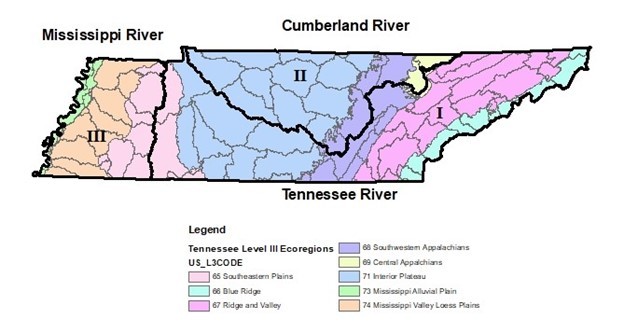
Major River Basins and Ecoregions in Tennessee
The SPARROW model is described in detail in SPARROW Surface Water Quality Model: Theory, Application and User Documentation (Schwarz, et al, 2006). The SAGT nitrogen model is detailed in Spatial analysis of instream nitrogen loads and factors controlling nitrogen delivery to streams in the Southeastern United States using spatially referenced regression on watershed attributes (SPARROW) and regional classification frameworks (Hoos and McMahon, 2009). The companion phosphorus model is described in A Regional Modeling Framework of Phosphorus Sources and Transport in Streams of the Southeastern United States (Garcia, et al, 2011). The Tennessee Specific Model is described in Adapting a regional water quality model for local application: A case study for Tennessee, USA (Hoos, et al, 2019).
The output can be viewed from based on either total load (lbs/yr) or yield (lbs/acre/yr) and at several different scales (state, HUC-8, or HUC-10). Note that the HUC-8s with the highest total load are not necessarily the HUC-8s with the highest yield. The new SPARROW model includes spreadsheet-based calculator (reference, link) to evaluate changes in annual nutrient loading.
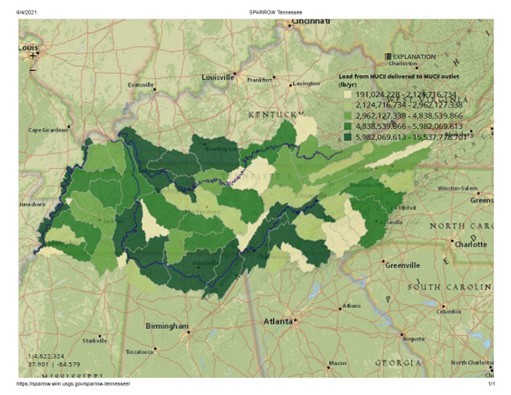
Total Nitrogen Load by HUC-8
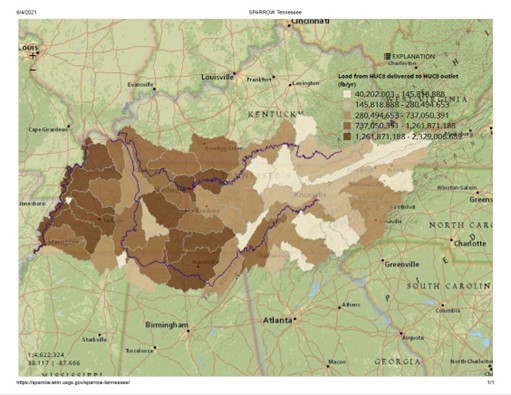
Total Phosphorus Load by HUC-8
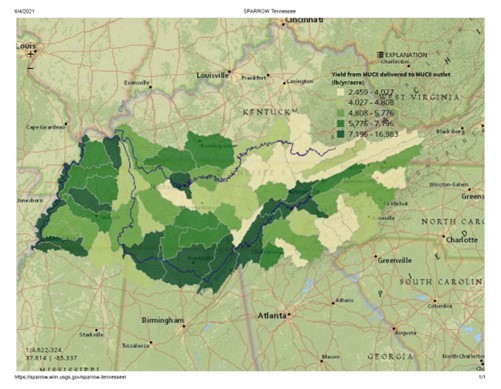
Total Nitrogen Yield by HUC-8
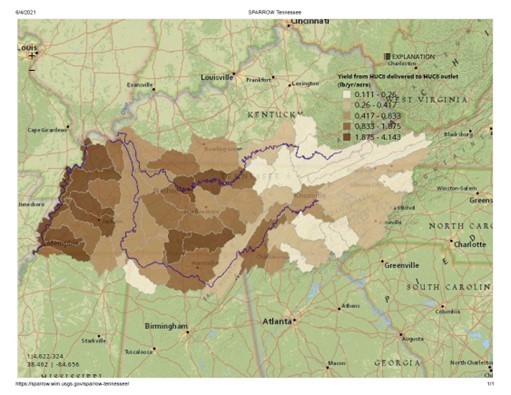
Total Phosphorus Yield by HUC-8
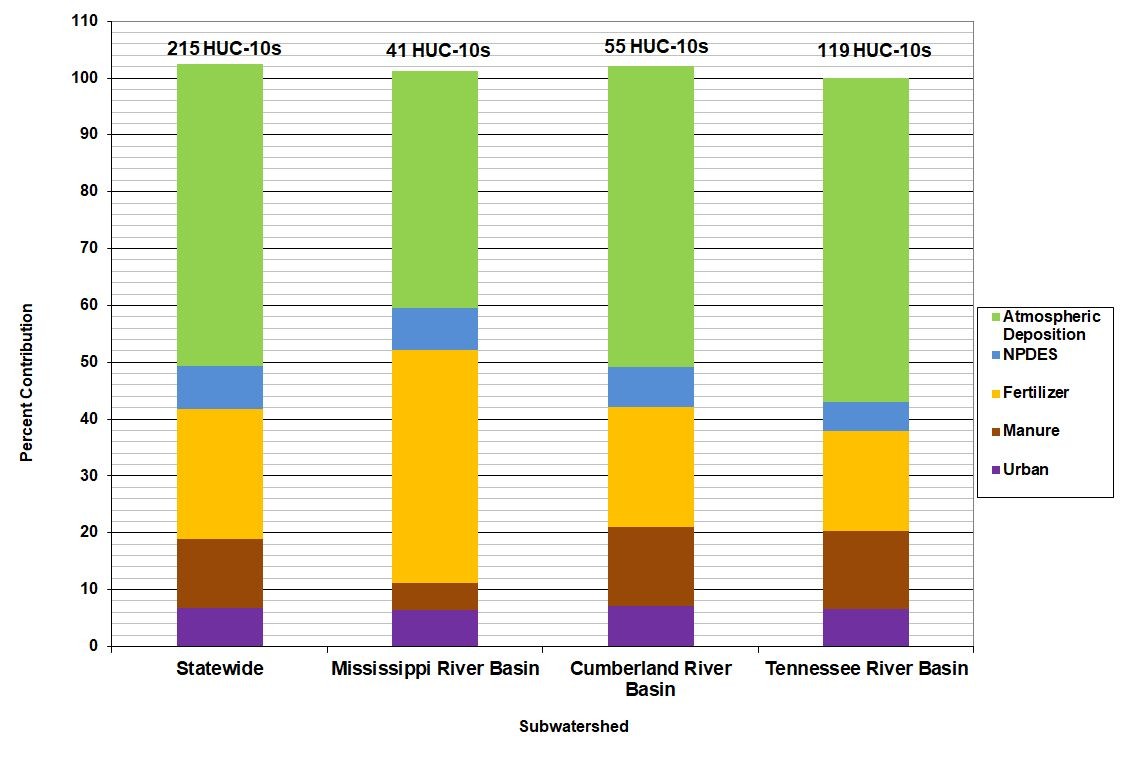
Tennessee SPARROW sources contribution - Total Nitrogen
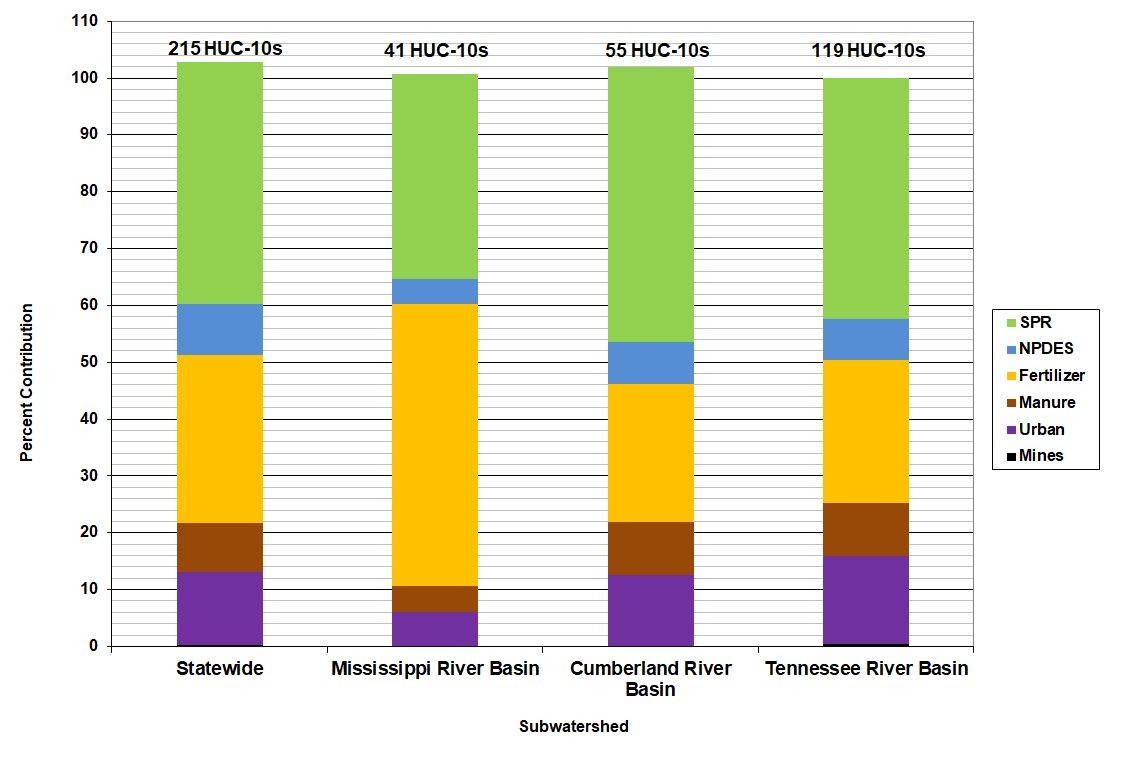
Tennessee SPARROW sources contribution (SPR – Soil Parent Rock) - Total Phosphorus
This Page Last Updated: April 10, 2025 at 10:44 AM