Household Hazardous Waste Program (HHW)
What is HHW?
Household Hazardous Waste (HHW) is any unwanted or spent household product that can easily catch fire (flammable), eat away at or irritate living tissue (corrosive), react violently with water or other chemicals (reactive), or be poisonous to humans and animals (toxic). Usable household products may exhibit hazardous properties, but until they become waste, they are not appropriate for the mobile household hazardous waste program. Before attending a mobile collection event, please review the lists below of acceptable and unacceptable items.
Tennessee's Mobile Collection Service has been in operation since 1993 and is open to the citizens of Tennessee. The program is limited to households. Businesses, institutions, and agri-business operations should contact a permitted hazardous waste transporter for proper disposal. Agri-businesses may, however, dispose of their pesticides through the Agricultural Pesticide Waste Collection Program.
Since the program began there have been over 1300 one-day collections. Over 358,000 Tennessee families have brought in over 23 million pounds of household hazardous waste for proper disposal. The program is funded by a $0.95 per ton surcharge on waste entering landfills. Providing household hazardous waste collection to the citizens of Tennessee is an important and worthwhile cause. Proper disposal of HHW helps to protect the environment and sanitation workers and can reduce the toxicity of landfill leachate. Additionally, it provides an opportunity for citizens to rid their homes of potentially dangerous chemicals.
The average home in Tennessee produces 20 pounds of household hazardous waste yearly. Typical items disposed of include cleaning fluids, pesticides, mercury thermometers and thermostats, swimming pool chemicals, paint thinner, and automotive fluids. Some items that are accepted but may be recycled locally and on a year-round basis are used oil, rechargeable batteries, used antifreeze, propane cylinders, and compact fluorescent bulbs. Many of these items are commodities and may generate revenue for the local collection site. Regardless, local collection sites are more convenient for the customer, and they help to save the state tens of thousands of dollars annually.
You may be surprised at how easy it is to clean without these hazardous chemicals. Here is a list of do-it-yourself green cleaning solutions, many of which are as simple as vinegar and lemon!
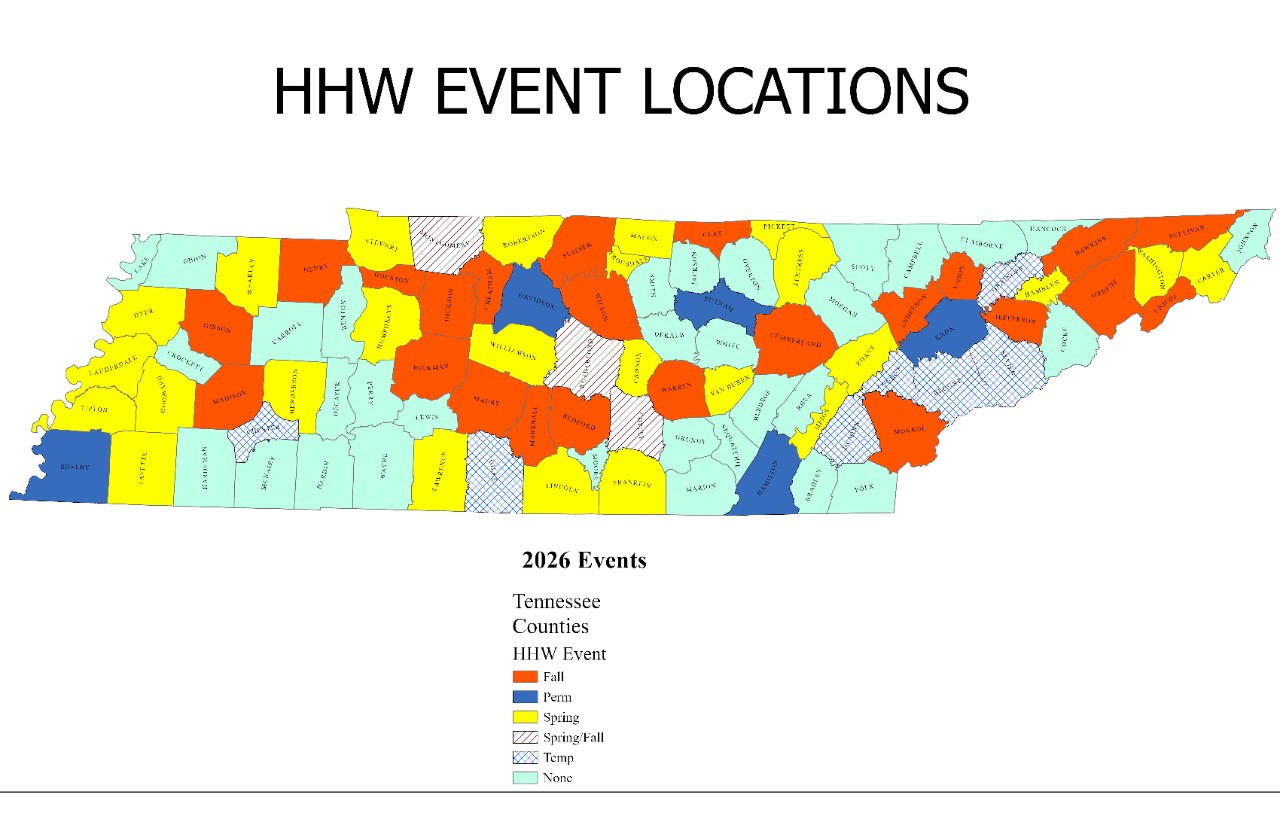
HHW Collection Events
Any Tennessee citizen can participate in the Mobile Household Hazardous Waste Collection Service. Collections only occur in the fall and spring to avoid extreme weather. The process is very simple. Check the collection schedule to determine a convenient event for you. The schedule is posted in January each year. You can also subscribe to our newsletter to receive collection event reminders for your county.
Check our list of acceptable and unacceptable items to determine what you can bring. On the day of the event, load the unwanted materials into your trunk or the back of your truck. For safety, don't mix materials, keep them in their original containers, double-package any leaking containers, and place any breakable containers in a box, cushioned with newspaper. When you get to the event, you will be surveyed to find out in what county you live and how many households you are bringing waste from.
Only households may use the service to dispose of hazardous wastes. No commercial, institutional, or agri-business waste will be accepted. The Tennessee Department of Agriculture runs an Agricultural Pesticide Waste Collection Program that will accept pesticides from farmers. Additionally, NO explosive, ordnance, ammunition, radioactives, or medical waste will be accepted. Smoke detectors are not accepted, but may be recycled elsewhere.
Tennessee's Mobile Collection Service has been in operation since 1993. Since then, there have been over 1,500 one-day collections. Over 383,000 Tennessee families have brought in over 25 million pounds of household hazardous waste for proper disposal. The program is funded by a $0.90 per ton surcharge on waste entering landfills.
Participation
- Any Tennessee resident can participate in the Mobile Household Hazardous Waste (HHW) Collection Service.
- Only households may use the service to dispose of hazardous wastes.
- No commercial, institutional, or agri-business waste will be accepted.
Event Scheduling
Mobile Household Hazardous Waste (HHW) Collections only occur in the fall and spring to avoid extreme weather. The process is very simple. The spring schedule is posted by February, and the fall schedule is posted by August. On the day of the event, load the unwanted materials into your trunk or the back of your truck. For safety, don't mix materials; keep them in their original containers; double-package any leaking containers; and place any breakable containers in a box cushioned with newspaper. When you get to the event, you will be surveyed to find out in what county you live and how many households you are bringing waste from.
Safe Transportation of HHW to the Event
When transporting materials to the site, place containers in sturdy boxes lined with newspaper to prevent spills and cross-contamination in the trunk of a car or back of a truck. Be sure to keep materials away from children and pets. Materials should be kept in the original container whenever possible. If not, place the waste in a plastic jug with a secure lid and label its contents.
| Household Hazardous Waste (HHW) Collection - Event Schedule | |
|---|---|
| Dates | Events |
| 2026 | Mobile Collection Schedule |
HHW Collection Facilities
If you are a resident of Knox, Hamilton, Davidson, Putnam, or Shelby Counties, you may take your HHW to the permanent collection site located in your county. Additionally, seven temporary HHW containers have been strategically placed across the state for year-round disposal opportunities for all Tennessee residents.
Acceptable Items
Automotive and Marine Products
- Fuel and oil additives
- Grease and rust solvents, naval jelly
- Carburetor and fuel injector cleaners
- Starter fluids
- Body putty
- Antifreeze / coolant
- Gasoline
Home Maintenance / Improvement Products
- Used strippers and thinners
- Adhesives
- Driveway sealant
- Roofing tar
- Wallpaper remover
Home Lawn and Garden Products
- Pesticides
- Fertilizers
- Wood preservatives
Miscellaneous
- Pool chemicals
- Photo processing chemicals
- Medicines / drugs
- Aerosols / compressed gas
- Mercury thermostats and thermometers
- Fluorescent tubes
- Compact fluorescent bulbs
- Needles and sharps (in a puncture-proof container)
Items No Longer Accepted at Mobile HHW Collections
Items no longer accepted at the mobile HHW collections are alkaline batteries, paint, and electronics. Alkaline batteries sold after May 13, 1996, have no mercury added and may be discarded in the regular trash. Nickel-cadmium (Ni-Cd), nickel metal hydride (Ni-MH), lithium ion (Li-Ion), and small sealed lead-acid (Pb) batteries. Other items not accepted at the mobile HHW collections include ammunition, explosives, medical waste, radioactive material, and any items from a school, commercial business, or agri-business. Smoke detectors are not accepted, but may be recycled elsewhere.
Unacceptable Items
Medical / Biological
- Infectious wastes
- Dead animals
- Any waste from a doctor's office, clinic, or veterinarian's office
Explosives / Ammunition
- Fireworks
- Military ordnance
- Gun powder
- Ammunition
Radioactive
- Smoke detectors
- Radium paint
Business / Institutional Waste
- No businesses, large or small
- No colleges or universities
- No schools
- No hospitals
- No home improvement or painting contractors
- No agribusiness
Miscellaneous
- Empty containers of any kind
- Automotive gas tanks
- Alkaline batteries - may be thrown away in the trash
- Electronics – contact your local Solid Waste Department for guidance
- Paint – contact your local Solid Waste Department for guidance
A product is considered hazardous if it is:
- Flammable: capable of catching fire easily,
- Corrosive: capable of irritating or eating away at living tissue,
- Reactive: reacts violently with air, water, or other chemicals, or
- Toxic: poisonous to living organisms.
Examples of flammable products include many solvent-based materials such as varnish strippers, enamel paints, and driveway sealants.
Some household items that may be corrosive include acidic or caustic cleaners such as toilet bowl cleaner, oven cleaner, and drain opener as well as batteries, especially car batteries.
Reactive type chemicals can include strong peroxides, ammonia, chlorine-based products, and mothballs.
Toxic materials include antifreeze, pesticides, and windshield washer fluid.
The most effective way to spot potentially dangerous household chemicals is to read the label. Manufacturers are required by law to inform consumers of any possible risks to human health. Additionally, information concerning potential risks to the environment is also included.
Signal words to look for:
- CAUTION- the product is mildly toxic (1 oz. to 1 pt. is the fatal dose) or a possible skin irritant.
- WARNING- the product is moderately toxic (1 tsp. to 1 tbsp. is the fatal dose) or can cause skin injury with prolonged contact with skin or has a moderate chance of catching fire or reacting with another chemical.
- DANGER- the product is highly flammable, explosive, and/or reactive or is capable of causing injury on contact with eyes or skin.
- POISON- the product is extremely toxic (a taste to 1 tsp. is the fatal dose).
Most modern products if stored properly and used according to directions should not put you, your family, your pets, or the environment at risk. You should use extreme caution when using a very old product because consumer safety standards were much less stringent in the past. For example, liquid mercury was once used as medicine. Additionally, many products change after being exposed to hot and cold as well as humidity. The best idea for antiquated products is to bring them to a household hazardous waste collection event.
Some things you can do to prevent products from harming anyone:
- Use a product only for its intended purpose.
- Keep products in their original containers.
- Keep all pertinent information regarding use, storage, and disposal.
- Follow all safety precautions.
- Keep container tightly sealed and in a secure location.
- Never mix products.
When buying household products in the future there are some important considerations:
- Buy only what you need.
- Buy a non-hazardous or the least hazardous product for the job, i.e., choose a product with a "caution" label over one with a "warning" label.
- Buy multi-use products instead of highly specialized items that might go unused for months.
- Buy pesticides and similar items that have a localized application, e.g. roach bait discs instead of fumigants.
There are several safe and easy ways to dispose of many of your unwanted items.
- Used oil, oil filters, anti-freeze, and automotive batteries
- Latex paint should be used up, given away, or dried up and disposed of in your regular garbage. Use kitty litter, sawdust, or shredded paper to speed the drying process.
- Oil-based paint should be used up, given away, or carried to the county paint collection facility (if available).
- Computers and televisions can often be recycled locally through your local solid waste department or through a private recycler. Check the phone book for electronic recyclers.
- Batteries - Alkaline batteries may be disposed of with your regular garbage.
Rechargeable batteries and cell phones can be recycled. Find a collection site near you by visiting the Call2Recycle website. Also, several home improvement stores take power tool batteries. Lead acid batteries can be recycled locally through your solid waste department or at many automotive retail stores (ie, AutoZone, Advance Auto Parts, Napa). - Ink jet cartridges can be recycled at most office supply stores and post offices.
- Regular household cleaners should be used up or can be washed down the drain. If you are on a septic tank, you may want to only pour out small amounts at a time.
- Propane cylinders can be recycled locally through your solid waste department.
- Smoke detectors should be returned to the manufacturer. Look for the address on the device.
- Explosives and ammunition should be safely disposed of by contacting your local police and fire departments.
- Needles and sharps should be placed inside a sturdy plastic container with a screw on lid (such as a laundry detergent or fabric softener bottle) and disposed of in your regular garbage. Bend the tip of the needle to prevent puncture.
All other products should be safely stored and brought to any Household Hazardous Waste Mobile Collection event in the state or to one of the Temporary HHW Containers. If you are a resident of Knox, Hamilton, Davidson, Putnam, or Shelby Counties, you may take your HHW to the permanent collection site located in your county.
The Tennessee General Assembly passed the Solid Waste Management Act of 1991 (T.C.A. §68-211-829), and T.C.A. §68-211-828 also provides for Competitive grants for the collection of household hazardous waste at permanent sites.
Organizing and Hosting HHW Collection Events
HHW collection events only occur in the spring and fall to avoid extreme conditions. Spring events begin in late March and end in early June. Fall events begin on the Saturday after Labor Day and end in early November. HHW events do not occur on Easter or Memorial Day weekend. Request for service may be sent up to a year in advance, but must be received by December 1st of the previous year.
The State pays the contractor a minimum set-up fee each time the HHW Collection Service is mobilized, regardless of participation at the event. In order to provide the most cost-efficient service, the events should be well utilized. A collection event cannot be successful without advertising.
Year-Round Collection of HHW and BOPAE
Solid Waste Management encourages counties to educate their citizens year-round concerning the proper use and disposal of HHW. Counties should use all available means to communicate the characteristics of HHW, the consequences of improper disposal, and the basic concept of reducing, reusing, and recycling HHW whenever possible.
By following certain guidelines, many HHW items (i.e. propane tanks, computers and televisions, paint, batteries, used oil, antifreeze, fluorescent lamps, mercury thermostats, and oil filters) can be safely collected by existing solid waste staff on a year-round basis. This higher level of service to local residents can reduce mobile collection costs, prevent landfilling of waste, and improve water quality. The Division of Solid Waste Management established Household Paint Management Guidance and Policy for counties involved in household paint collection and handling.
2030 Elkton Pike
Pulaski, TN
931-424-7035
Hours: 7 am to 5 pm Mon, Wed, Fri | 7 am to 12 pm Sat
Chester County THHWC
315 Talley Store Road
Henderson, TN
731-989-9855
Hours: 7:30 am to 4 pm Tues & Thurs
Grainger County THHWC
2458 Narrow Valley Road
Rutledge, TN 37861
865-828-4881
Hours: 8 am to 4 pm Mon, Tues, Thurs, Fri, Sat
McMinn County / Athens City Recycle Center
118 Rocky Mount Road
Athens, TN
423-744-2749 | 423-744-2745
Hours: 7 am to 3 pm Mon, Fri | 11 am to 6 pm Tues, Wed, Thurs | 8 am to 12 pm Sat
Blount County Recycling Center THHWC
331 Levi Street (off of McArthur Rd)
Maryville, TN
865-268-3238 or 865-982-4652
Hours: 8 am to 4:30 pm Tues, Thurs, Sat
Loudon County THHWC / Loudon Convenience Center
300 Rock Quarry Road
Loudon, TN 37774
865-458-8536
Hours: 9 am to 4 pm Sat
Sevier County THHWC / Centerview Convenience Center
943 Centerview Road
Sevierville, TN 37862
865-774-6677
Hours: Mon-Fri, 6:30 AM – 3:00 PM; Sat, 7:00 AM – 12:00 PM
Minimum Requirements to Qualify for an HHW Collection Event
The HHW Program has established criteria for scheduling HHW events. The following provides an overview of the minimum requirements to qualify for an HHW Collection event. These requirements are established to eliminate the collection of BOPAE materials at mobile events and provide funding for the disposal of the most hazardous materials found in households. A county shall provide regular or year-round services directly or by contract if adequate sites are not otherwise available in the county for the use of the residents of the county.
- Alkaline Batteries: The County may recycle alkaline batteries or educate the public that alkaline batteries no longer contain mercury and therefore may be disposed of in their garbage.
- Rechargeable Batteries (Ni-Cd, Ni-MH, Li-Ion, Ni-Zn, small sealed lead acid): The County shall provide year-round collection and recycling of rechargeable batteries. Call2Recycle offers a collection program for a fee.
- Lead Acid Batteries: Per T.C.A. 68-211-866, “each county shall provide directly, by contract or through a solid waste authority at least one (1) site to receive and store waste tires, used automotive oils and fluids, and lead-acid batteries, if adequate sites are not otherwise available in the county for the use of the residents of the county.” Lead-acid batteries have value, and most counties contract with a local battery recycler.
- All other batteries shall be managed by the State HHW Contractor at mobile HHW collections.
- Used Automotive Oil: Per T.C.A. 68-211-866, “each county shall provide directly, by contract or through a solid waste authority at least one (1) site to receive and store waste tires, used automotive oils and fluids, and lead-acid batteries, if adequate sites are not otherwise available in the county for the use of the residents of the county.” Well-managed used oil collection generates revenue from used oil transporters or provides cost avoidance when collected by the county and burned in used oil heaters.
- Used Antifreeze: Per T.C.A. 68-211-866, “each county shall provide directly, by contract or through a solid waste authority at least one (1) site to receive and store waste tires, used automotive oils and fluids, and lead-acid batteries, if adequate sites are not otherwise available in the county for the use of the residents of the county.” Most used oil transporters provide antifreeze collection at no cost in order to get the used oil also. Otherwise, antifreeze collection and recycling averages a cost of $35-50 per 55-gallon drum.
- Paint: The County shall provide regular collections of oil-based paint. Oil-based paint shall be collected at a fixed location and disposed of by the State HHW contractor in scheduled milk run pick-ups. The county may collect and manage the latex paint by recycling or solidification, as approved by the Department’s Division of Solid Waste Management Environmental Field Office. Refer to the Household Paint Management Guidance and Policy for details.
- Electronics: The County shall provide scheduled collections of household electronic scrap for recycling. The equipment to be collected shall include central processing units (CPUs), laptops, cathode ray tubes (CRTs), televisions, flat-screen monitors, peripherals, printers, scanners/copiers, fax machines, cell phones, and personal digital assistants.
In an effort to provide mobile collection service to a greater number of counties and to capture the most hazardous household chemicals throughout the State, the HHW Program will no longer accept paint or electronics at the mobile collection events. Local governments will be expected to provide regular collection of batteries, oil, paint, antifreeze, and electronics (BOPAE) to be considered for future HHW service. The minimum requirements to be considered to receive mobile HHW collection service are detailed in the following section.
The State’s contractor will collect oil-based paint only at fixed locations (i.e., convenience centers, recycling centers, etc.). They will continue to provide storage containers, box liners, and milk run pickup service. This service will continue to be provided at no cost to the County. Refer to the Household Paint Management Guidance and Policy for details.
In the Fiscal Year 2010, paint and electronics combined represented a statewide average of 74% by weight and 35% by costs of materials collected and managed at mobile HHW events. This volume of the material requires the mobilization of increased staffing by the contractor and the county, heavy equipment, and additional supplies and resources to adequately manage these wastes at mobile collection events. Experience indicates that when these two minimally hazardous waste streams are diverted away from the mobile collection events, participation and idle times in long lines decrease tremendously. Reduced participation and shorter traffic lines allow for smaller HHW event sites. We suggest hosting events at solid waste convenience centers or recycling centers where BOPAE is currently managed by the county.
The Household Hazardous Waste Program staff is available to discuss options that can best meet the needs of each County. Learn more about the year-round collection of BOPAE and hosting successful BOPAE Collection Events. If you would like to participate and need technical assistance in launching a local BOPAE program, please contact Robert Wadley by email or at 615-741-4907.
VSQG - Schedule an Appointment for a Collection Near You
Very Small Quantity Generators, who generate less than 220 pounds of hazardous waste per month and have in storage less than 2,200 pounds, are now eligible to participate in the mobile HHW/VSQG Collection Events. To request a price quote and schedule an appointment, please contact Clean Harbors Environmental Services at 615-643-3170 with a waste inventory. Most VSQG collection appointments will be scheduled immediately following the HHW event ending time.
Businesses that generate no more than 220 pounds of hazardous waste or 2.2 pounds of acutely hazardous waste per month are "Very Small Quantity Generators" or VSQGs. These guidelines are set out in the Code of Federal Regulations 40 CFR 265.201.
Typical VSQG businesses include:
- Automotive repair/painting
- Dentists
- Print shops
- Beauty Salon
- Dry cleaners
- Property managers
- Construction
- Painters
- Public Storage
The VSQG program in the TDEC-supported Household Hazardous Waste (HHW) Program allows qualifying generators to transport their hazardous wastes to any one of the mobile collection events scheduled throughout the State, or they can work directly with a hazardous waste disposal company for the proper management options.
- Aerosols Mercury Pesticides
- Batteries Cleaners Electronics
- Gasoline/fuels, Motor oil/auto fluids, Oil Filters
- Paint-related material
- Photo Chemicals, Propane cylinders, Solvents
- Thinners/varnish
- Arsenic compounds
- Cyanide compounds
This program will not accept radioactive, biological, medical, or ammunition or explosive wastes.
To request a price quote and schedule an appointment, contact Clean Harbors Environmental Services at TNCESQG@cleanharbors.com or 615-643-3170 with a waste inventory. Most VSQG collection appointments will be scheduled immediately following the HHW event ending time.
Businesses will be required to provide the following information prior to scheduling an appointment.
• Name
• Address
• Contact person
• Phone number of the company.
• Estimate of volume and type of waste generated per month.
• Complete waste inventory being transported to the event.
Disposal pricing is based on the type of material and is generally charged on a per-pound basis. A trained chemist will review your waste inventory and provide an estimated cost for disposal when your appointment is scheduled. All waste will be weighed upon delivery.
Payment by check or credit card is due upon delivery.
Leave waste in the original container if possible. Never commingle or consolidate waste items. Keep labels intact when possible. Provide MSDS or laboratory analysis, when available, with your waste inventory. Never transport damaged or leaking containers. For safety, place all wastes in a trunk, pickup bed, or other ventilated area that is separate from passengers.
Archive
This section contains presentations, reports, and other documents related to this project that were created and posted prior to the April 24, 2026, start date for the Title II Section 508, requiring government agencies to have all web content ADA-compliant, and are, as such, identified as archived.
Contacts

Kelsey Davis
Community Program Manager
Office of Environmental Stewardship
615-532-0079
kelsey.davis@tn.gov

Paul Pleiman
Environmental Consultant
Office of Environmental Stewardship
615-829-3698
paul.pleiman@tn.gov
This Page Last Updated: September 22, 2026 at 12:30 PM