Tennessee and the Volkswagen Diesel Settlement
For additional information about the VW Settlement, please visit EPA’s Volkswagen Clean Air Act Partial Settlement webpage, the U.S. Department of Justice’s Volkswagen Settlement webpage, and the Volkswagen/Audi Diesel Emissions Settlement Program website. Additional resources related to the VW Settlement can be found on TDEC's VW Settlement Resources page.
In 2015, Volkswagen (VW) publicly admitted that it had secretly and deliberately installed a defeat device—software designed to cheat emissions tests and deceive federal and state regulators—in approximately 590,000 model year 2009 to 2016 motor vehicles containing 2.0 and 3.0 liter diesel engines. The United States Department of Justice (DOJ) filed a complaint against VW, alleging that the company had violated the Clean Air Act. In October 2016 and May 2017, the U.S. District Court, Northern District of California (“Court”), approved two partial settlements related to the affected 2.0 and 3.0 liter vehicles, respectively, totaling $14.9 Billion (“the VW Settlement”).
In April 2017, a third partial settlement, addressing civil penalties and injunctive relief, was approved by the Court. Under the third partial settlement, VW has paid a $1.45 Billion civil penalty for the alleged civil violations of the Clean Air Act. The money was collected via the Department of Justice and was deposited to the U.S. Treasury.
The VW Settlement will be implemented through the First Partial Consent Decree and Second Partial Consent Decree. Under these consent decrees, VW has agreed to:
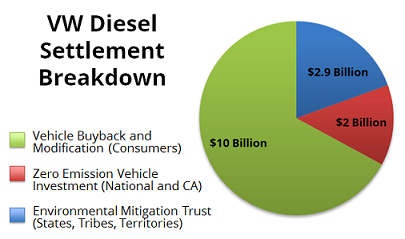
- Dedicate $10 Billion to the recall of at least 85% of the affected 2.0 and 3.0 liter vehicles;
- Invest $2 Billion in zero-emission vehicle infrastructure and promotion (“Zero Emission Vehicle Investment Plan”); and
- Establish a $2.9 Billion Environmental Mitigation Trust to mitigate the environmental effects of the excess nitrogen oxide (NOX) emissions from the affected vehicles.
Information on these three components of the VW Settlement is available below.
For more information on the State of Tennessee and the VW Settlement EMT, click here. For more information on the State’s BMP, click here.
Under Appendix C to the Volkswagen Diesel Settlement’s First Partial Consent Decree, VW must invest $2 Billion over 10 years in projects that support the increased use of ZEVs, which are defined as battery electric vehicles (BEVs), plug-in hybrid vehicles (PHEVs), and fuel cell electric vehicles (FCEVs). This will be a VW-administered program. VW has created a separate entity within VW Group of America, known as Electrify America, LLC, to oversee the ZEV investment. The funding will be distributed over four, 30 month cycles: $300 Million per cycle in the National ZEV Investment Plan with EPA oversight (totaling $1.2 Billion) and $200 Million per cycle in the California ZEV Investment Plan with California Air Resources Board (CARB) oversight (totaling $800 Million).
On December 9, 2016, VW launched www.electrifyamerica.com, which provides information on VW's Zero Emission Vehicle infrastructure and awareness campaign, as well as details on how states, municipalities, and others can submit proposals to help inform VW's ZEV Investment Plans over the next 10 years.
Eligible National ZEV Investment expenses include:
- Design/planning, construction/installation, and operation and maintenance of ZEV infrastructure;
- Brand-neutral education or public outreach that builds or increases awareness;
- Programs or actions to increase public exposure or access to ZEVs without requiring the consumer to purchase or lease a ZEV at full market value, such as car sharing services or ride hailing services.
On April 9, 2017, Electrify America published the National ZEV Investment Plan: Cycle 1, which runs through June 2019. On February 4, 2019, Electrify America published the National ZEV Investment Plan: Cycle 2, which runs from July 2019 through December 2021. EPA reviewed and approved both plans prior to publication.
In June 2021, Electrify America released its Cycle 3 National ZEV Investment Plan (covering the third of the four cycles, which will run from January 2022 to July 2024). The Plan details how Electrify America will invest $300 Million in Cycle 3 funds into charging infrastructure and consumer education—including in areas not previously addressed in Cycles 1 and 2, such as access to EV charging for residents of multi-unit dwellings and infrastructure for taxi and transportation network company vehicles. Specifically, this plan outlines community charging infrastructure investments in 25 metropolitan areas, including the Nashville-Davidson County, Murfreesboro, and Franklin metropolitan area, and expands upon Cycle 1 and 2 investments in EV corridor charging along major highways. Several of these corridors run through Tennessee, including I-40, I-24, I-65, and I-75. The Plan anticipates 1-3 new stations to be added to the Nashville area and identifies the I-24 corridor between Manchester, TN and Atlanta as a regional route to be prioritized for new stations, upgrades and enhancements, and ongoing operations. As of now, there are ten Electrify America stations that are online and operational in Tennessee (in Memphis, Jackson, Clarksville, Nashville, Manchester, Cookeville, Ooltewah, Knoxville, and Kodak).
TDEC has submitted feedback to Electrify America for the Cycle 1, Cycle 2, and Cycle 3 solicitations for public comment, proposals, and recommendations. The State will continue to coordinate and engage with the company in an effort to spur investment by Electrify America in Tennessee.
Stay up-to-date on Electrify America’s activities by visiting media.electrifyamerica.com to read all relevant press releases. To view an up-to-date map of all current and planned Electrify America charging stations, visit www.electrifyamerica.com/locate-charger.
More information regarding the VW Settlement ZEV Investment can be found in Appendix C to the First Partial Consent Decree.
The First and Second Partial Consent Decrees require VW to dedicate $10 Billion to the removal or modification of at least 85% of the subject 2.0 liter vehicles by June 30, 2019, the subject 3.0 liter generation 1 vehicles (MY 2009-2012) by November 30, 2019, and the subject 3.0 liter generation 2 vehicles (MY 2013-2016) by May 31, 2020. These vehicles can be removed or modified through:
- Vehicle buyback,
- Lease termination, or
- An EPA-approved emissions modification.
Visit www.VWCourtSettlement.com for more information on approved emissions modifications for 2.0 and 3.0 liter subject vehicles as well as consumer options related to subject vehicle buyback and lease termination.
More information regarding the VW Settlement Vehicle Buyback and Emissions Modification Program can be found in Appendices A and B to the First and Second Partial Consent Decrees.
Click here to sign up for the TDEC VW Settlement email list.
How are we doing? Please provide any feedback related to TDEC's VW Settlement webpage to Deputy Director of Programs, Innovation & Transportation, Communications, Alexa Voytek at Alexa.Voytek@tn.gov or 615-613-1096.
If it is hard for you to read, speak, or understand English, please see our Language Assistance webpage for more information about our free language assistance services.
This page contains various tools and resources related to the Volkswagen Settlement. Please contact OEP Deputy Director of Programs, Innovation & Transportation, Communications, Alexa Voytek, at Alexa.Voytek@tn.gov if you have questions about the materials below.
Archived content is provided for reference purposes only and is not maintained to current accessibility standards.
In October 2017, the Court approved two Trust Agreements for Beneficiaries (archive): one for the 50 states, the District of Columbia, and the Commonwealth of Puerto Rico ("State Trust Agreement" (archive)), and one for the separate allocation for federally recognized Indian tribes in the U.S. ("Tribal Trust Agreement" (archive)). These Trust Agreements outline the requirements, procedures, timelines, and project definitions that Beneficiaries must follow with regard to administration of the Environmental Mitigation Trust.
The State Trust Agreement required Beneficiaries to file with the Court a Certification for Beneficiary Status under Environmental Mitigation Trust Agreement (Appendix D-3) no later than 60 Days after the Trust Effective Date of October 2, 2017. On November 15 and 16, 2017, the State of Tennessee filed with the U.S. District Court and submitted to the Trustee its Certification for Beneficiary Status Under Environmental Mitigation Trust Agreement (archive). On January 29, 2018, Wilmington Trust, serving as the Trustee of the Volkswagen Diesel Settlement Environmental Mitigation Trust, filed with the Court a Notice of Beneficiary Designation (archive) for the State of Tennessee and all other Certifying Entities that submitted their Certification for Beneficiary Status forms to the Trustee as outlined in the State Trust Agreement.
Additional, related Court Documents appear below:
- Volkswagen Settlement Amended Partial Consent Decree (2.0 Liter Settlement) (filed on 9/30/2016)(archive)
- Volkswagen Settlement Amended Second Partial Consent Decree (3.0 Liter Settlement) (filed on 12/20/16)(archive)
- Volkswagen Settlement Third Partial Consent Decree (Civil Penalty) (filed 1/11/17)(archive)
- Environmental Mitigation Trust Agreement for State Beneficiaries (filed on 10/02/2017)(archive)
The following Quick Reference documents are easily navigable resources on topics related to the Environmental Mitigation Trust:
- Quick Reference - Appendix D-2 (State Trust Agreement)(archive) - The Trustee may only disburse funds for Eligible Mitigation Actions, and for the Eligible Mitigation Action Administrative Expenditures specified in Appendix D-2 to the State Trust Agreement. To view the comprehensive list of Eligible Mitigation Actions and Eligible Mitigation Action Administrative Expenditures, please refer to this Quick Reference.
- Quick Reference - Elements of a Beneficiary Mitigation Plan (archive) - Beneficiaries of the Environmental Mitigation Trust must submit a Beneficiary Mitigation Plan at least 30 days prior to submitting the first funding request. To view the elements that are required within the Beneficiary Mitigation Plan, please refer to this Quick Reference. The State has also created a Beneficiary Mitigation Plan webpage, available here.
- Quick Reference - Elements of a Funding Request (archive) - In addition to preparing the Beneficiary Mitigation Plan, Beneficiaries are responsible for submitting requests for Eligible Mitigation Action funding by filing with the Trustee a Beneficiary Eligible Mitigation Action Certification form (funding request). To view the elements that are required within a funding request, please refer to this Quick Reference.
In March 2017, the Court appointed Wilmington Trust, N.A. as Trustee of the Environmental Mitigation Trust. The Trustee has established and will maintain a public-facing website, accessible at https://www.vwenvironmentalmitigationtrust.com, for the full life of the Trust. The State Trust Agreement details the elements that must be made available by the Trustee on this website, which shall include items such as the Notice of Beneficiary Designation, semi-annual reports, audits, funding requests and determinations with regard to such funding requests, Trust Administration Costs, and an accounting of all Trust Assets.
TDEC hosted several Volkswagen Diesel Settlement Public Information Sessions across the state. These meetings provided an overview an overview of the VW Settlement, the Environmental Mitigation Trust, TDEC’s process for developing a Beneficiary Mitigation Plan for Tennessee, and the types of Eligible Mitigation Actions that can be funded by Tennessee’s Environmental Mitigation Trust allocation. Click here (archive) for a list of all Q&A from the TDEC Volkswagen Diesel Settlement Public Information Sessions. Click here (archive) to view TDEC’s Volkswagen Diesel Settlement Public Information Webinar recording (published December 22, 2017).
The websites and resources below were created and are maintained by various Volkswagen Diesel Settlement stakeholders and participants. Please refer to these pages for more information on the VW Settlement.
United States Department of Energy (DOE)
State Planning for VW Settlement Funds: Quick Reference Guide on Stakeholder Engagement (archive)
United States Department of Justice (DOJ)
U.S. DOJ Volkswagen Settlement webpage
United States Environmental Protection Agency (EPA)
Volkswagen Clean Air Act Partial Settlement webpage
Frequently Asked Questions for Beneficiaries, Fourth Edition, August 2022
Presentation by EPA on the Volkswagen Settlement (11/18/2016)(archive)
Federal Aviation Administration (FAA)
Webpage on Applicability of Volkswagen Settlement Funds to Airports and Airlines
National Association of Clean Air Agencies (NACAA)
Volkswagen Settlement Repository for State and Local Agency Links and Programs
National Association of State Energy Officials (NASEO)
NASEO Volkswagen Settlement webpage
Volkswagen Settlement Beneficiary Mitigation Plan Toolkit
Webinar: Emissions Tools for States and VW Beneficiary Mitigation Plan Toolkit Overview (3/29/2017)
Volkswagen/Audi
Volkswagen/Audi Diesel Emissions Settlement Program consumer website
In addition to the FAQs below, TDEC has answered all questions received from stakeholders who attended Volkswagen Diesel Settlement (VW Settlement) Public Information Sessions across the state. These meetings provided an overview of the VW Settlement, the Environmental Mitigation Trust (EMT), TDEC's process for developing a proposed Beneficiary Mitigation Plan (BMP) for Tennessee, and the types of Eligible Mitigation Actions (EMAs) that can be funded by the State of Tennessee’s EMT allocation. All of these sessions were free and open to the public. Click here for a list of all Q&A from the TDEC VW Settlement Public Information Sessions.
In 2015, VW publicly admitted that it had secretly and deliberately installed a defeat device—software designed to cheat emissions tests and deceive federal and state regulators—in approximately 590,000 model year 2009 to 2016 motor vehicles containing 2.0 and 3.0 liter diesel engines. The United States Department of Justice (DOJ) filed a complaint against VW, alleging that the company had violated the Clean Air Act. In October 2016 and May 2017, the U.S. District Court, Northern District of California, approved two partial settlements related to the affected 2.0 and 3.0 liter vehicles, respectively, totaling $14.9 billion (“the VW Settlement”).
Affected 2.0 liter diesel vehicle models and model years include:
• Jetta (2009 – 2015)
• Jetta Sportwagen (2009-2014)
• Beetle (2012 – 2015)
• Beetle Convertible (2012-2015)
• Audi A3 (2010 – 2015)
• Golf (2010 – 2015)
• Golf Sportwagen (2015)
• Passat (2012-2015)
Affected 3.0 liter diesel vehicle models and model years include:
• Volkswagen Touareg (2009-2016)
• Porsche Cayenne (2013-2016)
• Audi A6 Quattro (2014-2016)
• Audi A7 Quattro (2014-2016)
• Audi A8 (2014-2016)
• Audi A8L (2014-2016)
• Audi Q5 (2014-2016)
• Audi Q7 (2009-2016)
For more information, click here: https://www.epa.gov/vw/frequent-questions-about-volkswagen-violations.
The First and Second Partial Consent Decrees require VW to dedicate $10 Billion to the removal or modification of at least 85% of the subject 2.0 liter vehicles by June 30, 2019, the subject 3.0 liter generation 1 vehicles (MY 2009-2012) by November 30, 2019, and the subject 3.0 liter generation 2 vehicles (MY 2013-2016) by May 31, 2020. These vehicles can be removed or modified through:
• Vehicle buyback,
• Lease termination, or
• An EPA-approved emissions modification.
On July 27, 2017, the U.S. Environmental Protection Agency (EPA) and California Air Resources Board (CARB) announced that they had approved technical fixes for most of the affected 2.0-liter engine vehicles, including Jetta, Golf, Beetle and Audi A3 models. On October 23, 2017, the EPA and CARB announced that they had approved technical fixes for all 3.0-liter Sub-Generation 2.1 and 2.2 SUVs, including Porsche, Touareg, and Audi Q7 models. Within 10 days of each emissions modification approval, VW is to notify vehicle owners and lessees that they can bring in their vehicles for modification. Further information on the details of the approved emissions modifications, as well as information about consumer options related to affected vehicles, can be found at www.VWCourtSettlement.com.
More information regarding the VW Settlement Vehicle Buyback and Emissions Modification Program can be found in Appendices A and B to the First and Second Partial Consent Decrees.
The VW Settlement will be implemented through the First Partial Consent Decree and Second Partial Consent Decree. Under these consent decrees, VW has agreed to:
1. Dedicate $10 Billion to the recall of at least 85% of the affected 2.0 and 3.0 liter vehicles;
2. Invest $2 Billion in zero-emission vehicle infrastructure and promotion (“Zero Emission Vehicle Investment Plan”); and
3. Establish a $2.9 Billion Environmental Mitigation Trust (EMT) to mitigate the environmental effects of the excess nitrogen oxide (NOX) emissions from the affected vehicles.
Additional information on these three components of the VW Settlement can be found here: http://www.tn.gov/environment/VWSettlement.
The First Partial Consent Decree and Second Partial Consent Decree require VW to establish a $2.9 Billion EMT to be distributed among Beneficiaries (states, tribes, and certain territories) for defined EMAs that reduce NOx. Each Beneficiary’s allocation is based on the number of registered, subject VW vehicles within its jurisdiction. Using this allocation methodology, the State of Tennessee’s initial allocation is $45,759,914.40.
The State will strive to have no less than 80% of its initial allocation obligated well in advance of the 10th anniversary of the Trust Effective Date (TED) of October 2, 2017. On that date, a Beneficiary may request a supplemental allocation by filing with the Court and submitting to the Trustee a report that demonstrates it has obligated at least 80% of funds allocated to it (paragraph 5.4.2 of the State Trust Agreement). This supplemental allocation will be determined by dividing the “Remainder Balance” between those determined to be “Supplemental Funding Eligible Beneficiaries” (paragraphs 5.4.1 and 5.4.3-4, respectively). Not later than the 15th anniversary of the TED, unused Beneficiary funds shall be returned to the Trust. The final disposition of Trust assets will be distributed in accordance with the State Trust Agreement (paragraph 5.4.5).
TDEC currently serves as the Lead Agency for purposes of administering the State of Tennessee's EMT allocation.
Under the First Partial Consent Decree and Second Partial Consent Decree, VW has agreed to establish a $2.9 Billion EMT to mitigate the environmental effects of the excess nitrogen oxide (NOx) emissions from the affected vehicles. In March 2017, the Court appointed Wilmington Trust, N.A. as Trustee of the EMT, and in October 2017, the Court approved two Trust Agreements for Beneficiaries: one for the 50 states, the District of Columbia, and the Commonwealth of Puerto Rico (“State Trust Agreement”), and one for the separate allocation for federally recognized Indian tribes in the U.S. The State of Tennessee (“the State”) officially became a Beneficiary of the EMT on January 29, 2018, allowing the State to fund EMAs, as defined in the First Partial Consent Decree and State Trust Agreement, that comply with the State’s BMP.
Beneficiary Mitigation Plan
Pursuant to Paragraph 4.1 of the State Trust Agreement, each Beneficiary shall submit to the Trustee and make publicly available a BMP. The BMP must be submitted by a Beneficiary to the Trustee no later than 30 days prior to submitting its first funding request.
The BMP must explain the process by which the Beneficiary shall seek and consider public input on its BMP and summarize how the Beneficiary plans to use its allocation, specifically addressing the following:
1. the process by which the Beneficiary will seek and consider public input regarding its BMP;
2. the Beneficiary's overall goal for the use of the funds;
3. the EMA categories the Beneficiary anticipates will be appropriate to achieve the stated goals;
4. a preliminary assessment of the percentages of funds anticipated to be used for each EMA category;
5. a general description of the expected ranges of emission benefits the Beneficiary estimates would be realized by implementation of the EMAs identified in the BMP;
6. a description of how the Beneficiary will consider the potential beneficial impact of the selected EMAs on air quality in areas that bear a disproportionate share of the air pollution burden within the Beneficiary’s jurisdiction.
Paragraph 4.1 of the State Trust Agreement also states that the BMP is “intended to provide the public with insight into a Beneficiary’s high-level vision for use of the mitigation funds and information about the specific uses for which funding is expected to be requested.” The State Trust Agreement notes that the BMP “need only provide the level of detail reasonably ascertainable at the time of submission.” The State Trust Agreement further provides that the BMP is not binding on any Beneficiary, and it does not create rights in any person to claim an entitlement of any kind. As such, Beneficiaries have the flexibility to adjust their goals and specific spending plans at their discretion. If Beneficiaries elect to make adjustments, they must provide the Trustee with updates to their BMP.
Funding Requests
In addition to preparing the BMP, Beneficiaries are responsible for submitting EMA funding requests associated with specific mitigation projects by filing with the Trustee a Beneficiary Eligible Mitigation Action Certification form. Paragraph 5.2 of the State Trust Agreement notes that these requests must include:
• An explanation of how the funding request fits into the Beneficiary’s BMP;
• A detailed description of the proposed EMA, including its community and air quality benefits;
• An estimate of the NOx reductions anticipated as a result of the proposed EMA;
• A project management plan for the proposed EMA, including a detailed budget and an implementation and expenditure timeline;
• A certification that all vendors were or will be selected in accordance with applicable state public contracting laws;
• For each proposed expenditure exceeding $25,000, detailed cost estimates from selected or potential vendors;
• A detailed description of how the Beneficiary will oversee the proposed EMA;
• A description of any cost share requirement to be placed upon the owner of each NOx source proposed to be mitigated;
• A description of how the Beneficiary complied with notice of availability of EMA funds requirements;
• A description of how the EMA mitigates the impacts of NOx emissions on communities that have historically borne a disproportionate share of the adverse impacts of such emissions; and
• A detailed plan for reporting on EMA implementation.
While the State has yet to determine details associated with selection of projects for funding, it is anticipated that TDEC will solicit proposals for specific categories of EMAs included in its BMP. TDEC will review these proposals and determine which projects will receive funding after consideration of factors including but not limited to projected emissions reduction benefits of the project, geographic location of the project, availability of other funding sources for the project, other co-benefits of the project, etc.
Lastly, Paragraph 5.3 of the State Trust Agreement states that Beneficiaries are responsible for reporting semiannually on progress implementing each EMA.
In July 2018, TDEC released a proposed Beneficiary Mitigation Plan (BMP) for implementing the State’s initial allocation of $45,759,914.40 from the VW Settlement EMT. The State’s final BMP, released in September of 2018 and last updated in July of 2022 may now be accessed here: http://www.tn.gov/environment/VW_BMP.
The Trust Effective Date (TED) is October 2, 2017. Within 60 days of the TED, potential Beneficiaries were required to file for Certification of Beneficiary Status. The Trustee had 120 days from the TED to file a list of designated Beneficiaries. On January 29, 2018, Wilmington Trust, serving as Trustee of the VW Diesel Settlement EMT, filed with the Court a Notice of Beneficiary Designation for the State of Tennessee and all other Certifying Entities that submitted their Certification for Beneficiary Status forms to the Trustee as outlined in the State Trust Agreement.
Beneficiaries of the EMT must submit a BMP at least 30 days prior to submitting the first funding request. Beneficiaries are then responsible for submitting requests for EMA funding by filing with the Trustee a Beneficiary Eligible Mitigation Action Certification form (funding request). The Trustee must act upon funding requests within 60 days of receipt.
Beneficiaries of the EMT must submit a Beneficiary Mitigation Plan (BMP) at least 30 days prior to submitting the first funding request. The BMP summarizes how a Beneficiary intends to use allotted funds.
Below is a projected timeline of TDEC’s BMP development process. These timeframes are subject to change, and TDEC will update its stakeholders with any alterations as it progresses through Plan development.
The State’s final BMP may now be accessed here: State of Tennessee’s Beneficiary Mitigation Plan. TDEC anticipates that it will employ the following order when releasing project solicitations:
1) Class 4-8 School Buses;
2) Class 4-8 Shuttle and Transit Buses;
3) Class 4-7 Local Freight Trucks, Class 8 Local Freight and Port Drayage Trucks; and
4) Light Duty ZEV Supply Equipment.
Additional project solicitations for these categories will be released until eligible project funds are exhausted.
TDEC will also host workshops throughout the state and/or via webinar in order to provide the public with information regarding the proposal process, program and project eligibility, timelines for implementation, and reporting requirements. Interested persons and entities are advised to sign up for the TDEC VW email list here in order to receive related email updates on topics including, but not limited to, revisions to the BMP, funding cycles, and project solicitation. For additional information on the VW Settlement, visit the TDEC website here: http://www.tn.gov/environment/VWSettlement.
The purpose of the EMT is to execute environmental mitigation projects that reduce emissions of nitrogen oxides (NOx) (State Trust Agreement at p. 1, “Purpose and Recitals”). Appendix D-2 of the State Trust Agreement lists 10 specific EMA categories and various EMA administrative expenditures that are eligible for EMT funding. (All terms that are both bolded and italicized in this section are defined in Appendix D-2 of the State Trust Agreement.) Eligible projects under these EMA categories include replacing or Repowering older diesel engines with new diesel, Alternate Fueled (e.g., compressed natural gas (CNG), propane, diesel-electric hybrid), or All-Electric engines (including installation of associated charging infrastructure); replacing older diesel vehicles, vessels, and equipment with new diesel, Alternate Fueled, or All-Electric vehicles, vessels, and equipment (including installation of associated charging infrastructure); and installing charging infrastructure for light duty All-Electric vehicles. In addition, a Beneficiary may use EMT funds for non-federal voluntary match for projects eligible under the Diesel Emission Reduction Act (“DERA”) program of the Energy Policy Act of 2005.
Nine of the 10 EMA categories have separate sub-categories for Non-Government Owned and Government Owned projects. For Non-Government Owned, the percentage of the cost of an EMA that can be funded by the EMT is dictated by the sub-category of the EMA (i.e., replacement with a new diesel vehicle versus replacement with a new All-Electric vehicle). For Government Owned, up to 100% of the cost of an EMA can be funded with EMT funds, regardless of the sub-category. All eligible engines, vehicles, vessels, and equipment must be Scrapped.
The EMA categories are as follows:
1. Large Trucks: Class 8 Local Freight Trucks and Port Drayage Trucks;
2. Buses: Class 4-8 School Bus, Shuttle Bus, or Transit Bus;
3. Freight Switchers;
4. Ferries and Tugs;
5. Ocean Going Vessel Shorepower;
6. Medium Trucks: Class 4-7 Local Freight Trucks;
7. Airport Ground Support Equipment;
8. Forklifts and Port Cargo Handling Equipment;
9. Light Duty Zero Emission Vehicle Supply Equipment; and
10. Diesel Emission Reduction Act (DERA) Option.
To review the specific EMA categories that the State will fund, please refer to the State of Tennessee’s Beneficiary Mitigation Plan.
Please see the Public Participation and Presentations page for information on the State’s VW Settlement public feedback processes.
TDEC aims to provide opportunities for the meaningful involvement in and access to its programs and services for all people regardless of race, color, national origin, or income. TDEC accomplishes equitable and meaningful involvement of all Tennesseans through several strategies:
• Engaging the public to raise awareness of TDEC projects or services and to provide stakeholders with a meaningful opportunity to provide input during the decision-making process;
• Hosting public meetings/hearings in centralized locations and at times accessible to the community, such as evenings or on weekends;
• Collaborating with the TDEC Office of Communications to share relevant information with local media resources and minority newspapers;
• Utilizing the community contacts maintained by the Regional Directors of TDEC’s Office of External Affairs and various other TDEC Divisions;
• Accommodating vulnerable or minority communities by utilizing language assistance services for Limited English Proficiency individuals and groups when necessary; and
• Hosting “Enhancing Engagement in Your Community” conversations across the state, which serve as opportunities for TDEC to learn how to improve its outreach within underserved and/or underrepresented communities and to enhance opportunities for communities to provide input on TDEC programming.
These strategies have been an essential part of the development of the State’s Beneficiary Mitigation Plan (BMP). TDEC will continue to employ these strategies as it releases information on future funding opportunity announcements and project solicitations related to the VW Settlement Environmental Mitigation Trust.
The State Trust Agreement also requires Beneficiaries to include within the BMP a “description of how the Beneficiary will consider the potential beneficial impact of the selected Eligible Mitigation Actions on air quality in areas that bear a disproportionate share of the air pollution burden within its jurisdiction.” To address these requirements, the State has developed a “Disproportionate Burden Index” (DBI), which combines environmental, economic, and demographic datasets in a geospatial format to determine geographic units in Tennessee that have the highest air quality burden. Given that disproportionate burden is relative to the location of a project, TDEC will utilize the DBI and its geospatial display during the proposal review phase to assist with project prioritization and selection, focusing on the location and/or service area of the proposed project. Refer to Section VI. Consideration of Disproportionate Burden of the State of Tennessee’s Beneficiary Mitigation Plan, which can be accessed at http://www.tn.gov/environment/VW_BMP.
For additional information about the VW Settlement, please visit EPA’s Volkswagen Clean Air Act Partial Settlement webpage, the U.S. Department of Justice’s Volkswagen Settlement webpage, the Volkswagen/Audi Diesel Emissions Settlement Program website, and the National Association of State Energy Officials and National Association of Clean Air Agencies Volkswagen Settlement Clearinghouse webpage. Additional resources related to the VW Settlement can be found on TDEC's VW Settlement Resources page.
This Page Last Updated: October 29, 2026 at 6:34 PM