The Right to Party
Dr. Cynthia George spent her first six weeks of life in an incubator. She jokes that this experience “really set the stage for me to become both a punk rocker and a disability advocate from birth.”
Long before she knew what the word “advocacy” meant, she was already taking part. At five years old, she had a friend named John who had spina bifida (a condition that affects the spine). She would pull him to the cafeteria in a blue wagon painted to look like The Mystery Machine from Scooby-Doo. Even back then, she marched into the principal’s office to demand ramps for a bump that almost bounced John out of his wagon every day.
“I really have been advocating for people with disabilities since I was a child,” she says. These days, she’s a PhD social worker and a professor at Tennessee State University. She’s also the lead singer of Dr. Cyn and the Graduates Rise. Now, she’s using everything she’s learned to create something Nashville has never seen: Disabled to the Front.
The idea came from a conversation with disabled friends across Tennessee. Cynthia asked them what was missing from their lives – what existing disability services weren’t actually helping with. Her friend Amelia Rome gave her an honest answer:
“I just want to party.”
“She said, ‘There is no one that is fighting for my right to party. Can you just help me party?’” Cynthia remembers. “She’s stuck in Suewanee, and for her to be able to get to Nashville where there is a bar or even restaurants that are open late at night was really a struggle.”
This need to access nightlife isn’t just a Tennessee problem. According to Cynthia’s research, while “not much is known, not studied by academics,” but groups across the country have been forming to plan nightlife events for people with disabilities. There are calls from people with disabilities for engagement in social life, including the fun parts that happen after dark.
Nashville seemed like the right place to start. The city brands itself “The It City” and “Music City,” with lots of nightlife options. It has a Mayor’s Office of Nightlife and a Mayor’s Advisory Committee for People with Disabilities. The city was chosen to host the 2034 Special Olympics, which makes accessibility improvements even more important.
From Punk Rock to Disability Rights
Cynthia’s relationship with Nashville’s music scene has changed over the years. She started sneaking into venues at 14 years old to see live music. More recently, she’s been going to shows with a rolling walker. The venues that had always welcomed her – where she would stand right next to the speakers to drown out background noise that could cause overstimulation – suddenly became obstacle courses.
“Sometimes, the venue did not have accessible parking spaces. Sometimes, the venue was so small and tight that it was difficult for me to get my walker in, or there were stairs that I had to lift up and over,” she explains. “Sometimes, the venues forced me to sit in the back. ‘Anybody with a mobility device has to be in the back or to the side in a designated ADA section.’”
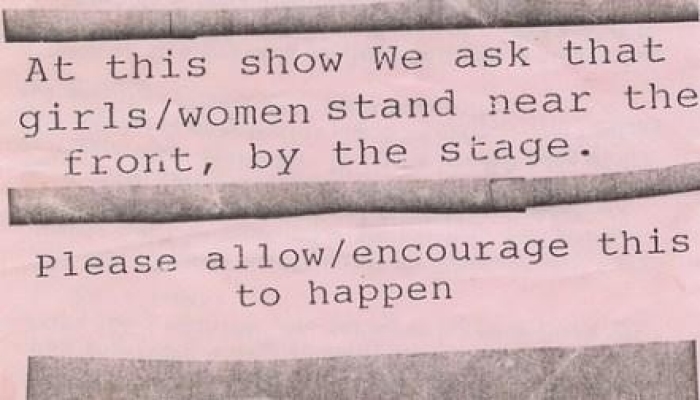
The name “Disabled to the Front” comes directly from Cynthia’s punk rock background and the riot grrrl movement of the 1990s. “Girls to the Front” was a movement that created safe space at the front of music venues for women and girls who were being trampled in mosh pits and attacked. “Me being a punk singer and loving to go to shows, it felt very natural for me to use the phrase ‘disabled to the front,’” Cynthia says.
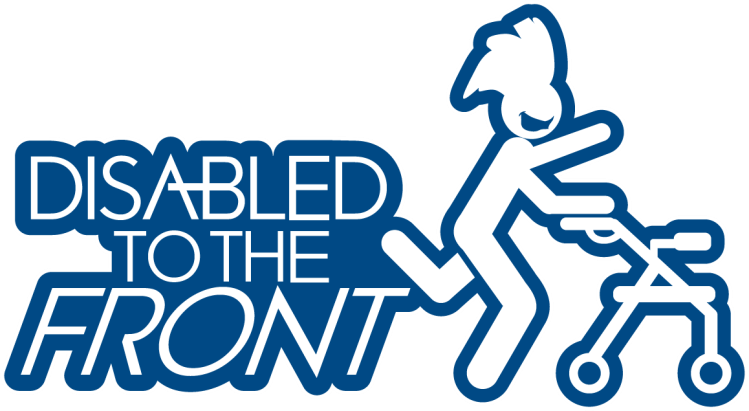
The logo (created by artist Marilou Herrera) shows a blue stick figure with a mohawk and a big grin, using a rolling walker and showing movement, like updated accessibility symbols. Cynthia also noticed something important: among all the international symbols for accessibility, there wasn’t one for a rolling walker. “It’s not just about holding me up,” she explains. “It’s about increasing the ability and the distance that I could walk, the types of places that I can go.”
Understanding the Problems
People with disabilities face many challenges when trying to access nightlife. These problems come from larger issues that affect many people, and more specific issues that differ from person to person.
General problems include:
- Transportation with buses and rideshare services can be an issue, especially at night and when traveling between counties. Many people with disabilities don’t have access to cars or can’t afford modifications to make cars accessible. Sidewalks, curb cuts, and rideshare drop-off points are often in bad shape.
- People in long-term care facilities often face an unofficial “be in bed by midnight rule.”
- Many people with disabilities haven’t gotten the chance to learn important safety skills for nightlife situations. Service industry workers get little to no training about disabilities.
- Negative attitudes and worry from others create more barriers. That can include concern from caregivers, whether they mean to be controlling or not.
“Reduced peer support networks and/or self-confidence to go out,” make the problem worse, Cynthia says. So do the costs of going out and spending money on “non-essential” purchases. There’s worry and stress about whether accommodation requests will be met, fear that mobility aids might be broken or taken, and general fear of embarrassment, shame, or getting hurt.
Problems specific to venues are just as tough.
- Many places have no ADA contact information on their websites, or they don’t respond to accessibility requests.
- Websites and ticket links are often hard to use.
- Heavy doors don’t have automatic openers, doorways and walkways are too narrow, and thresholds and ground surfaces create obstacles.
- Physical barriers include steps, broken elevators or lifts, and bathrooms that aren’t accessible. Bars are often too high for wheelchair users to reach.
Perhaps most frustrating, “ADA seats are often along the back or sides” of venues - exactly where Cynthia refuses to sit.
The Dignity of Risk
An important part of Cynthia's philosophy (and Disabled to the Front's mission) is the concept of "dignity of risk" - the idea that people with disabilities deserve the same opportunities to face danger and make their own choices as anyone else. This comes from ideas about self-determination: that taking reasonable risks is essential to learning and being human.
Dignity of risk values learning from experience, requires informed choice, balances risk and protection, and builds independence. Most importantly, it shifts focus from protection and help to creating environments where people can thrive.
"Going out at nightlife can be dangerous, right? It's an alcohol fueled environment. Sometimes people don't have the best intentions," Cynthia says. "All of these are very real dangers that everyone has to face, and it's just about whether or not people with disabilities get a chance to face those dangers."
She continues: "People with disabilities don't want to be kept safe all the time. We're not uniquely precious. We want some adventure. We want some excitement. We want to live our lives, and part of that is being exposed to danger and learning how to overcome it."
Building a Movement
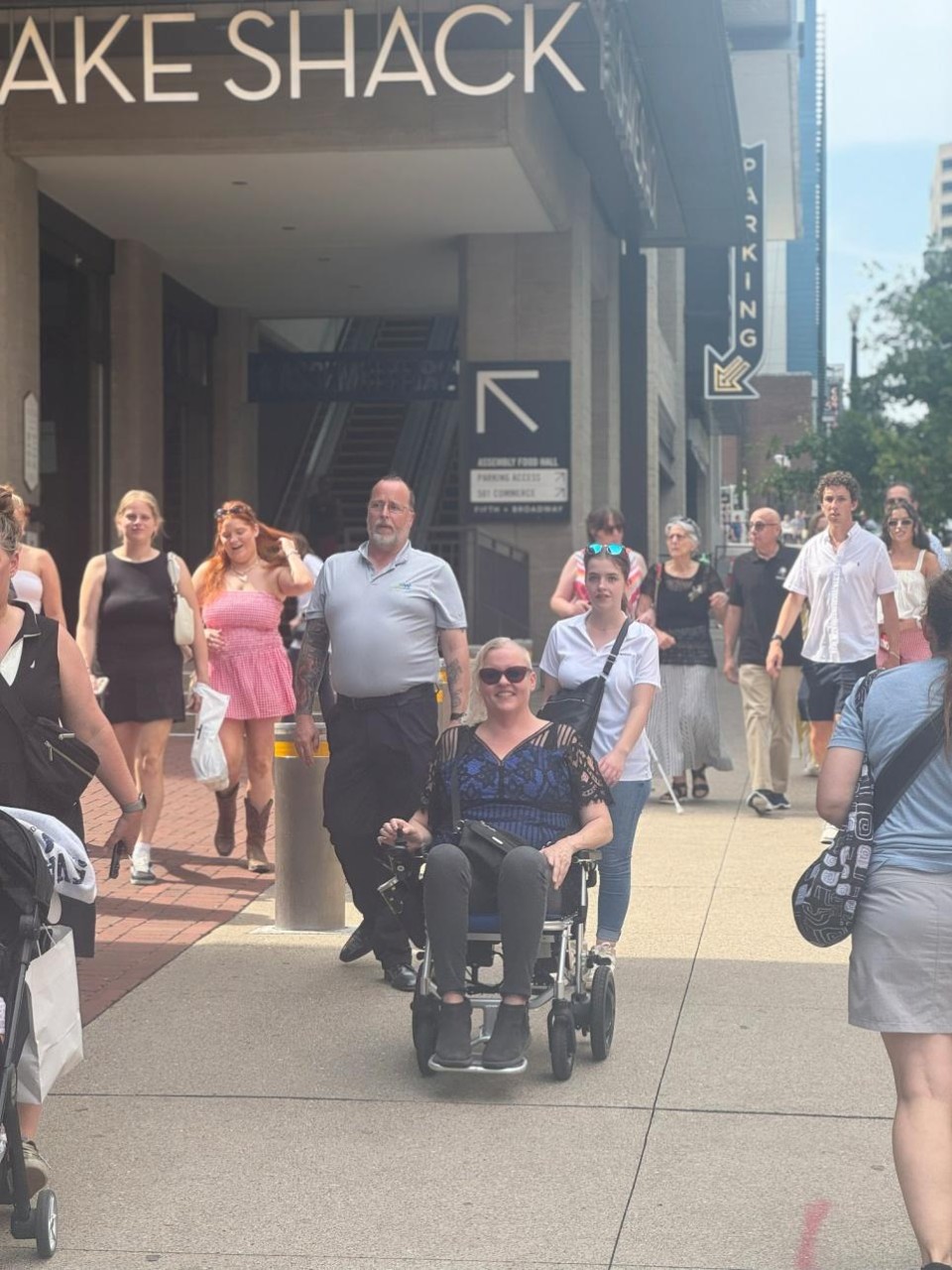
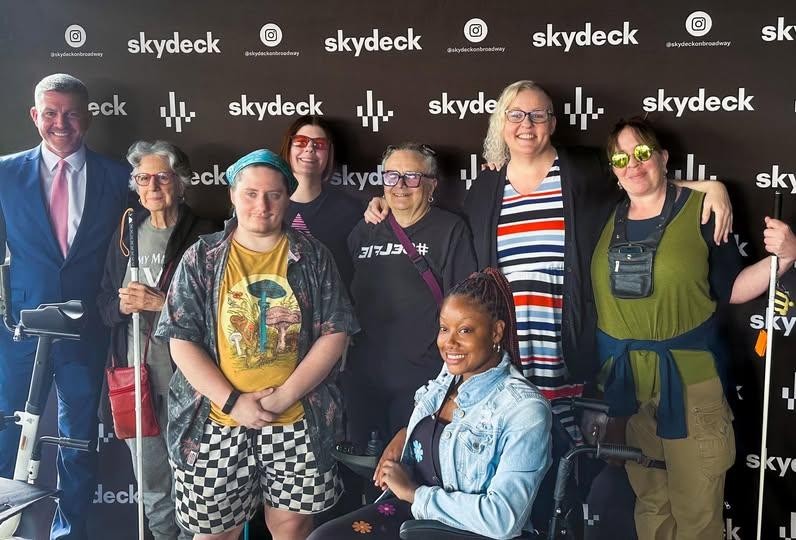
After connecting with Nashville's Mayor's Office of Nightlife, Cynthia officially launched Disabled to the Front in January 2025 with a show at East Side Bowl. The show featured all disabled artists. About 140 people came, and news coverage helped spread the word. The launch party was a success. Since then, the group has kept the momentum going through monthly Zoom meetings with their advisory group and real actions throughout Nashville. They've done accessibility tours at major entertainment areas like 5th and Broadway. They’ve worked to bring NaviLens (an accessibility app for blind and low-vision users) to Nashville venues and even the Nashville Zoo.
“From those news articles, the word just started spreading and the universe sent me an amazing advisory council full of people to help me build this and make decisions,” Cynthia says. The group focuses on building relationships and teaching rather than fighting. They work with venue owners who want to be more accessible.
The group has also provided iPhone skills training through partnerships with the National Federation of the Blind, tested accessibility at rooftop bars on Broadway, and attended community events – always with two goals: advocacy and actually participating in the nightlife. One of their biggest wins came when Nashville Metro Council passed Resolution RS2025-1503, calling for a city-wide ADA audit.
Cynthia gave public testimony supporting the resolution, which will help the city prepare for the 2034 Special Olympics.
Success Stories and Ongoing Challenges
Cynthia’s advocacy has already created real improvements across Nashville. At Brooklyn Bowl, after she left a They Might Be Giants show because of inaccessible seating, the venue created a new ADA section on the upper level with chairs that have backs. “That space is there because of me,” she says proudly.
Dark Matter, a venue that prides itself on being inclusive, didn’t have ADA parking until Cynthia messaged from their parking lot before having to turn around and go home. They immediately created a accessible space and now ask her advice
on accessibility for events like their upcoming Dark Matter Fest.
Still, challenges remain. Many venues don’t respond to accessibility emails, leaving disabled patrons to choose between staying home or showing up and risking chaos. The burden consistently falls on people with disabilities to advocate for themselves.
“It makes people with disabilities feel like you don’t want us there,” Cynthia explains. “It can really lead to an uncomfortable evening and make people... it kind of wears them out.”
Disabled to the Front is working on multiple things to create big changes. They’re pushing for better training for venue owners about ADA requirements. They’re working with the city’s 60 ADA coordinators to make compliance reports public. They’re developing a self- assessment tool for venues, a mini-zine to share basic disability rights information for service workers, and working with venues to identify the best mapping options for accessibility information.
The group is also planning a session on disability for the national Night Mayor Conference. They’re pushing for better training to be connected to beer permitting, teaching bartenders, bouncers, and servers how to better serve disabled patrons.
“We are focusing on the venues that want us right now, that have sought me out or responded to the press articles and said, ‘Come help us be more accessible, we want people with disabilities here,’” Cynthia explains.
“Now we are gearing up for more of a fight to work with those venues that may not be as willing.”
Understanding the ADA and Moving Beyond Just Following Rules
An important part of Disabled to the Front’s work involves teaching people what the Americans with Disabilities Act actually requires. Despite what many people think, “there are lots of myths about establishments being grandfathered in or exempt from standards,” Cynthia explains.
“However, all establishments must come up with some form of reasonable accommodation to be accessible to people with disabilities.”
All Title III establishments must be accessible under the ADA and should have had ADA Transition Plans in place since 1990. New construction should definitely follow accessibility standards. The problem isn’t the law; it’s enforcement and education. “ADA supports in general are poorly funded and monitored,” Cynthia notes, with “limited access to meaningful complaint processes and the courts.”
Rather than immediately pursuing legal action, Disabled to the Front focuses on building relationships and education.
Getting Out There
For people with disabilities in Tennessee wondering how to get more involved in nightlife (or any community activity), Cynthia offers concrete steps:
- If you’re a person with disabilities who wants to go out more:
- You can call or email venues before you go. Ask specific questions such as:
- “Do you have accessible parking?”
- “Can I bring my wheelchair to the front?”
- “Are your bathrooms accessible?”
- Feel empowered to document your experiences, good and bad. Take photos, write reviews, share on social media. This can help other people with disabilities know what to expect.
- Bring a friend the first few times if you’re nervous. There’s power in numbers!
- Know your rights. The ADA says venues have to provide reasonable accommodation. You’re not asking for special treatment, you’re asking for equal access.
- If you own or manage a venue:
- Make it easy for people to reach you. Put clear ADA contact information on your website; an email, phone number, or contact form specifically for accessibility questions goes a long way.
- Then, respond when people contact you. Even if you can’t fix everything immediately, acknowledging requests shows you care.
- Ask people with disabilities for feedback. They’re the experts on what works and what doesn’t.
- Train your entire staff: bartenders, servers, security, everyone. They should know how to help without being condescending or making assumptions.
- Get creative. Not every solution has to cost a lot of money. Sometimes it’s as simple as moving a table, keeping a pathway clear, or having a portable ramp available.
- If you want to help your community become more accessible:
- Push for a city-wide ADA audit. You can use Nashville’s Resolution RS2025-1503 as a model to bring to your local government.
- Download accessibility mapping apps like RollMobility and start documenting which places are accessible in your area.
- Amplify disabled voices. Follow disabled creators and advocates on social media. Attend events put on by disability organizations.
- Support disabled artists by using resources like RAMPD (Recording Artists and Music Professionals with Disabilities) to find and promote disabled musicians, performers, and creators in your area.
- Connect with the ADA National Network. They have free resources, training, and support for individuals, businesses, and communities.
What's Next
As Disabled to the Front continues to grow, they're expanding beyond Nashville's music scene to address broader accessibility issues. They're serving on community boards, giving feedback to transportation departments about new construction, and working to bring their model to other cities. They’re also getting national attention, with Cynthia presenting their work at the Council on Social Work Education’s Annual Program Meeting in Denver.
“We want Disabled to the Front to encourage these venue owners to work a little bit harder to make it easier for people with disabilities to make those requests and to come in and experience the nightlife,” Cynthia says.
The Bigger Picture
Disabled to the Front represents something bigger than just access to Nashville’s music scene. It recognizes that people with disabilities deserve full participation in community life, including the parts that happen after dark, involve alcohol, or might be considered “non-essential.”
“It is time to wake up and get engaged in the political process,” Cynthia says. Advocacy can start small and personal. Whether it’s asking a restaurant about accessible parking, requesting a chair with a back at a venue, or simply showing up and taking up space, every action matters.
The group’s name, “Disabled to the Front,” isn’t just about physical placement at concerts. It also involves centering disabled voices and experiences in conversations about community access and inclusion, and refusing to be pushed to the edges of social life.
To learn more about Disabled to the Front, follow @DisabledToTheFront on social media. For venues interested in accessibility consultation or communities wanting to start their own advocacy efforts, contact Dr. Cynthia George at cgeorge9@tnstate.edu.