Nuclear Lifecycle Innovation Campus
On January 28, 2026, the U.S. Department of Energy (DOE) published a Request for Information (RFI) regarding its Nuclear Lifecycle Innovation Campus (NLIC) initiative, designed to secure America’s energy dominance and accelerate the nation’s development and commercialization of advanced nuclear technologies. Using a voluntary, state-led partnership model, DOE seeks to establish integrated, full-cycle nuclear ecosystems that could co-locate and support the entire nuclear value chain in one campus while exploring durable pathways for managing used nuclear materials in a safe, secure, and fiscally responsible manner.
Governor Bill Lee submitted Tennessee’s comprehensive response, spanning nearly the full nuclear lifecycle, on April 1, 2026. More than half of U.S. states, including Tennessee, submitted responses outlining their willingness, readiness, and technical capacity to host an integrated nuclear ecosystem. The Tennessee Department of Environment and Conservation's Office of Energy Programs (TDEC OEP) and the Tennessee Department of Economic and Community Development (TNECD) sought input and received support from key partners across the state’s existing nuclear industry footprint when developing Tennessee’s response.
On July 28, 2026, DOE announced the selection of Tennessee, Utah, Oklahoma, Louisiana, and Idaho and as potential host states for the development of an NLIC. Memorandums of Understanding (MOU) have been executed with each state as a precursor to negotiating host agreements. Tennessee continues to work toward finalizing its campus concept and will update this website when new information becomes available.
NLIC Purpose
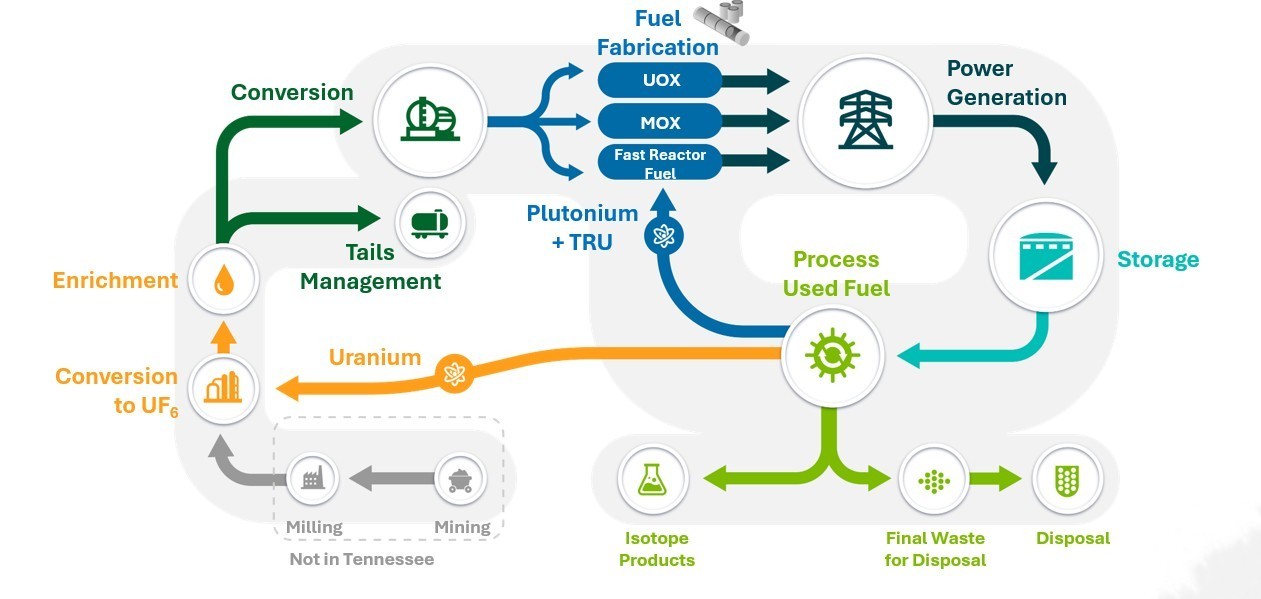
DOE’s NLIC initiative is about more than just building new nuclear power generation. These campuses must be designed to support the entire nuclear supply chain. This can include:
- Fuel development, including fabrication, conversion and deconversion, enrichment, and reprocessing or recycling;
- Advanced manufacturing and advanced reactor deployment;
- Isotope production for medical, industrial, and national security applications;
- Proliferation resistance and other safety technologies and protocols;
- Workforce and supply chain development;
- Interim and long-term material storage;
- Environmental stewardship; and
- Secure transportation networks.
Tennessee’s Proposed NLIC Concept
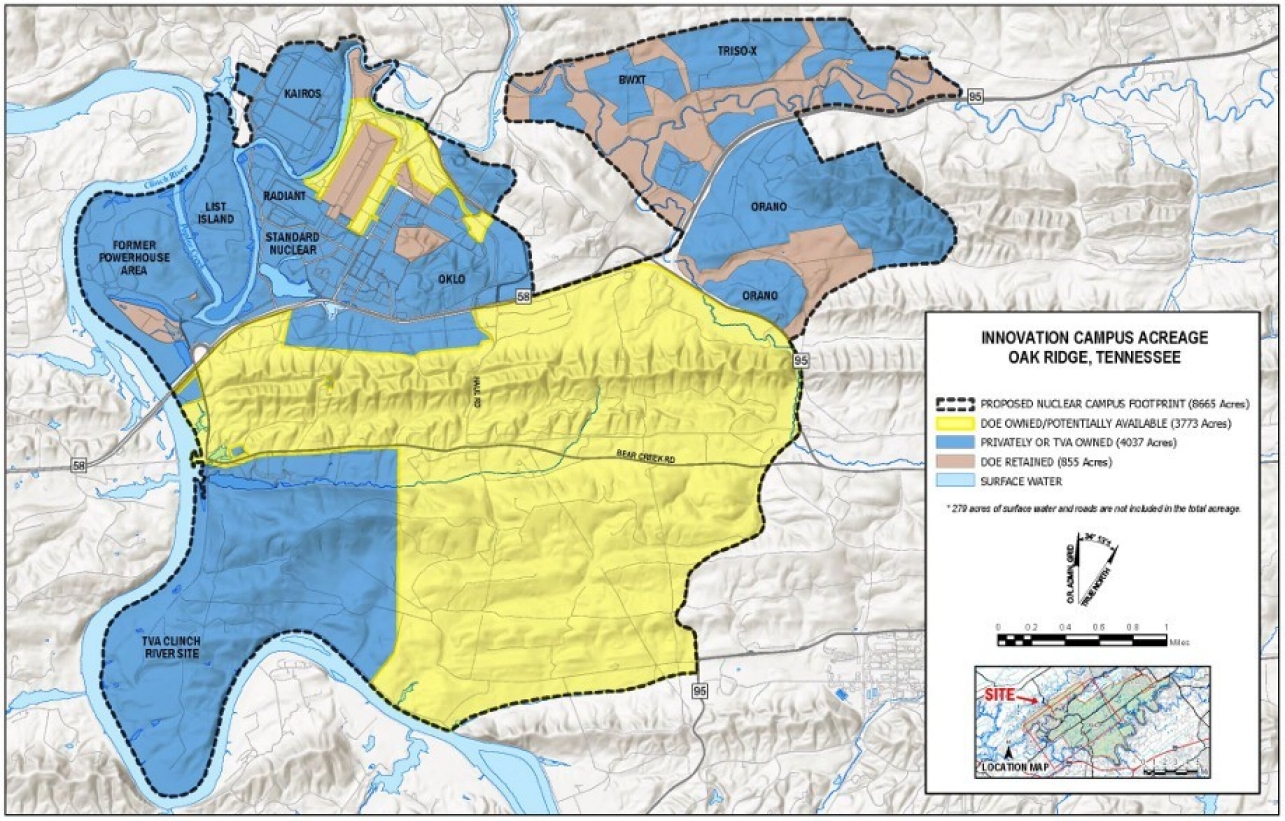
Oak Ridge, TN has been identified as the primary site for Tennessee’s NLIC approach due to its extensive nuclear infrastructure, research capabilities, skilled workforce, and existing industrial investments. Development of an NLIC will harness and amplify these critical public and private resources to further advance innovation within the nation’s nuclear supply chain.
The primary campus will encompass approximately 8,665 acres with adjacency to Oak Ridge National Laboratory (ORNL), the Y-12 National Security Complex (Y-12), and Tennessee Valley Authority's (TVA) Clinch River small modular reactor development site. It will bring together nuclear research, fuel development, advanced manufacturing, data centers and high-performance computing, power generation, isotope production, transportation, workforce development, and environmental stewardship in one regional ecosystem. Functions requiring additional space or specialized site conditions, such as nuclear materials storage, supply-chain operations, and workforce facilities, would be housed at satellite locations, as needed.
The State has identified potential areas that may be geologically and seismically suitable for a long-term repository and are in close proximity to the primary site. The State will continue research and site assessment activities to confirm suitability of a site located outside of the Oak Ridge primary campus.
Please Note: An NLIC is a complex and critical undertaking involving coordination among myriad public and private partners and ongoing compliance with regulatory authorities. The nuclear industry and its regulations are also rapidly innovating and evolving. Tennessee’s initial NLIC proposal is under active evaluation and is continuing to be refined, in collaboration with DOE and other partners, to best meet the needs of the state as well as the nation’s overall energy goals.
To be added to our Nuclear Lifecycle Innovation Campus listserv, please email the TDEC OEP email list here.
On July 28, 2026, DOE announced selection of Tennessee, Utah, Oklahoma, Louisiana, and Idaho to continue negotiations for hosting NLICs. Tennessee will continue to work with DOE and other partners to refine the Tennessee NLIC concept.
Today, Tennessee is already home or has commitments to many lifecycle functions. Selection of Tennessee as a Nuclear Lifecycle Innovation Campus will hasten development in this sector and benefit DOE and the country through establishment of a comprehensive, one-stop-shop for nuclear lifecycle management and reindustrialization.
DOE has indicated a preference for working with states who can set more ambitious timelines for Innovation Campus deployment. Tennessee can meet this national urgency for nuclear lifecycle support, as the state already houses federal facilities and significant private investment that address cutting-edge functions of nuclear reindustrialization (e.g., fuel fabrication, enrichment, reprocessing or recycling used nuclear fuel, advanced separations).
Tennessee is also a national leader in supporting the deployment of co-located industries with its nuclear lifecycle investments. This includes research and development of advanced reactors, current nuclear power generation, and advanced manufacturing, on top of extant global leadership in high-performance computing.
The State intends to embrace fuel reprocessing and recycling as well as diverting critical materials and isotopes into other health, defense, and industrial uses. These activities can reduce the amount of material to be stored and reshape the country’s needs for interim and long-term materials management solutions.
Through meaningful collaborations across public and private partnerships, benefits of establishing an NLIC in Tennessee are expected to include:
- Strengthening of Tennessee's leadership in nuclear innovation and power generation
- Creation of high-quality, skilled jobs
- Support for local businesses and manufacturers
- Expansion of workforce training opportunities
- Attraction of additional private investment
- Accelerated deployment of advanced nuclear technologies
As Tennessee works to finalize its NLIC concept, the State’s Nuclear Energy website will be used as the central hub for updates and opportunities to participate.
Questions can also be addressed to TDEC.OEP@tn.gov or ECD.Nuclear@tn.gov.