Perinatal Regionalization
Tennessee's Perinatal Regionalization Program provides for the diagnosis and treatment of certain life-threatening conditions of pregnant women and newborn infants. The five Regional Perinatal Centers in Tennessee make specialized care available to health care providers for the consultation and referral of these high-risk patients.About Perinatal Regionalization
Mission: To improve birth outcomes and reduce infant mortality.
The Perinatal Regionalization Program was established to ensure that pregnant women and newborns with life-threatening conditions have access to specialized care. Tennessee has five Regional Perinatal Centers that provide:
- Consultation and referral for high-risk patients
- Patient transport, when necessary
- Specialized staff skilled in high-risk perinatal care
- Post-graduate education for physicians, nurses, and other medical personnel
- Site visits to local hospitals to support quality improvement
The regionalization system has been in place since the early 1970s. Created by state statute, it provides the statewide infrastructure needed for high-risk perinatal care. This system continues to play a vital role in improving birth outcomes and reducing infant mortality across Tennessee.
Regional Perinatal Centers
Services are coordinated between medical providers and the Regional Perinatal Centers to ensure high-quality care for mothers and newborns across Tennessee.
Each of Tennessee’s five Regional Perinatal Centers provides advanced Level III or Level IV obstetric and neonatal care, offering specialized services for high-risk pregnancies and critically ill newborns. These centers work closely with local hospitals, clinics, and healthcare providers to support timely referrals, patient transfers, and ongoing care coordination.
Below is a map of the Regional Perinatal Center locations, along with contact information for each center:
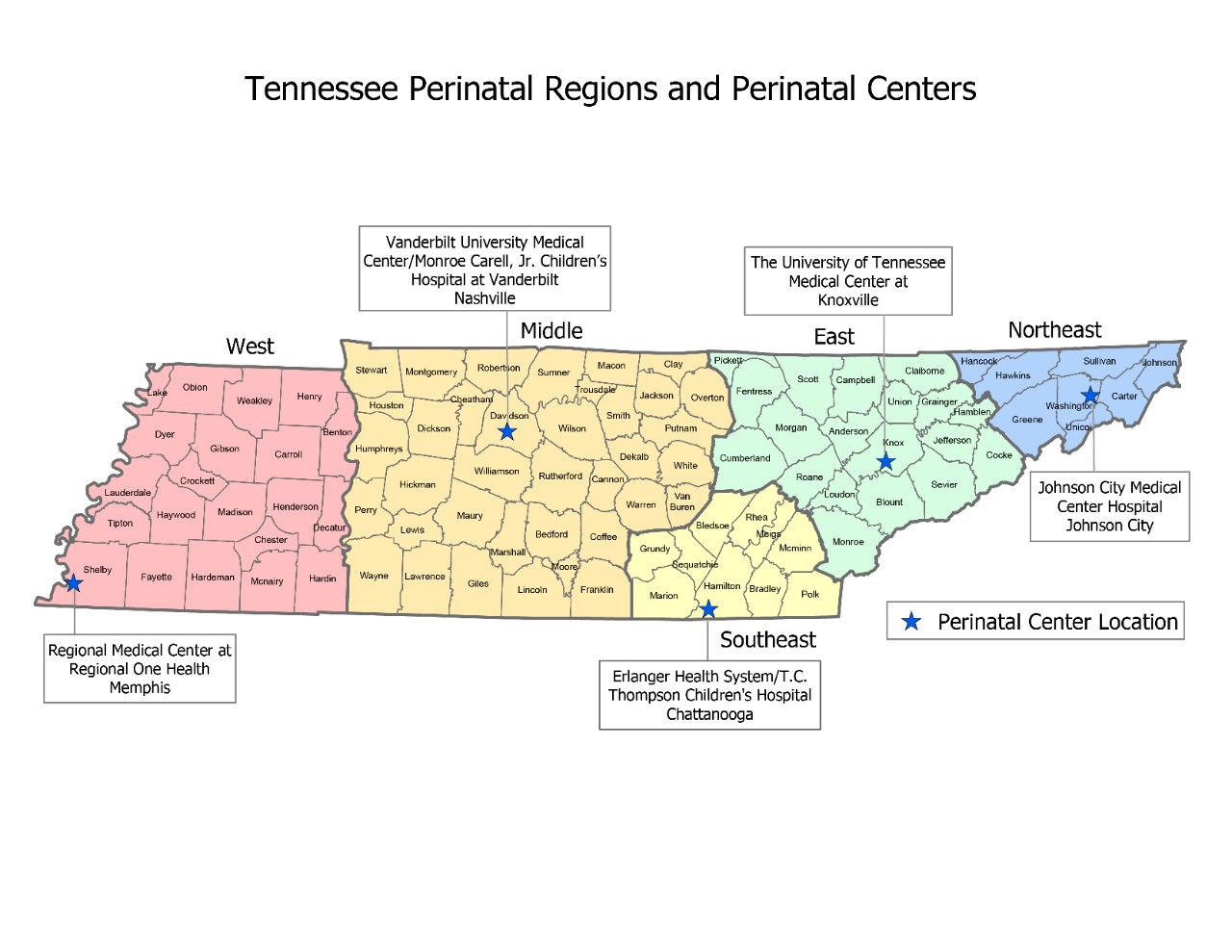
East Tennessee Regional Perinatal Center – The University of Tennessee Medical Center at Knoxville
Knoxville, Tennessee
- Labor & Delivery (L&D): Call (865) 305-9830
- Maternal Referrals: Call 1-800-422-9301 or 865-305-9300
- Neonatal Consult/Transport: 1-800-732-7295 or 865-305-9834
- NICU: 865-305-9834
Middle Tennessee Regional Perinatal Center – Vanderbilt University Medical Center/Monroe Carell, Jr. Children’s Hospital at Vanderbilt
Nashville, Tennessee
- L&D: 615-322-2555
- OB Consults/Referrals: 1-888-636-8863 or 615-343-0976
- Neonatal Consult/Transport: 1-800-288-8111
- NICU: 615-322-0963
Northeast Tennessee Regional Perinatal Center – Johnson City Medical Center Hospital
Johnson City, Tennessee
- Perinatal Center Office: Call (423) 431-6640
- Labor & Delivery (L&D): Call (423) 431-6437
- Referrals: Call 1-800-365-5262
- Neonatal Consult/Transport: Call (423) 431-6671
- NICU: Call (423) 431-6671
Southeast Tennessee Regional Perinatal Center – Erlanger Health System / T.C. Thompson Children's Hospital
Chattanooga, Tennessee
- Labor & Delivery (L&D): Call (423) 778-7956
- OB Consults / Referrals: Call (423) 778-8100 or 1-866-4HI-RISK
- Neonatal Consult/Transport: Call (423) 778-6438
- NICU: Call (423) 778-6438
West Tennessee Regional Perinatal Center – Regional Medical Center at Regional One Health
Memphis, Tennessee
- Labor & Delivery (L&D): Call (901) 545-7345
- OB Inpatient Transport: Call (901) 545-8181
- Neonatal Consult/Transport: Call (901) 545-7366
- NICU: Call (901) 545-7366
Perinatal Advisory Committee
The Perinatal Advisory Committee is composed of 21 members, including Center directors, experts in perinatal medicine, hospital administrators, nurses, and physicians. It provides advice and direction to the Department of Health and works to improve maternal and infant health outcomes across Tennessee by reviewing data, identifying challenges, and recommending best practices and policies. Meetings are open to the public in accordance with Sunshine laws, and you can view their recordings, agendas, and notices below.
Perinatal Advisory Committee Meeting Recordings
Perinatal Advisory Committee Meeting Agendas
Sunshine Notices
Perinatal Advisory Committee (PAC) Workgroup
Recordings
January 23, 2026
December 22, 2025
December 17, 2025
November 17, 2025
November 3, 2025
September 29, 2025
August 15, 2025
July 30, 2025
Agendas
Sunshine Notices
Additional Resources
Tennessee Initiative for Perinatal Quality Care (TIPQC)
TIPQC seeks to improve health outcomes for mothers and infants in Tennessee by engaging key stakeholders in a perinatal quality collaborative that will identify opportunities to optimize birth outcomes and implement data-driven provider- and community-based performance improvement initiatives. To learn more, visit the TIPQC website.
Reports and Publications
The Department of Health collects data on births, pregnancies, and deaths through the Vital Records system. These data (numbers and rates) are located on the Department’s Vital Statistics website. The information includes pregnancies and births by county, by race, and by various ages, infant deaths by county and by race, and low-weight births by county and by race.
Tennessee Perinatal Regionalization System Guidelines
- 9th Edition, Guidelines for Regionalization, Hospital Care Levels, Staffing and Facilities (2020)
- 2nd Edition Guidelines on Equipment, Supplies, and Training for Emergency Medical Services and Emergency Department Staff (2025)
- 8th Edition of Educational Objectives in Medicine for Perinatal Social Workers 2023
- 7th Edition, Educational Objectives for Nurses, Levels I, II, III,IV and Neonatal Transport Nurses (2022)
- 8th Edition, Guidelines for Transportation (2025)
Archives
Tennessee Perinatal Regionalization System Guidelines
- 7th Edition, Guidelines for Transportation (2020)
- 8th Edition, Guidelines for Regionalization, Hospital Care Levels, Staffing and Facilities (2014)
- 7th Edition, Education Objectives in Medicine for Perinatal Social Workers (2019)
- 1st Edition, Guidelines for Equipment, Supplies and Training for Emergency Medical Services and Emergency Department Staff (2020)
- 6th Edition, Guidelines for Transportation (2014)
- 6th Edition, Educational Objectives for Nurses, Levels I, II, III,IV and Neonatal Transport Nurses (2014)
Other Publications
Perinatal Regionalization Fact Sheets
This Page Last Updated: March 30, 2026 at 2:49 PM