Evidence Framework & Clearinghouses
The Tennessee Evidence Framework
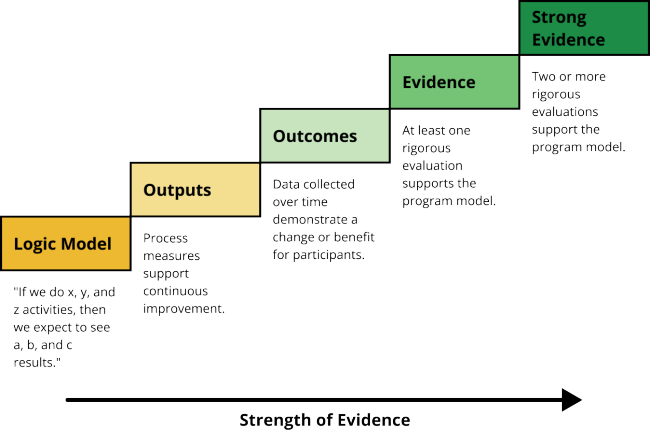
The Tennessee Evidence Framework standardizes language used enterprise-wide to classify programs based on available supporting evidence. Programs move through five progressive steps: logic model, outputs, outcomes, evidence, and strong evidence.
A logic model is a planning tool and visual representation of how a program works toward outcomes. Logic models define the "if-then" relationship: "If we do x, y, and z activities, then we expect to see a, b, and c results."
Logic models typically include:
- Inputs (resources dedicated to the program)
- Activities (what the program does)
- Outputs (direct products of activities)
- Outcomes (changes in participants' knowledge, attitudes, behaviors, or conditions)
- Impact (longer-term changes in systems or populations)
Logic models are written during program planning and are often required by funders in grant applications and annual reports.
Outputs are the concrete, measurable results of the program’s activities. They are process measures that track program implementation and participant engagement.
Examples include:
- Number of people served
- Services delivered
- Training sessions completed
- Materials distributed
Outputs confirm program activities are happening as designed, but don't yet demonstrate participant change.
Outcomes are data collected over time demonstrating changes in participant behavior or benefit. They measure trends over the short or long term, indicating program impact on people or systems. Outcomes may also include ROI or cost/benefit calculations.
Examples include:
- Percent of students reading at grade level by third grade
- Average number of traffic accidents per day
- Job growth rate
- Dollars saved per $1 spent
At this step, agencies track whether participants experience desired changes and look for trends, but causal connection to the program isn't yet rigorously established.
A program reaches the Evidence level when at least one high-quality study shows that the program itself is responsible for the results it achieves. This type of evaluation uses strong methods and comparison groups to look at the difference between what happened with the program to what would have happened without it. As a result, the findings show whether the program caused the outcomes, and not just that the outcomes are related or happened at the same time.
Programs reach Strong Evidence when supported by two or more rigorous evaluations. Multiple studies increase confidence that program effects are real, replicable, and generalizable.
Tennessee recognizes three types of rigorous evaluation.
Randomized Control Trials (RCT)
- Randomly assign participants to treatment and control groups
- Compare outcomes between groups
- Considered "gold standard" for establishing causation
- Control for selection bias and confounding variables
Quasi-Experimental Designs (QED)
- Create comparison groups without random assignment
- Use statistical controls to create equivalent comparison groups
- Include methods like difference-in-differences, regression discontinuity, matching, and interrupted time series
- Valuable when randomization isn't feasible or ethical
Systematic Reviews
- Statistical method to synthesize results from multiple separate studies
- Estimate overall effect on outcomes
- Consider quality of included studies
- Draw on multiple experimental studies to form conclusions
Evidence clearinghouses are databases created by government agencies, research, institutions, and other groups that compile and rate program evaluations, helping agencies identify proven interventions. Tennessee uses several key resources:
- The National Results First Clearinghouse is operated by Penn State and includes studies from ten different social service-related clearinghouses.
- The Washington State Institute for Public Policy (WSIPP) has a database of benefit-cost studies related to several social service areas. Entries include meta-analysis of specific outcomes and direct links to studies it uses.
- While it is not comprehensive, OEI has compiled a list of Evidence-Based Clearinghouses, which are other trusted clearinghouses organized by policy area.
Evidence clearinghouses help agencies:
- Identify programs with strong evidence in specific areas
- Understand what works before designing new interventions
- Make evidence-based budgeting decisions
- Justify program investments with rigorous research
Steps for using clearinghouses:
- Identify the policy area or outcome of interest
- Search clearinghouse databases for relevant programs
- Review evidence ratings and study quality
- Consider program fit with Tennessee context
- Assess implementation requirements and cost
- Determine whether to adopt proven program or adapt elements