Evaluation Guidelines & Standards
Purpose & Scope
Tennessee's Evaluation Guidelines define principles to guide the planning and execution of program evaluations across state government. These guidelines foster a shared understanding of language and principles for all evaluations conducted by state agencies and their contractors, supporting rigorous, relevant evaluations and evidence-based decisions that drive continuous improvement.
What is Evidence Building?
Evidence is a robust body of research that evaluates the effectiveness of existing programs or proposed initiatives. Building evidence involves qualitative and quantitative studies that inform budget, policy, and program decisions. The pinnacle of evidence building is rigorous program evaluation using experimental or quasi-experimental designs.
Evidence helps Tennessee learn and make better decisions. Done consistently, evidence building results in a budget increasingly informed by solid data and research, ensuring the state allocates resources responsibly and improves outcomes for all Tennesseans.
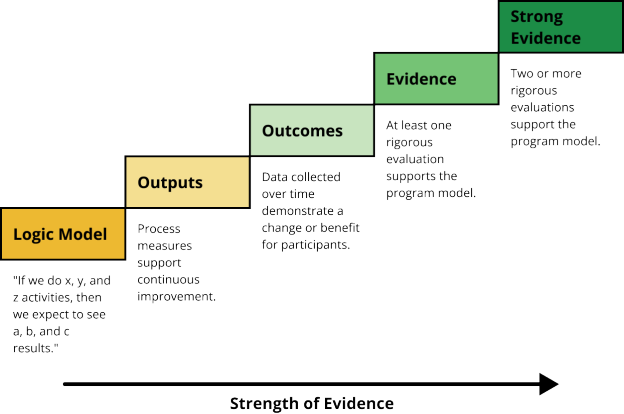
The Tennessee Evidence Framework provides a common language for describing how much evidence supports a program and how that evidence is built over time. It recognizes that all programs start somewhere and that evidence development is a continuous process.
The Framework reflects a continuum of evidence, beginning with clear program design and progressing toward rigorous evaluation as programs mature:
- Logic Model: Programs clearly describe how their activities are expected to lead to desired results and lay the foundation for learning and improvement.
- Outputs: Programs track service delivery and process measures to support day‑to‑day management and continuous improvement.
- Outcomes: Programs collect data over time to understand whether participants experience meaningful changes or benefits.
- Evidence: At least one rigorous evaluation shows that the program model is producing intended results.
- Strong Evidence: Two or more rigorous evaluations confirm the program’s effectiveness across settings or populations.
Agencies actively contribute to evidence building by engaging with the framework at the level that best fits their program’s purpose, scale, and maturity. By strengthening program design, improving data use, and pursuing evaluation when appropriate, agencies help move programs along the continuum and expand the state’s overall evidence base to support better decisions for Tennesseans.
OEI provides:
- Collaboration with the governor's office and state leaders to identify strategic evidence needs and develop the Learning Agenda
- Support to agencies in identifying programs that would benefit from evaluation
- Technical assistance including funding, training, evaluation design consultation, external partner identification, and results dissemination planning
State agencies are responsible for:
- Conducting internal and external evaluations independently
- Following principles in the Evaluation Guidelines
- Using the Framework to develop rigorous evidence for programs
- Moving programs, where possible, from "Outcomes" to "Evidence" steps through quality evaluation
Tennessee supports multiple evaluation types, each serving an important role in evidence building:
Formative Evaluation assesses program feasibility, appropriateness, and acceptability to make sure a program is well designed and ready to succeed before it is fully launched
Process (or Implementation) Evaluation documents what a program is actually doing and whether it is being carried out as planned to identify areas for improvement.
Outcome Evaluation examines whether participants experience meaningful changes, such as improved knowledge, behaviors, or conditions, to make sure the program is actually making a difference for participants.
Cost Benefit/Cost Effectiveness Evaluation compares the cost of a program to the results it achieves to understand its value and help decision-makers and the public understand whether a program’s results are worth the resources invested.
Impact Evaluation determines whether the program caused the results by comparing outcomes to what would have happened without the program.