Electronic Data Auditing Procedures
DATA REQUIREMENTSBENEFITS OF AUDITING ELECTRONIC DATA
Document retrieval can be costly in terms of time and effort for both the auditor and the taxpayer. Complete electronic data records allow the Department to assess the accuracy of tax reporting more efficiently and can often reduce the time and effort required to retrieve paper documents. Such time savings benefit both the taxpayer and the auditor. Furthermore, having sufficiently rich data may enable the auditor to make tax determinations directly from the electronic data.
Questions or Concerns
You are encouraged to ask questions of the EDG auditor or field auditor during the audit process. You may also email questions to support.data@tn.gov.
Recordkeeping
As provided by Tenn. Code Ann. § 67-1-113, the taxpayer is required to maintain suitable records for determining the taxpayer’s Tennessee tax liability. If these records are in an electronic format, the taxpayer is required to provide the records in a standard record format.
Tenn. Code Ann. § 67-1-113. Keeping and maintenance of records – Access to records – Penalties for noncompliance. – (a) All persons and entities subject to any tax administered by the commissioner shall keep and preserve suitable records from which the taxpayer and the commissioner can determine the Tennessee tax liability, if any. All such records shall be open to examination at all reasonable hours by the commissioner or any authorized agents of the commissioner. If the taxpayer maintains any such records in an electronic format, the taxpayer shall comply with reasonable requests by the commissioner or the commissioner’s authorized agents to provide those electronic records in a standard record format.
Data Records
Electronic data consists of the records produced by accounting software for a business. In general, sales and use tax audits focus on taxable transactions. Thus, records for transactions involving sales and expense invoices, journal entries, accruals, reversals, etc. are usually of the most interest. The auditor may access any data necessary to balance to the taxpayer’s books and records. Other records may be required depending on the tax types being audited.
Electronic Data File
To limit additional time and monetary expense, the electronic data file should be in a robust format pulled directly from the taxpayer’s accounting system. The preferred format is a non-delimited, fixed width flat file along with a record layout. The Electronic Data Group (EDG) auditor will work with the taxpayer’s software support or Information Technology (IT) department to determine the best format for the data file based on the accounting system options. It is important to obtain electronic data directly from the accounting system to expedite the audit process. Electronic data that is contained in multiple files with multiple formats, corrupted, malformed, complicated, inadequate background information and documentation or converted from Excel to another format can lead to delays in verifying the data and require the taxpayer to submit data multiple times.
Confidentiality of Records
Any Department of Revenue employee with access to taxpayer data is required to maintain the data in a confidential manner. Each Department employee signs a confidentiality agreement. Tax information provided by the taxpayer may only be accessed, used, or disclosed in the performance of official duties strictly for the purpose of state tax administration. Access to federal or state tax information is allowed on a need to know basis to perform official duties and may only be disclosed to other employees of the Department who have a need to know the information in the performance of their official duties. Disclosure restrictions continue to apply even after employment with the Tennessee Department of Revenue ceases.
Data Fields and Record Layout
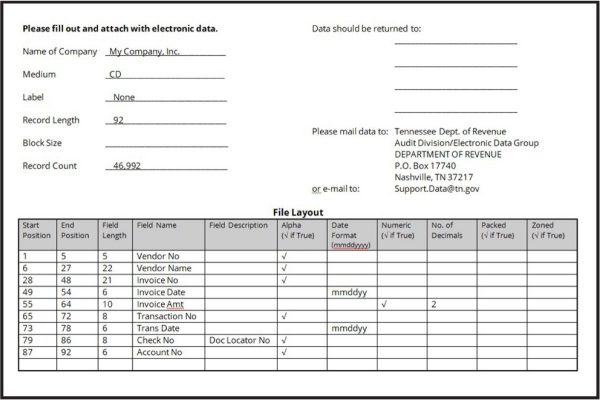
The taxpayer provides an electronic data record layout which clearly identifies data fields. Additionally, for each field, the following information is given: Start and end positions for the field; field length; field name; field description; data type (i.e., alpha, numeric, date, etc.)
Data Media
The Department accepts electronic records stored on a variety of data media such as CD, DVD, or USB flash drive. Upon request, the taxpayer can be provided with a Secure File Transfer Protocol (SFTP) to transmit data. The taxpayer is encouraged to consult with the Department before submitting electronic data.
Data Verification Procedure
Ideally, the field auditor will contact the taxpayer and schedule an entrance conference to be held before the beginning of the examination. All interested parties should attend. The field auditor will discuss the audited taxes and periods. The Electronic Data Group (EDG) auditor will discuss the electronic records. The taxpayer should involve someone from their Information Technology (IT) department with knowledge of the accounting system and extracting the transactional data from the system. It is helpful to have access to the electronic data to show the EDG auditor which fields are captured, records are available, format the records are stored in, etc. If there have been changes in the accounting software during the audit period, we will need to know if the records from the previous software are available. It is important to have complete electronic data for the periods covered by the audited financial statements, which are used for verification of the electronic data and therefore, the electronic data should cover the same time period. The audit period may not cover the same time frame, but once the electronic data is verified, any periods outside of the audit period can be removed. The taxpayer should test the electronic data before submitting it to make sure it reconciles to the audited financial statements. Only after the data has been obtained and verified will the department commence field work.
Electronic Data Verification
The field auditor verifies data received for correctness and completeness by reconciling the electronic data with the taxpayer’s audited financial statements. The EDG auditor uses ACL software to read in the taxpayer’s data and prepare verification totals. Accounts/sales in the data are totaled by year (fiscal or calendar) and account and are then compared with the totals from the taxpayer’s audited financial statements.
The taxpayer supplies all additional records needed to reconcile differences. Timing issues, manual adjustments to accounts, etc., may cause amounts to not match perfectly, but the Department expects the amounts to closely agree. After the auditor has verified the electronic data, he/she will ask the taxpayer to provide invoices from a listing of example data. The example data that is provided to the auditor from EDG performs several functions: it confirms that the taxpayer can pull the source documentation from the fields of data provided, it allows the auditor to compare the provided fields with invoices, and it allows both parties to discuss the fields provided and the contents thereof.
Defining Audit Population
The auditor will discuss with the taxpayer what will be removed from the electronic data to arrive at an appropriate population for examination. The audit population is the total set of unique transactions. The auditor may perform compliance tests on the data to determine what items can be removed. For example, if a taxpayer with locations outside TN provides sales data, the auditor will perform a compliance test on the out-of-state locations to determine if there are any sales into Tennessee from those locations. If the compliance test is passed, the auditor will request the sales data for those locations outside Tennessee be removed from the audit population. For expenses, the auditor will select specific expense accounts to examine. The taxpayer will have the opportunity to include any expense accounts he/she would like to be included as well. Once the population is defined for a sales and use tax audit, the auditor will decide whether to audit the entire population or request a statistical sample. Refer to the Statistical Sampling for Sales and Use Tax Audits manual for more information on the statistical sample procedures.