State Historic Sites
Tennessee’s commitment to preserving its history began long before the formal creation of the State Historic Site Program. In 1848, the state purchased ten acres near Hohenwald to protect the death site of Meriwether Lewis, now protected by the National Park Service’s Natchez Trace Parkway. This act predated many significant federal and private preservation initiatives across the United States at the time. This was followed by the 1856 acquisition of Andrew Jackson’s home, The Hermitage. In 1889, the house was deeded in trust to the Ladies’ Hermitage Association to maintain and operate the site. This agreement established a management model still practiced today: The state owned property is protected and preserved by the state but relies on external partner organizations for management and operations.
The modern State Historic Site Program traces to 1919 with the establishment of the Tennessee Historical Committee, followed by a groundbreaking 1921 legislative mandate that empowered the Committee to protect and acquire historic battlefields and homes. The state then purchased the Andrew Johnson Tailor Shop a few months later where it became the first state owned, and operated, historic site. Today, the site is protected as the Andrew Johnson National Historic Site under the National Park Service. Under the leadership of John Trotwood Moore, the state also purchased the James K. Polk Home and the Sam Davis Home by 1930.
In 1940, the Committee was reorganized as the Tennessee Historical Commission and by 1945 purchased its first property, the Tipton-Haynes farm. The modern State Historic Site Program effectively came about in 1969, when the General Assembly established a $100,000 major maintenance fund dedicated to state historic sites, which launched the ability for the program to have a formal administrative responsibility over the properties. Today, the program has a diversified portfolio beyond traditional house museums to include industrial sites (Burra-Burra Copper Mine) and sites dedicated to the Civil Rights Movement (Alex Haley Boyhood Home).
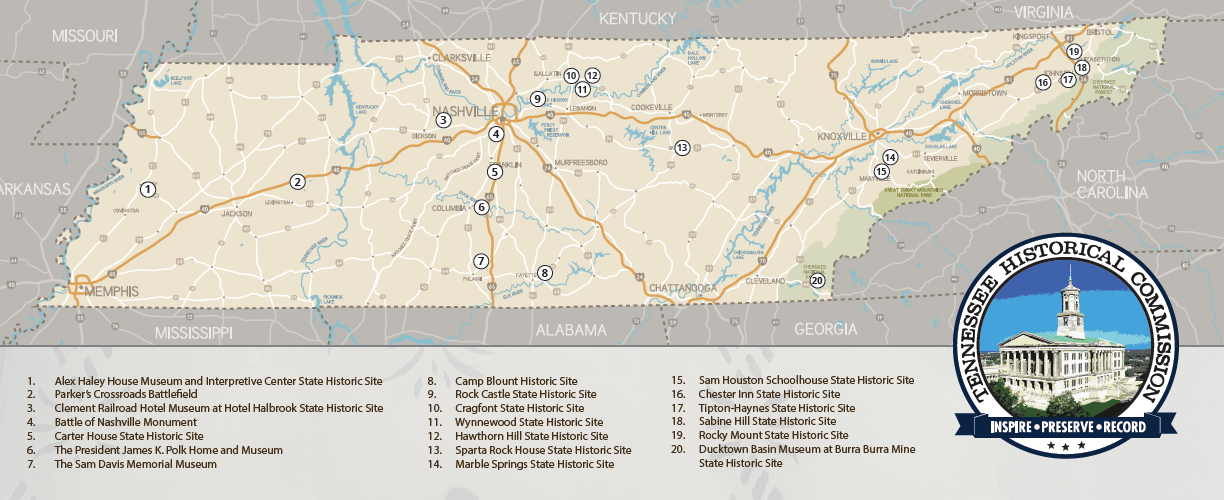
Today, the State Historic Site Program oversees 17 state-owned properties through a unique partnership with partner organizations who manage the daily operations and oversight.
For information regarding the National Register of Historic Places, please visit here.
Click the link below for an interactive digital guide to our State Historic Sites!
| Contact | |
|---|---|
| Bobby Cooley State Historic Sites Program Coordinator (629) 395-8012 Bobby.Cooley@tn.gov | David Britton State Historic Sites Program Coordinator (931) 434-6028 David.Britton@tn.gov |
For information regarding the National Register of Historic Places, please visit here.