State Office of Rural Health
The State Office of Rural Health supports the Tennessee Department of Health's efforts to improve and enhance the accessibility, availability, and affordability of quality health care in Tennessee by creating a central focus and coordination of rural health care resources.About the State Office of Rural Health (SORH)
History
In July 1993, the State Office of Rural Health was established through a grant by the federal Office of Rural Health Policy. Within the rural areas of the state of Tennessee, there was a need for a central focus and coordinated effort to identify obstacles unique to rural areas. Solutions were also required to bring about changes and reforms that would improve and enhance the health care of rural citizens.
Mission
To improve and enhance the accessibility, availability, and affordability of quality health care in Tennessee by creating a central focus and coordination of rural health care resources.
Learn More
Rural Health is America’s Health. Learn more about how the State Office of Rural Health supports rural communities across Tennessee, and visit Tennessee's Rural Health Transformation Program webpage for additional information on rural health initiatives and funding opportunities.
Tennessee Rural Health Task Force
Tennessee’s rural communities face unique health care challenges that impact both physical and behavioral health. Rural Tennesseans often experience diminished access to care, in part due to limited availability of health care facilities, long travel times to receive care, workforce shortages for high-demand health care professions, and a high cost of health care.
In recent years, Tennessee has prioritized programs and resources to improve rural health care, including the Health Care Modernization Task Force, Healthy Smiles Initiative, Tennessee Rural Hospital Transformation Act of 2018, Tennessee Broadband Accessibility Act, and the Small and Rural Hospital Readiness Grant Program.
Recognizing the opportunity to build upon these initiatives, Governor Bill Lee established the Tennessee Rural Health Care Task Force, led as a public-private partnership originating in the Tennessee Department of Health and charged with developing a set of recommendations to improve rural health care across Tennessee.
Responsibilities
- Problem identification and needs assessment at a policy level for rural areas of the state.
- Formulation of innovative solutions and approaches designed to improve and enhance health care in rural areas.
- Identify, seek, and support obtaining federal, state, and foundation resources for rural areas.
- Coordinate statewide activities that most effectively address rural health care needs.
- Promote activities that support the recruitment and retention of health professionals in rural areas.
Activities
- Administer the National Health Service Corps Program.
- Administer the J-1 VISA Waiver Program and State Conrad 30 Program.
- Develop rural health initiatives.
- Provide technical assistance for Rural Health Outreach Grants.
- Recommend designations for federal Health Professional Shortage Areas.
- Partner with communities, institutions, and associations to advance rural health.
- Participate in the Cooperative Agreement with the federal Health Resources and Services Administration.
Contact
Mindy A. Goff, MPH, Director of State Office of Rural Health
Email: Mindy.A.Goff@tn.gov
Phone: 615-253-2702
Cell: 615-289-4464
TDH Related Programs & Divisions
Primary Care Office
The Primary Care Office is responsible for determining the shortage designations for Primary Care, Dental Health, and Mental and Behavioral Health. Data collection and reporting are primary tasks of the office, as well as being the liaison to State and Federal programs.
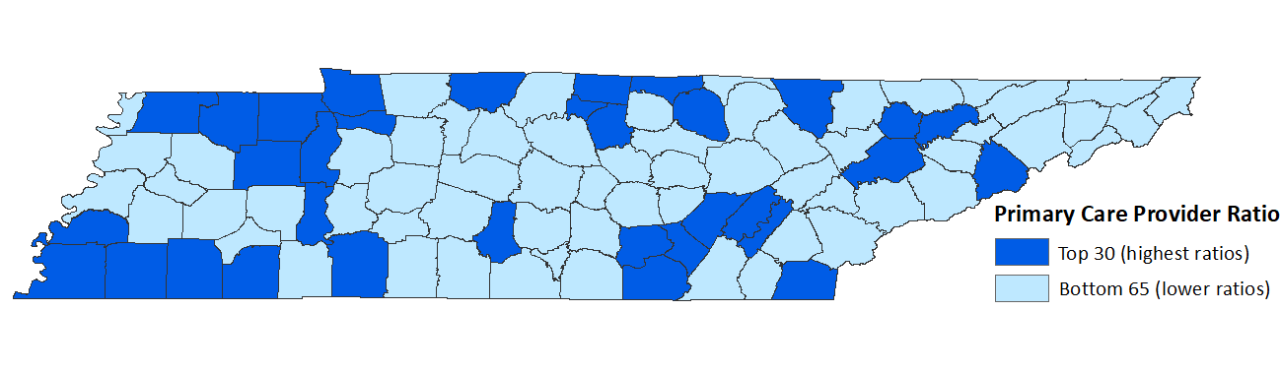
Health Access Provider Survey (HAPS)
The Primary Care Office conducts the Census of Tennessee Providers every year. This survey collects important information about healthcare providers in the state. The data helps identify areas where there are not enough providers.
When a shortage is identified, programs are available to help bring more providers to these areas, including:
- 3-R Net: Helps healthcare organizations recruit qualified providers.
- Tennessee Student Loan Repayment Program (TSLRP): Offers state-funded incentives for healthcare providers who work at approved locations.
- National Health Service Corps (NHSC): Offers federal funding incentives for providers who work at approved sites.
These programs are designed to increase access to healthcare in areas that need it most.
For more information on HAPS, contact the Director of the Office of Primary Care, Marcus Flatt, at 615-253-5799 or email PrimaryCare@tn.gov.
HAPS Census Participation
The State Office of Rural Health is conducting its annual census of primary care-adjacent health professionals. Completing the census takes less than 5 minutes. The information collected helps identify areas with a shortage of healthcare providers for the coming year.
These shortage area designations are important because they guide the allocation of state and federal assistance for both patients and providers in those areas.
We are requesting information from the following healthcare professionals who practice in an outpatient setting:
- Physicians
- Physician Assistants
- Advanced Practice Nurses
Specialties included:
- Family Practice
- General Practice
- Pediatrics
- General Internal Medicine
- Public Health
- Gynecology
- Obstetrics
- Obstetrics/Gynecology
Help us collect important information about healthcare providers in Tennessee by completing the appropriate census:
Health Access Program
The Health Access Act of 1989 created the State Treasurer's Health Access Incentive Account. This program was established to improve access to healthcare for the people of Tennessee by encouraging healthcare practitioners to work in areas of the state that are designated as Health Resource Shortage Areas (HRSA).
Funds from this program can help communities increase access to healthcare by identifying qualified healthcare providers to offer services or establish practices in areas that need them.
The purpose of the Health Access Program is to:
- Help communities improve access to health and dental care services.
- Identify qualified healthcare providers to provide services or open practices in shortage areas.
- Coordinate with programs and institutions that train healthcare practitioners, including both physicians and non-physician healthcare practitioners (HCPROs) as well as dental care practitioners (DCPs).
Contact
Marcus Flatt, Director of the Office of Primary Care
Email: Marcus.Flatt@tn.gov
Phone: 615-253-5799
Loan Repayment Programs
Explore the Tennessee Department of Health State Office of Rural Health loan repayment programs that help eligible primary care clinicians repay educational loans in exchange for a service commitment at approved sites in federally designated Health Professional Shortage Areas (HPSAs).
Dental Loan Repayment Program
Dental Loan Repayment Program helps recruit and retain dentists in underserved areas of Tennessee by providing educational loan repayment in exchange for service in federally designated Health Professional Shortage Areas. The program strengthens access to dental care for uninsured and underserved populations by supporting providers who practice in safety-net and community-based settings.
Program Contact:
Mindy Goff, MPH, Director of State Office of Rural Health
Phone: 615-253-2702
Cell: 615-289-4464
Email: Mindy.A.Goff@tn.gov
Tennessee Healthy Smiles Initiative
The Tennessee Healthy Smiles Initiative, led by the Tennessee Department of Health, expands access to oral health care for underserved Tennesseans—including uninsured adults through Smile 180 and older adults through Smile on 65+. Learn more about the Healthy Smiles Initiative (2021).
Smile 180
Smile 180 supports access to dental care for uninsured and underserved Tennesseans by strengthening the dental workforce and expanding services in high-need communities. The initiative improves oral health outcomes through provider support, training opportunities, and partnerships with safety-net clinics across the state.
Program Contact:
Alle Crampton, Uninsured Adult Healthcare Safety Net Program Director
Phone: 629-208-5444
Email: Alle.M.Crampton@tn.gov
Smile on 65+
Smile 65+ expands access to dental care for Tennesseans ages 65 and older by supporting preventive and restorative oral health services through safety-net clinics and community partners across the state. The program helps address oral health needs that affect overall health, independence, and quality of life for older adults who may be uninsured or lack dental coverage.
Program Contact:
Alle Crampton, Uninsured Adult Healthcare Safety Net Program Director
Phone: 629-208-5444
Email: Alle.M.Crampton@tn.gov
J-1 Visa Program and State Conrad 30 Program
Thank you for your interest in potential employment opportunities in one of Tennessee’s medically underserved areas.
- Rules and Regulations (2006): Review the Rules and Regulations Governing the State Conrad J-1 Visa Waiver Program for the Tennessee Department of Health, Office of Health Access.
- Policies and Procedures (2006): Read the State Conrad J-1 Visa Waiver Program Policies and Procedures for detailed program guidance.
Thank you again for your interest in healthcare opportunities across Tennessee.
This Page Last Updated: March 26, 2026 at 3:48 PM