March 2026
From Our Chief Strategy Officer
Dear readers,
With lots of support, she has been able to talk to us about it. After a rough occupational therapy session on Monday, she told us she misses her previous therapist, who moved away a couple years ago. The message was clear: Lina is thinking about people who have disappeared from her life.
I am telling you this story because it’s a small example from my own family of something that comes up in our work at the Council nearly every day: the importance of understanding and supporting root causes of behavior.
We talk fairly often about the fact that people with intellectual and developmental disabilities (IDD) have higher rates of behavioral health needs than the general public. But we don’t talk as often about why. (A note to say: by behavioral health, we mean the way mental and physical health affect a person’s behavior.)
We may say that a person’s behavior is a result of their disability. But we sometimes miss the very real, human reasons for that behavior. For example, many people with IDD – like Lina – rely on systems of support that are vulnerable to disruption. Those disruptions can create a lot of feelings for the person whose life is being affected. People with IDD may not have the skills or get the support they need to process and appropriately express complex feelings.
When people with IDD don’t get the behavior supports they need, they can end up in crisis, sometimes leading to cycles of law enforcement or criminal justice involvement. This is why behavior supports and safety issues continue to be our highest priorities at the Council. We hear too many stories of people with IDD in distress who were further harmed because those around them did not have the knowledge or resources to help. We are hard at work, in partnership with agencies and individuals across the state, on solutions.
There are ways you can help.
- If you have had a disability-related experience with police or the criminal justice system – good, bad, or a mix – your story can help our work. You can share as much or as little personal information as you want. Click here to submit your safety story.
- Explore our free behavior supports resources – including our printable healthy behavior checklist to help you think about root causes for behavior.
You’ll continue to hear from us about behavior and safety-related issues and how we’re working on solutions. Stay tuned!
And, hey – happy Developmental Disabilities Awareness Month! I am so grateful to be a part of this remarkable community with all of you.
- Jolene Sharp, Chief Strategy Officer
Upcoming Opportunities
Work Experience for Young People with Disabilities
A new opportunity may be available for young people with disabilities who want work experience.
The Youth Employment Program, or YEP, is working with Vocational Rehabilitation to help those under 24 with disabilities connect to job experience. Young people do not have to be part of Vocational Rehabilitation to join.
To qualify, a person must:
- be between 14 and 24 years old
- have a disability
Each area will only have a certain number of spots available.
Young people who are interested can fill out a referral form or contact their local American Job Center to learn more. People who already work with a Local Workforce Board or American Job Center can also reach out to them directly for more information.
Coming Soon: The Annual Arts issue of Breaking Ground
Our upcoming arts issue of Breaking Ground magazine is one you won’t want to miss.
This issue spotlights the work of talented artists with disabilities from across Tennessee, alongside a feature on our partnership with the Smithville Fiddler’s Jamboree and Crafts Festival – a uniquely Tennessee tradition that brings together music, craft, and community every year.
Breaking Ground is our free magazine published four times a year. Every issue is packed with stories and ideas that matter to our community – from policy updates to self-advocacy to history that matters more now than ever.
The arts issue hasn’t dropped yet, so there’s still time to make sure it ends up in your hands. Sign up today to receive it for free, in your inbox, mailbox, or both.
30 Years of The Scholarship Fund: Apply Today!
If you’ve identified a disability-related event that would benefit you or a family member, visit the Scholarship Fund application page here for financial support to attend.
For more than 30 years, the Council’s Scholarship Fund has helped Tennesseans with disabilities and their families attend leadership meetings, disability conferences, and training opportunities - both in Tennessee and across the United States. Beyond learning, this fund opens doors to networks and connections that might not exist without this support.
Starting in 2026, the Scholarship Fund is managed through a new partnership with United Cerebral Palsy of Tennessee. There’s still time to apply for events now through June 30, 2026.
Want to learn more about the history of the Scholarship Fund? Read the story of a family using it to attend a conference in Breaking Ground Issue 124.
Community Q&A: Courtney Johnson
Courtney Johnson is a Governor appointed member for our Council, serving the First Tennessee Development District; public policy committee chair; and author of Just Keep Stimming.
How would you define community?
I see community as more than just a place to live. It's the feeling of belonging, of being exactly where you're meant to be. It's a neighbor who greets you by name at the mailbox, or a friend who drops everything in the middle of the night when you need help. Community is not where you live; it's where you belong.
Looking back, what role has community played in your life?
Growing up, I didn't quite have that sense of community. I found it as an adult, during a research internship where our small class always made sure I felt included. They were supportive with my communication device, stuck up for me when someone wasn't respectful, and made sure the places we went were wheelchair accessible. It raised the bar for what inclusion looked like for me and gave me a real feeling of belonging.
What does community look like for you right now?
Stability in a chaotic world. I have support staff who make sure I'm involved in the things that give me joy, supportive friends, a loving fiancé, and neighbors who keep watch for my safety. There's no single way to find community, and it's not necessarily just the people who live next to you.
Why does community matter in people's day-to-day lives?
Humans are not meant to be alone. Independence as it's defined is a myth. Everyone relies on someone else in some capacity. The true need is interdependence, because all life is interconnected. That connection and belonging are significant parts of humanity, and people with disabilities deserve to experience that, too.
Policy Corner: Council News to Know
Bills are moving along at this point in the legislative session! Here’s an update on a few active bills that would impact our current priorities.
SB1868 - Extended DCS custody for children who assault staff
Allows a court to order a child to remain in custody of the Department of Children's Services for up to an additional 6 months if the child has assaulted a staff member at their placement.
Why does this matter?
- Children could be held in state custody without being charged with a crime.
- This could affect children with disabilities at a higher rate than children without disabilities.
SB2362 - DCS and DDA collaboration for children with I/DD
Requires collaboration between the Department of Children's Services and the Department of Disability and Aging for children with intellectual and developmental disabilities.
Why does this matter?
- Improves services and oversight for children with I/DD who are in or at risk of entering state custody.
- Allows DDA to provide training and insight on how to best support children with disabilities.
- Requires DCS to submit a report showing how they are putting the law into practice.
SB1684 - Accessible parking placards for pregnant people
Allows pregnant people in their 2nd and 3rd trimester to be eligible for an accessible parking placard.
Why does this matter?
- There is already a shortage of accessible parking, which is essential for some people with disabilities and their families.
- People with high-risk pregnancies are already eligible for accessible parking under the Americans with Disabilities Act (ADA).
- Council member Bliss Welch, who uses a wheelchair, has advocated for this bill based on her challenges finding accessible parking.
SB2485 - Video surveillance in special education classrooms
Allows a Local Education Agency or public charter school to use video camera surveillance in special education classrooms to continuously monitor students, teachers, and staff with consent from classroom staff and a majority of parents.
Why does this matter?
- Teachers would be allowed access to footage if they believe it contains evidence of assault. Teachers are able to report occurrences in their classrooms without photos or video.
- Advocates have expressed concerns about whether students with disabilities could face criminal penalties based on camera footage.
Public Comment Request:
The Council has done a lot of work to increase access to adult size changing tables.
Here’s a chance to tell a federal office about how to make sure tables/changing stations actually meet the needs of people with disabilities and their families.
If you or your loved ones use these tables, your voice matters. Read more here and submit comments by April 20.
- Bayleigh Pirtle, Policy Intern
Disability Day on the Hill 2026
This year, Tennessee's disability community showed up and showed out. Under the banner of "Adventures in Access," advocates, families, self-advocates, and partner organizations from across the state gathered at the Capitol to make sure lawmakers heard directly from the people affected by the policies they pass.
Our Council members and Partners graduates came together in force and joined staff for a day of meetings, conversations, and the particular kind of exhausted-but-energized feeling that comes from a day well spent at the Hill.
Partners scholars were there, too, representing the next generation of disability policy voices in Tennessee.
So much of this work happens in the hallways and the in-betweens, not just the formal meetings.
The Hill may be behind us, but the work isn't. Stay connected for ways to keep your voice in the room all year long.
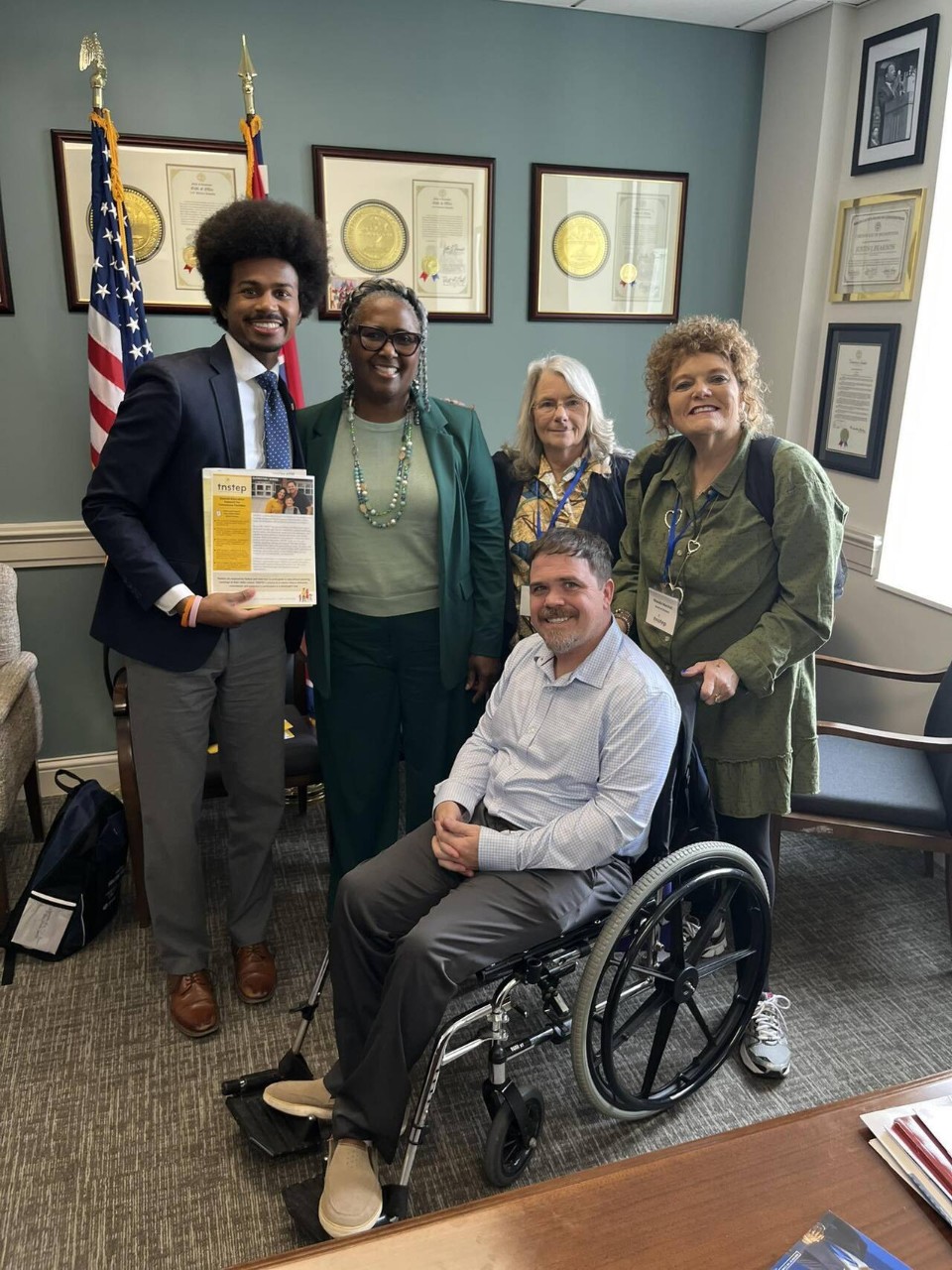
Representative Justin Pearson (D-Memphis), Partners Scholar Rhonda Roberts (far right) and fellow DDH advocates
Community Events & Training
Tennessee Disability MegaConference
Friday, August 21, 2026 · Embassy Suites, Murfreesboro
This year’s theme is “Impact through Advocacy: Raising Voices, Shaping Futures.”
It will focus on practical, lived experience and the work people are already doing to create change. If you've got something to share with the disability community, breakout session proposals are open now, with a focus on self-advocacy.
What's new this year:
- It will now be one full day, down from two days based on past attendance patterns.
- There will be a lower ticket price - $99, with sales opening soon.
- The event will also be moving from May to August, and from downtown Nashville to Murfreesboro. That change is intended to help avoid busy spring schedules and make travel easier for many attendees.
More details will be coming soon, including keynote speaker announcements and ticket sale information. Hotel rooms are already available through the conference room block for anyone who wants to book early.
2026 DEAL Luncheon
Tuesday, April 28 · 12 p.m. · Riverside Revival, Nashville
Disability Rights Tennessee is hosting the 2026 Disability Empowerment and Advocacy Luncheon soon.
You may know this event as the Disability Employment Awareness Luncheon. The new name reflects a broader focus on disability leadership, advocacy, and community across Tennessee.
Hosted by Disability Rights Tennessee, DEAL brings people together for lunch, conversation, and stories from the disability community.
Tickets |
|
|---|---|
| General admission | $100 |
| Nonprofit professionals | $75 |
| Self-advocates, people with disabilities, and family members with lived experience | Free |
Sponsored tickets
Available depending on space, on a first-come basis. To sponsor a ticket for a community member, contact Lee Sherwood at LeeS@DisabilityRightsTN.org.
→ You can purchase your tickets here.
2026 Tech Summit
October 28–29, 2026 · Department of Disability and Aging
The Department of Disability and Aging’s tech summit is coming back this fall. More details, including how to attend and sponsorship opportunities, will be shared in the coming weeks.
Stay tuned!
Job Openings in the Disability Field
Development Manager
Full-time | Majority Remote | Nashville Based
The Down Syndrome Association of Middle Tennessee is hiring a Development Manager to lead fundraising and donor engagement efforts. The role involves cultivating donor relationships, managing campaigns, writing grants, and working alongside staff and the board to grow DSAMT's revenue and impact.
To apply, send a resume and cover letter to Tanya Chavez at tanya@somethingextra.org.
Council Meetings 2025
- Friday, April 24 – Embassy Suites by Hilton Nashville Airport
For more information and to RSVP for our meetings, please call our main Council phone line at (615) 532-6615 or email Assistant to the Executive Director, Ashley Edwards, at ashley.edwards@tn.gov.