More Than Meets the Eye
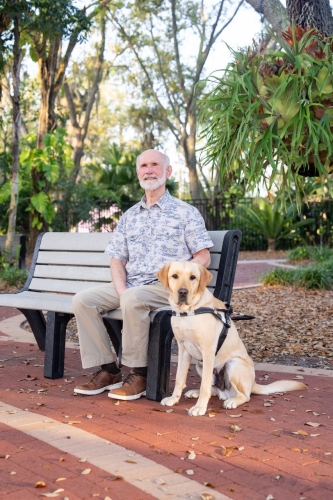
How Alt Text Opens the Door to Art for Blind and Low-Vision AudiencesThere is a moment Mike Harrell remembers clearly about his first guide dog, Bo. Mike was standing on a sidewalk in San Francisco, suitcase in hand. Bo stood at his side. In front of them was a 30-story Marriott hotel. Mike had just flown across the country alone.
“I guess we’ll find out how well this really works,” he told himself.
He gave Bo a command. The dog found the door, then the lobby, then the front desk. Later, Bo led him back through a labyrinth of escalators, elevators, and hallways - straight to his hotel room door.
Mike has spent a long time finding his way through a world that was not built with people like him in mind. Even before a collision with a car while riding his bike in 1980, he had congenital glaucoma – a condition that affects how well someone can see. After the accident, he kept a small amount of vision for decades. A household accident last year took what little sight was left.
Why Do We Say “Sighted?”
You’ll see the word “sighted” in this article. It simply means a person who can see. In disability communities, “sighted” is the common way to describe people who don’t have trouble seeing. This is like how “hearing” describes people who are not deaf. It simply names the majority experience. It avoids treating sight as normal and blindness as unusual.
Mike says his changing levels of vision since the cycling accident have mattered less to his life than another factor: “Really, it’s my ability to access the computer, the internet, and emails, and all of the stuff you can do with the computer. It’s that that gave me the ability to work.”
Something has been changing on the internet. It’s something that connects Mike’s lived experience to a conversation happening across the disability community, in courtrooms, in tech companies, in online art spaces, and yes, in the pages of magazines like this one.
It starts with two words most sighted people have never thought much about.
A Small Feature with a Big Job
Alt text - short for “alternative text” - is a written description tucked inside an image’s code. When someone who is blind or has low vision uses a screen reader, the software reads that description out loud. Without alt text, the screen reader might say a file name like “IMG_4872.jpg” or just the word “image.” This tells the user nothing.
“When it isn’t there,” Mike says, “I don’t have any idea what the graphic is. It’s not information that I’m going to get.”
What is a Screen Reader?
A screen reader is software that reads text on a screen out loud. It helps people who are blind or have low vision use websites, read emails, and open apps by listening instead of looking.
Common screen readers include JAWS (for Windows), VoiceOver (built into iPhones and Macs), and Narrator (built into Windows).
Ryan Jolley, who has very limited central vision, uses zoom tools and VoiceOver. At his desk, he can zoom in enough to see an image. But in other settings – riding in a car or using his phone outside – he depends on alt text.
“I really value the alt text when it’s there,” Ryan says, “and definitely lean on it for communicating whatever the visual thing is that’s supposed to be taken in.”
From the DOS Era to the Visual Web
When Mike first started using computers, everything was text-based. The old DOS system worked well with a screen reader. “I was used to the DOS system, and that was really very easy to access,” he recalls.
Then came the Graphical User Interface; windows, icons, and the mouse…and everything changed.
“Boy, when it first made that change, it was very discouraging,” he says. The new visual layouts – built for mouse clicks and scrolling – shut him out. “When people started using a mouse and all that stuff, that was totally meaningless for me. It really was still meant to be a visual world, so they had to totally change how the screen readers accessed that information.”
The alt text attribute has been part of the web almost from the start. In 1993, when browsers began displaying images, developers quickly saw the need for a text fallback. By 1995, the code used to build web pages (called HTML) added a way to attach descriptions to images. Four years later, the World Wide Web Consortium published its first set of accessibility rules.
The very first item said: “Provide a text equivalent for every non-text element.”
Alt Text and the Law
Section 508 of the Rehabilitation Act requires U. S. federal agencies to make online content accessible.
The Web Content Accessibility Guidelines (WCAG) list text labels for images as their first rule. A landmark 2006 lawsuit against Target showed that missing alt text can violate civil rights law.
That case opened the door to widespread legal action across retail, finance, and education.
The Special Case of Art
Alt text was first built for the everyday web: buttons, icons, product photos. However, as more art is posted online through social media, digital magazines, and gallery websites, alt text has taken on a bigger role. It is how blind and low-vision people take part in visual culture.
“I like colors. I like knowing that this looks soft or this looks hard. I like some details so I can then put that picture in my mind.”” — Mike Harrell
Mike used to paint and create detailed macramé fiber art. He is clear about what he wants from a good image label: color, texture, and detail. “Sometimes, when people are describing art for blind people, they forget that we do want to know colors,” he says.
“Giving us some description that really visually describes it – the colors, the sunset fades from the horizon – that kind of stuff is helpful.” He draws a useful line. When alt text is tied to a link or a button, keep it short; just say what happens when you click.
But when the image is the point – a piece of art, a photo, a scene – a longer, richer label is welcome.
Mike still visits galleries. He went to the Frist Art Museum in Nashville for a show on ancient Egypt. He couldn’t touch the objects, but someone described them to him.
“Just being there and having that description really means a lot to me,” he says. “That I can experience it in that way.”
When Alt Text Is Missing
It would be easy to see missing alt text as just an unchecked box.
But Mike’s words show it’s something more than that. “It brings back a lot of that feeling when I was young and feeling that there had to be something wrong with me…that everybody else is okay, but I am the one who is not. And that feeling is not comfortable, and it is not true, either.
But it’s still a feeling that comes up. And that’s part of what I feel when I run across those restrictive sites and restrictive attitudes.” After 46 years, Mike says he’s used to it.
But he adds that “it shouldn’t have to be that way because there are fairly simple ways around it.” If you share images on a website, in a newsletter, on social media, here are some simple steps that make a real difference.
Ryan's story shows that access isn't one-size-fits-all. Some people zoom in. Some listen. Some do both, depending on where they are and what device they're on. What matters most is that the label is there when it's needed.
Mike says the same thing: "I just want people to consistently put them there and to give you the information that tells you what that graphic is meant to communicate."
A Note on This Issue
This year's arts issue features work by artists with disabilities from across Tennessee. Every image includes alt text. For our digital edition, those descriptions were written with the same care the artists brought to their work. They note color, texture, composition, and mood.
For someone using a screen reader, a good label is the difference between taking in a piece of art and not knowing it's there. It's the difference between being part of the conversation and being left outside of it. Like Mike's first experience traveling independently with a guide dog, alt text allows him access to the experiences others enjoy.
The alt text field is not a technical chore. It's a few lines of text that say: this was made for you, too.