Infant Safe Sleep
Tennessee’s Infant Safe Sleep Program promotes safe sleep practices to reduce the risk of sleep-related infant deaths, including Sudden Unexpected Infant Death (SUID) and accidental suffocation.Babies Should Sleep Alone, on their Back, and in a Crib
The SUID/safe sleep program distributes educational materials and portable cribs to promote infants being placed alone, on their back and in a crib. This initiative implements multiple programs with birthing hospitals (BEST project), home visitors (safe sleep diaper bag project) and first responders (DOSE) to improve safe sleep behavior.
In 2021, there were 139 infant deaths that resulted from, or were associated with an unsafe sleep environment in Tennessee. Most of these deaths were preventable.
Contact
For more information about resources to support Infant Safe Sleep in Tennessee, email the Child Fatality Review Program Director at CFR.Health@tn.gov.
Community Projects Promoting Safe Sleep
BEST for Babies - Hospital Project
For information on the BEST for babies award criteria, Click Here.
The Tennessee Department of Health is partnering with hospitals across Tennessee to spread the Safe Sleep message to parents and caregivers.
Sleep-related infant deaths account for 20 percent of all infant deaths in Tennessee. Since 98.7 percent of Tennessee babies are born in hospitals, they play an important role in educating new parents and caregivers about ways to keep babies safe while sleeping.
The Tennessee Department of Health has partnered with 100% of birthing hospitals and 5 non-delivery hospitals across Tennessee to spread the safe sleep message to parents and caregivers. Click here for a list of participating hospitals.
These hospitals have agreed to:
- Develop and implement hospital Safe Sleep policy, which at minimum contains
- At least annual education to all perinatal staff (OB, peri/postpartum and pediatrics) on Safe Sleep recommendations
- Requirements for staff to model Safe Sleep recommendations
- Plan for at least quarterly internal compliance audits with hospital policy
- Submit annual report on educational activities and staff compliance to Tennessee Department of Health
As a part of the agreement, once Safe Sleep policy written and submitted to Tennessee Department of Health, partner hospitals receive:
- Free “Sleep Baby, Safe and Snug” board book for each birth in your facility
- Free TDH “ABCs of Safe Sleep” materials
- Free Recognition on TDH website
- Signed certificate from TDH Commissioner
- Press release template
- More information about the hospital partnership can be found in this presentation.
- Hospitals interested in partnering with the Tennessee Department of Health should complete and return the pledge form.
- For more information, please contact Rachel Heitmann (Rachel.heitmann@tn.gov).
Cribs for Kids® National Safe Sleep Hospital Certification Program
Apply for the Cribs for Kids® National Safe Sleep Hospital Certification
The Cribs for Kids® National Safe Sleep Hospital Certification program awards recognition to hospitals that demonstrate a commitment to reducing infant sleep-related deaths by promoting best safe sleep practices and by educating on infant sleep safety. By becoming certified, a hospital is demonstrating that it is committed to being a community leader and is pro-actively eliminating as many sleep-related deaths as possible.
Hospitals can earn one of three National Safe Sleep Certifications based on their levels of commitment:
BRONZE – Certified Safe Sleep Hospital
SILVER – Certified Safe Sleep Leader
GOLD – Certified Safe Sleep Champion
Tennessee Safe Sleep Statistics
"Infant mortality" refers to the death of a baby before their first birthday. The "infant mortality rate" is the number of infant deaths per 1,000 live births.
Number and Rate of Tennessee Infant Deaths
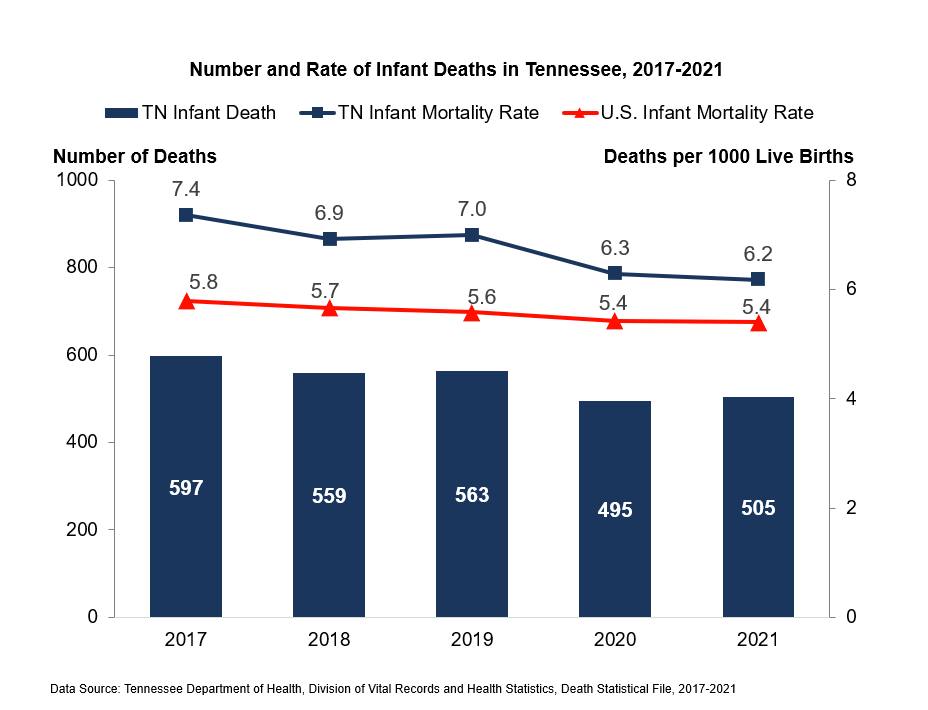
Description: The bar graph above shows the infant mortality rate over time in Tennessee for the years 2017 to 2021. In 2021 in Tennessee, 505 babies died before turning one. Tennessee's mortality rate in 2021 was 6.2 deaths for every 1,000 live births. Even though Tennessee's infant mortality rate in 2021 has fallen since 2017, when the rate was 7.4 deaths for every 1,000 live births, Tennessee's mortality rate is still higher than the national infant mortality rate in 2021 of 5.4 infant deaths for every 1,000 live births.
Sleep-Related Deaths in Tennessee
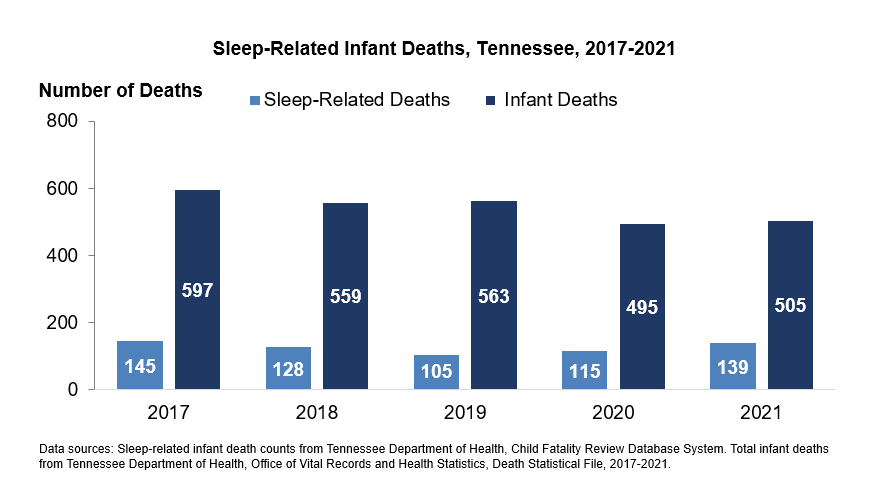
Description: The bar graph above shows the number of sleep related deaths in Tennessee, compared to the overall number of infant deaths in the state from 2017 to 2021. Even though the overall infant mortality rate and number of infant deaths has declined over the past few years, sleep-related deaths consistently account for approximately 1 in 4 infant fatalities. In 2021 there 139 infant sleep-related deaths. This means that about 25% of all infant deaths were due to sleep-related causes.
Contributing Factors to Sleep-Related Deaths in Tennessee
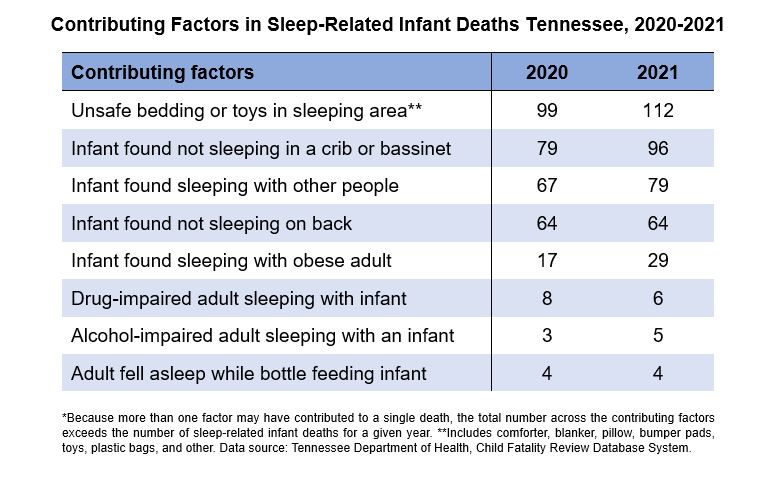
Description: The above table lists the main contributors of sleep-related deaths in Tennessee, in 2020 and 2021. In 2021, unsafe bedding or toys in the sleeping area contributed to 86 percent of deaths; infant not sleeping in a crib or bassinette was 69 percent of deaths; infant sleeping with other people, 58 percent of deaths; and, infant not sleeping on back was 56 percent of deaths in 2021. These data show why it is important to follow the ABC's of safe sleep—babies should sleep Alone, on their Back, and in a Crib.
Safe Sleep Resources
Tips for Parents and Caregivers
- Always place babies on their backs to sleep at night and at nap time. Babies who sleep on their backs are less likely to die of Sudden Infant Death Syndrome (SIDS).
- Babies should always sleep in a crib. The safest place for a baby is in the same room as the parents but alone in a separate sleep area.
- Keep loose objects, soft toys, and bedding out of the baby's sleep area. Do not use pillows and blankets in a baby's sleeping area. A baby should sleep in a crib with only a tight fitting sheet.
- Avoid letting your baby overheat during the night. A baby should be dressed lightly for sleep. Set the room temperature in a range that is comfortable for a lightly clothed adult.
- Do not use crib bumpers. These do not reduce injuries and can cause suffocation.
- Avoid smoking. Both maternal smoking during pregnancy and secondhand smoke after birth should be avoided.
- Breastfeeding is recommended for at least the first six months of life. Breastfeeding is associated with a reduced risk of SIDS.
For more information click here.
Resources for Hospitals
- Tennessee Department of Health — Safe Sleep Campaign
- American Academy of Pediatrics — Safe Sleep Policy Statement
- NICHD — Safe to Sleep Campaign
- Cribs for Kids — Step-by-Step Guide for Creating a Hospital Safe Sleep Program
Educational Tools
- Educational Flip Chart (Available in English, Spanish, or Arabic)
- Request copies from Rachel.heitmann@tn.gov
- View PDF sample of Educational Flip Chart
- Sample Training Presentation for Staff
- Downloadable PDF
- Downloadable PowerPoint® Presentation (includes speaker’s notes)
- Speaker’s Notes for PowerPoint Presentation
Model Policies
- East TN Children’s Hospital — Sample Safe Sleep Policy
- UT Medical Center Safe Sleep Policy — Model Hospital Policy
- First Candle — Model Hospital Policy
- Pennsylvania AAP — Model Hospital Policy Manual and Tool Kit
- Wellspan Health-York Hospital (Pennsylvania) — Infant Positioning/Safe Sleeping Practice Policy
- Central Ohio Hospital Council — Community Standards on Safe Sleeping Environments
This Page Last Updated: March 26, 2026 at 4:46 PM