Sickle Cell Awareness
Understanding Sickle Cell Disease
Sickle cell disease (SCD) is a condition that people are born with. It changes the way red blood cells work. Normally, red blood cells are round and soft, so they can move easily through blood vessels and carry oxygen to all parts of the body. In SCD, a change in a gene causes the hemoglobin inside the cells to form incorrectly. This makes the red blood cells stiff, sticky, and shaped like a crescent, or sickle. These sickle cells break apart more quickly, which can cause anemia, and clog small blood vessels. When blood flow gets blocked, oxygen cannot reach parts of the body, which can cause pain and other health problems.
The Tennessee Department of Health is committed to increasing awareness, connecting Tennesseans with reliable information and resources, and supporting efforts to improve health outcomes across the state. Whether you are living with sickle cell disease, caring for a loved one, or simply want to learn more, this site provides trusted information to help you understand the condition, available services, and steps you can take to protect your health.
Learn More About Sickle Cell Disease
Sickle Cell Disease Changes Blood Cells
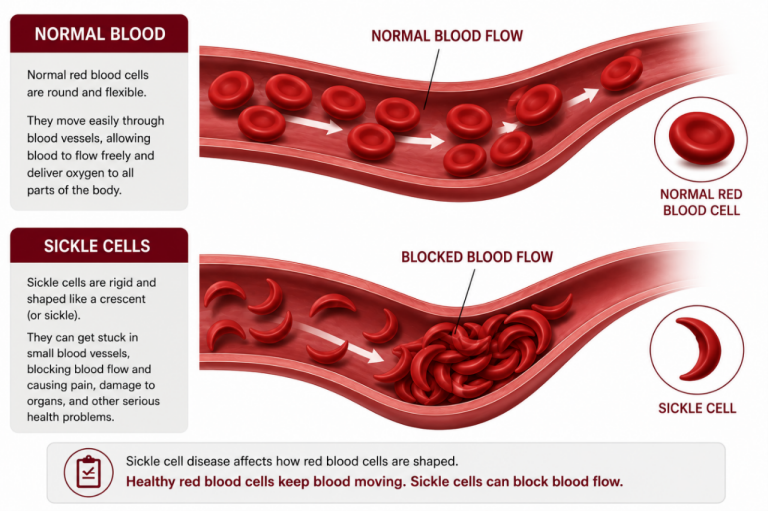
Image Description: This is an educational graphic that uses side‑by‑side illustrations to compare normal blood flow with blood flow affected by sickle cell disease. The top illustration shows healthy, round red blood cells moving smoothly through a blood vessel. The bottom illustration shows sickle‑shaped red blood cells that stick together and block blood flow within the vessel. Labels highlight that normal red blood cells are round and smooth, while sickle cells are crescent-shaped. The important information from this image is sickle cell disease affects how red blood cells are shape. Healthy red blood cells keep blood moving. Sickle cells can block blood flow.
Contact
For basic information or questions about Sickle Cell Disease, contact TDH's Newborn Screening Program:
- Phone: (615) 532-8462
- Toll-Free: (855) 202-1357
- Fax: (615) 532-8555
- Email: nbs.health@tn.gov
Sickle Cell Genetics & Inheritance
Sickle cell trait (SCT) is not a disease. It means a person has one sickle cell gene and one normal gene. People with SCT usually do not have symptoms, and SCT does not turn into SCD. However, they can pass the sickle cell gene to their children.
If a child gets one sickle cell gene and one normal gene, they will have SCT. But if both parents have SCT, their child could get two sickle cell genes. If that happens, the child will have SCD. More than 1% of babies born in Tennessee have SCT, which shows why newborn screening is so important.
Inheritance Pattern of Sickle Cell Disease
Sickle cell disease is inherited when a child receives two sickle cell genes—one from each parent. If both parents are carriers, there is a 1-in-4 (25%) chance with each pregnancy that their child will have sickle cell disease. Genetic counseling and testing can help you understand your risk and family planning options.
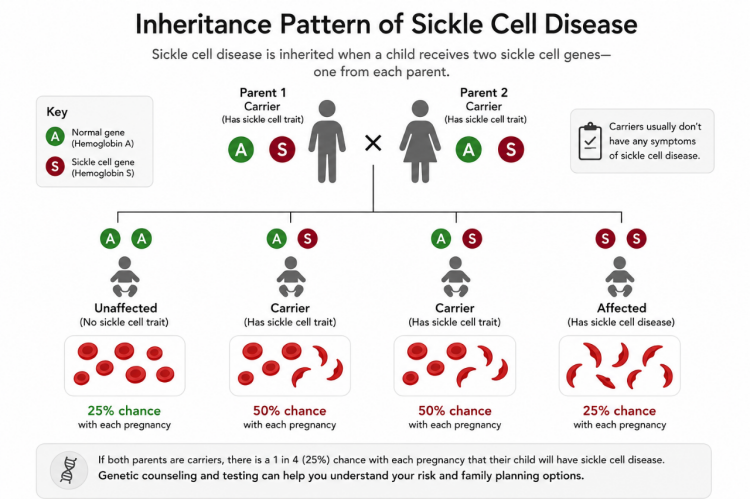
Image Description: An infographic that explains how sickle cell trait is inherited. It shows a situation where one parent is a carrier of the sickle cell trait and has one normal hemoglobin gene (A) and one sickle cell gene (S). The other parent is not a carrier and has two normal hemoglobin genes (A). The infographic uses simple pictures and colors to show how these genes can be passed to a child.
It explains that each pregnancy has a 50% chance of the child getting two normal genes and not being affected, and a 50% chance of the child getting one normal gene and one sickle cell gene, making the child a carrier. The image also notes that people with sickle cell trait usually do not have symptoms of sickle cell disease. It encourages families to consider genetic counseling and testing to better understand their risks and plan for future pregnancies.
Early Detection and Treatment are Important
Causes of Sickle Cell Disease
The usual hemoglobin gene is called hemoglobin A, while the most common abnormal genes are known as hemoglobin S or hemoglobin C. There are also a few other, less common hemoglobin genes.
How is Sickle Cell Diagnosed?
In the United States, all newborn babies are checked for certain health conditions, including sickle cell disease. In Tennessee, this newborn test looks for both sickle cell disease (SCD) and sickle cell trait (SCT). Older children and adults can ask a doctor for a check‑up and a special blood test (called hemoglobin electrophoresis) to find out if they carry the sickle cell gene or have another related condition.
Finding sickle cell disease early is important because it can raise the risk of infections and other health problems. A doctor may also recommend more tests to make sure there are no other problems.
Complications of Sickle Cell Disease
Sickle cell disease can affect many major organs and cause a wide range of complications. Each person may have different symptoms, which may be mild or severe.
Common complications can include:
Anemia: In people with SCD, red blood cells break down earlier than they should. This causes a condition called anemia. Anemia occurs when the body does not have enough healthy red blood cells to carry oxygen.
Episodes of Pain: Periodic pain is a common complication of SCD. It occurs because sickle-shaped red blood cells can block blood flow in small blood vessels. Pain episodes may start suddenly, vary from mild to severe, and last for short or long periods. People may experience short episodes of pain, chronic pain, or both.
Fevers and Infections: People with SCD are more likely to develop infections, especially certain bacterial infections. A fever can be the first sign of an infection, and for some patients, it may be the only sign of infection. For those with SCD, it is important to be evaluated by a physician as soon as a fever develops.
Lung problems: There are several lung issues that can occur in people with SCD. These include acute chest syndrome, pulmonary hypertension, blood clots, and breathing problems during sleep.
Organ Damage: People with SCD are at a higher risk for problems involving the heart, kidneys, lungs, and other organs because reduced blood flow and oxygen can damage these tissues. Symptoms of organ damage can differ based on which organ is involved. This can be serious, so people with SCD need regular check-ups to watch for organ problems.
Circulation Problems: Sickled cells can block blood vessels, which can lead to problems such as blood clots, stroke, and painful swelling in the hands and feet.
How to Live a Healthy Life with Sickle Cell Disease
People with sickle cell disease (SCD) can stay healthier by following good habits.
- Keep up with medical care
It is important for people with SCD to see their doctor regularly. They should get all their routine vaccines, including vaccines for seasonal illnesses. Because they can get certain infections more easily, they may need extra vaccines to help protect them. Regular checkups help keep them healthy.
- Take medicines as directed
Medicines are an important part of treating SCD. Some medicines can be started when a child is still a baby to help prevent problems later on. Taking medicine every day, exactly as the doctor says, helps reduce pain episodes and other health issues.
- Exercise safely
Being active is good, but people with SCD should exercise carefully. Light or moderate activities are usually best. It is important to take breaks, drink water, and stop if you feel tired. Hard, heavy exercise can raise the chance of pain or other problems.
- Stay hydrated
People with SCD need to drink plenty of water each day. Drinking enough water helps the blood flow smoothly. If the body does not have enough water, red blood cells can get stickier and block blood vessels, which can cause pain. Staying hydrated is one of the easiest ways to help prevent problems.
- Practice good hygiene
People with SCD need to avoid infections. Washing hands often, staying away from people who are sick, and keeping up with vaccines are good ways to prevent illness.
- Avoid triggers
Some things can make pain episodes more likely. People with SCD should try to avoid:
- Extreme physical activity
- Not drinking enough water
- Stress
- Infections
- Sudden changes in temperature
- Smoking or vaping
- Drinking too much alcohol
- Drinking too much caffeine
Sickle Cell Disease Resources
Resources for Patients and Families
Tennessee Resources
- The Tennessee Sickle Cell Disease Surveillance Program
- The Sickle Cell Foundation of Tennessee
- Sickle Cell Foundation of Middle Tennessee
- Breaking the Sickle Cell Cycle Foundation
Resources for Physicians
- 2026 TennCare Sickle Cell Report
- Newborn Screening Data: Tennessee (2016-2020) | Sickle Cell Disease and Thalassemia Programs | CDC
- Clinical Practice Guidelines on Sickle Cell Disease - Hematology.org
- Evidence-Based Management of Sickle Cell Disease: Expert Panel Report, 2014 | NHLBI, NIH
- Addressing Sickle Cell Disease: A Strategic Plan and Blueprint for Action
- CMS Sickle Cell Disease Provider Toolkit
Supporting Students with Sickle Cell Disease
School staff, caregivers, and parents play an important role in supporting a student’s health, well-being and success at school. Good communication between families and schools can help students with sickle cell disease stay safe, take part in school activities and keep up with learning.
The information below offers practical guidance for teachers, school nurses, administrators, parents and caregivers. Each student’s needs are different. Families and school staff should work together to use the information that best supports the student and follow the student’s health care plan.
Students with sickle cell disease (SCD) can learn, play and take part in school activities. Each student is different. Work with the student, family and health care team to follow the student’s school health plan.
Help prevent health problems
- Let the student drink water often. Keep water nearby during class, recess and sports.
- Allow bathroom breaks as needed. Do not limit bathroom use.
- Help the student stay warm and dry in cold or rainy weather.
- Keep the student away from drafts, fans and air-conditioning vents.
- Offer breaks during exercise and physical activity.
- Avoid very hard exercise, extreme heat, high humidity and cold weather.
- Ask the student and family what activities are safe and comfortable.
- Follow the student’s health plan for medicines and pain care. Do not give medicine unless school policy and the health plan allow it.
Respond to pain or injury
- Take the student’s pain seriously.
- Stop the activity and move the student to a quiet, comfortable place.
- Contact the school nurse and follow the student’s health plan.
- Do not use ice or cold packs unless the student’s health care plan says to do so.
- For an injury, use regular first aid, such as direct pressure for bleeding or raising an injured arm or leg.
- Call 911 for trouble breathing, severe weakness, loss of movement, confusion or other serious symptoms.
Know the warning signs
Call the school nurse and follow the emergency plan if the student has:
- Severe or sudden pain
- Fever
- Trouble breathing
- Chest pain
- Extreme tiredness, fainting or unusual sleepiness
- Sudden trouble speaking, walking, seeing or using an arm or leg
- A seizure or severe headache
Sudden changes in speech, movement, balance, vision or alertness may be signs of a stroke. Call 911 right away.
Support learning and attendance
- Watch for changes in attention, memory, learning or schoolwork.
- Do not assume these changes are caused by poor effort or behavior.
- Tell the family and school nurse about concerns.
- The student may need learning support, testing, a Section 504 plan or an Individualized Education Program (IEP).
- Plan ahead for missed school days. Provide make-up work, tutoring, online work or a second set of books when needed.
- Focus on the most important work instead of giving a large amount of make-up work.
Support emotional health
- Protect the student’s privacy.
- Watch for teasing, bullying, sadness or withdrawal.
- Include the student in classroom and social activities.
- Recognize the student’s strengths, interests and talents.
- Encourage respect and kindness from all students.
Keep communication open
- Keep current contact information for the family, school nurse and health care team.
- Share concerns about pain, attendance, learning or behavior with the family and school nurse.
- Review the student’s health plan with staff who work with the student.
- Update the plan when the student’s needs change.
This information does not replace the student’s health care plan or medical advice. Contact the student’s health care team with questions.
Parents and caregivers can help their child stay healthy, safe and ready to learn at school.
Meet with the school
At the start of each school year:
- Meet with the teacher, school nurse, principal, counselor and physical education teacher.
- Explain that sickle cell disease (SCD) is an inherited blood disorder.
- Share how SCD affects your child.
- Explain your child’s warning signs and needs.
- Tell the school when to call you, the health care team or 911.
- Share emergency contact information and the name of your child’s preferred hospital.
- Tell the school who may know about your child’s condition. Protect your child’s privacy.
Create a written health plan
Work with the school nurse, your child and the health care team to create or update a written health plan. The plan should include:
- Emergency contacts
- Your child’s warning signs
- When to call you, the health care team or 911
- Access to water and bathroom breaks
- Safe activities and exercise limits
- Help during pain or illness
- Medicine instructions, including who may give medicine
- Steps to take if your child misses school
Review the plan at least once each school year and whenever your child’s health needs change. Follow school rules for giving medicine.
Ask about school supports
Ask the school if your child needs:
- A Section 504 plan for health needs and equal access to school
- An Individualized Education Program (IEP) if SCD affects learning and special education services are needed
- Extra time or breaks
- Water and bathroom access
- Safe clothing for hot or cold weather
- A second set of books or online classwork at home
- Help making up missed work
School staff can explain the process for requesting an evaluation or plan. Plans should be reviewed and updated as needed.
Plan for missed school
Before your child becomes ill:
- Ask how the school will share classwork and homework.
- Make a plan for tutoring or home instruction when available.
- Ask for the most important work first.
- Keep in contact with teachers during an absence.
- Tell the school when your child can return.
Keep communication open
- Share changes in your child’s health with the school nurse and teachers.
- Check in with the school during the year, not only when your child is sick.
- Tell the school about changes in pain, energy, learning or behavior.
- Ask teachers to contact you when they notice a change.
- Help your child learn to explain their needs.
- As your child grows, encourage them to speak up and take part in their health care.
This information does not replace your child’s health care plan or medical advice. Contact your child’s health care team with questions.
School staff should follow each student’s written health plan. When in doubt, contact the school nurse and the student’s parent or caregiver.
Pain
Pain is common in people with SCD. It may happen in the arms, legs, stomach, back or other parts of the body. Pain may also affect a student’s mood or behavior.
- Take every report of pain seriously.
- Ask the student to describe the pain, such as mild, moderate or severe.
- Use the student’s health plan to guide care.
- Allow the student to rest in a safe, quiet place.
- Give medicine only as allowed by the health plan and school rules.
- Contact the parent or caregiver when pain is new, worse than usual or does not improve.
- Call 911 for severe pain with trouble breathing, chest pain, fainting, confusion or other emergency signs.
- Never tell a student to simply “push through” the pain.
Fever
Students with SCD can become seriously ill from an infection. A fever of 101.3°F (38.5°C) or higher needs prompt medical attention.
- Follow the student’s health plan.
- Contact the parent or caregiver right away.
- Contact the student’s health care team as directed.
- Do not give medicine unless it is allowed by the health plan and school policy.
- Call 911 for fever with chest pain, coughing, trouble breathing, severe weakness or other emergency signs.
Stroke
SCD can increase the risk of stroke. A stroke can cause sudden changes in the brain and body. Some brain injuries may not have clear warning signs but may affect learning over time.
Call 911 right away for:
- Sudden weakness or numbness in the face, arm or leg
- Trouble speaking or understanding
- Trouble walking or seeing
- Severe, sudden headache
- Seizure
- Sudden confusion, dizziness or loss of balance
Also watch for gradual changes in:
- Attention or memory
- Schoolwork
- Behavior
- Speech or learning
Tell the parent or caregiver and school nurse about ongoing changes. The student’s health care team may need to evaluate them. Work with the family to help the student make up missed schoolwork.
This information does not replace the student’s health plan or medical advice. Follow school emergency procedures and contact 911 for serious or sudden symptoms.
Parents and caregivers may hear questions from school staff about sickle cell disease (SCD). These answers can help families explain SCD in clear, simple terms.
Is sickle cell disease contagious?
No. You cannot catch SCD like a cold or the flu. SCD is an inherited blood disorder. A child is born with it because it is passed down through genes from the parents.
Why does the student miss school?
A student with SCD may miss school because of:
- Doctor visits and regular checkups
- Pain
- Tiredness or anemia
- Illness or infection
- A hospital stay
- Other health problems linked to SCD
The student may need help making up missed work.
Why do some students with SCD have yellow eyes or skin?
Yellow eyes or skin are called jaundice. This can happen when red blood cells break down faster than usual. Jaundice can occur in people with SCD, but it may have other causes as well. Tell the student’s health care team about new or worsening yellow eyes or skin.
Why does the student need water at school?
Water helps prevent dehydration. Dehydration may increase the risk of pain and other health problems.
The student may need to:
- Keep a water bottle nearby
- Drink water during the day
- Take water breaks
- Use the restroom more often
The student’s health plan should explain the student’s specific needs.
Why does the student need more bathroom breaks?
SCD can affect the kidneys. Students with SCD may make more urine, even when they do not have enough water in their bodies. They may need to use the restroom more often. Bathroom breaks should not be limited.
Why may the student be smaller or develop later than other students?
SCD affects each person differently. Some students may grow more slowly or begin puberty later. This may be linked to anemia, the body’s need for more oxygen or other health problems. Regular medical care can help support healthy growth and development. Do not tease or draw attention to differences in a student’s body. Treat the student with respect and protect their privacy.
Each student with SCD is different. Families and school staff should follow the student’s written health plan and ask the student’s health care team for medical guidance.
When to Seek Medical Care
Contact the student’s parent or caregiver and follow the student’s health plan if symptoms start or get worse, including:
- Chest pain
- Stomach pain
- Severe or worsening pain
- Fever of 101.3°F (38.5°C) or higher
- Extreme tiredness or weakness
- Trouble breathing
Signs of a Stroke
Call 911 right away for:
- Sudden weakness or numbness on one side of the body
- Trouble speaking or understanding
- Sudden dizziness or severe headache
- Blurred or lost vision
- Trouble walking or keeping balance
- Sudden confusion, memory problems or a seizure
Always tell the parent or caregiver when the student’s health changes during the school day. Follow the student’s written health plan and school emergency procedures.
This Page Last Updated: September 28, 2026 at 2:36 PM