Rural Health Access for Tennessee's Future
Rural Health Access for Tennessee's FutureRural Health is America's Health
On July 4, 2025, Congress passed H.R. 1, the One Big Beautiful Bill Act, creating an unprecedented opportunity to transform rural healthcare in Tennessee. Through the new Rural Health Transformation Program, States can apply for up to $10 billion per year for five years to expand access, improve care, and strengthen local health systems. Half of these funds—$5 billion annually—will be shared equally among all participating states, while the other half will be directed where it’s needed most, based on guidance from the U.S. Department of Health and Human Services. This program offers Tennessee a historic chance to build healthier, stronger rural communities for generations to come.
Strategic Pillars
Make Rural America Healthy
Advance rural health by expanding access and promoting prevention through evidence-based interventions in chronic disease management, behavioral health, and prenatal care.
Sustainable Access
Strengthen rural providers as sustainable access points by enhancing efficiency and collaboration with regional systems in care delivery, technology, and emergency services.
Workforce Development
Recruit and retain skilled healthcare providers, health workers, and pharmacists in rural communities to meet local access needs.
Innovative Care
Promote innovative care models and payment strategies that improve outcomes, coordinate services, and shift care to more efficient, cost-effective settings.
Tech Innovation
Advance digital health by expanding telehealth, improving data sharing and cybersecurity, and supporting adoption of emerging healthcare technologies.
States Can Pick Three
The Rural Health Transformation Program requires each state to pick three areas of focus from the following list of approved uses for the RHT funding:
- Promoting evidence-based, measurable interventions to improve prevention and chronic disease management.
- Providing payments to health care providers for the provision of health care items or services.
- Promoting consumer-facing, technology-driven solutions for the prevention and management of chronic diseases.
- Providing training and technical assistance for the development and adoption of technology-enabled solutions that improve care delivery in rural hospitals, including remote monitoring, robotics, artificial intelligence, and other advanced technologies.
- Recruiting and retaining clinical workforce talent to rural areas, with commitments to serve rural communities for a minimum of 5 years.
- Providing technical assistance, software, and hardware for significant information technology advances designed to improve efficiency, enhance cybersecurity capability development, and improve patient health outcomes.
- Assisting rural communities to right size their health care delivery systems by identifying needed preventative, ambulatory, pre-hospital, emergency, acute inpatient care, outpatient care, and post-acute care service lines.
- Supporting access to opioid use disorder treatment services (as defined in section 1861(j)(1)), other substance use disorder treatment services, and mental health services.
- Developing projects that support innovative models of care that include value-based care arrangements and alternative payment models, as appropriate.
- Additional uses designed to promote sustainable access to high quality rural health care services:
Capital expenditures and infrastructure: Investing in existing rural health care facility buildings and infrastructure, including minor building alterations or renovations and equipment upgrades to ensure long-term overhead and upkeep costs are commensurate with patient volume, subject to restrictions in the funding policies and limitations.
Fostering collaboration: Initiating, fostering, and strengthening local and regional strategic partnerships between rural facilities and other health care providers to promote quality improvement, improve financial stability of rural facilities, and expand access to care.
Frequently Asked Questions on Rural Healthcare Transformation
What will be included in the RHT plan?
The rural health transformation plan must describe how the state would use funds from the program to:
- Improve access to hospitals, other health care providers, and health care items and services furnished to rural residents of the state
- Improve health care outcomes of rural residents of the state
- Prioritize the use of new and emerging technologies that emphasize prevention and chronic disease management
- Initiate, foster and strengthen local and regional strategic partnerships between rural hospitals and other health care providers to promote measurable quality improvement, increase financial stability, maximize economies of scale, and share best practices in care delivery
- Enhance economic opportunity for, and the supply of, health care clinicians through enhanced recruitment and training
- Prioritize data and technology driven solutions that help rural hospitals and other rural health care providers furnish high-quality health care services as close to a patient’s home as is possible
- Outline strategies to manage long-term financial solvency and operating models of rural hospitals in the state
- Identify specific causes driving the accelerating rate of stand-alone rural hospitals at risk of closure, conversion or service reduction.
Annual allotments distributed to states would remain available for use through the end of the second succeeding FY. Beginning in 2028, amounts allotted but unused would be redistributed in accordance with a methodology specified by the CMS Administrator. Redistributed amounts would remain available for use by the state through the end of the second succeeding fiscal year. States would not be required to match awarded allotments.
What activities does the funding allow?
Allowable activities for the funding include:
- Promoting evidence-based, measurable interventions to improve prevention and chronic disease management.
- Providing payments to health care providers for the provision of health care items or services.
- Promoting consumer-facing, technology-driven solutions for the prevention and management of chronic diseases.
- Providing training and technical assistance for the development and adoption of technology-enabled solutions that improve care delivery in rural hospitals, including remote monitoring, robotics, artificial intelligence and other advanced technologies.
- Recruiting and retaining clinical workforce talent to rural areas, with commitments to serve rural communities for a minimum of 5 years.
- Providing technical assistance, software, and hardware for significant information technology advances designed to improve efficiency, enhance cybersecurity capability development and improve patient health outcomes.
- Assisting rural communities to right-size their health care delivery systems by identifying needed preventative, ambulatory, pre-hospital, emergency, acute inpatient care, outpatient care and post-acute care service lines.
- Supporting access to opioid use disorder treatment services, other substance use disorder treatment services, and mental health services.
- Developing projects that support innovative models of care that include value-based care arrangements and alternative payment models.
- Additional uses designed to promote sustainable access to high quality rural health care services.
The Application Process and Timeline
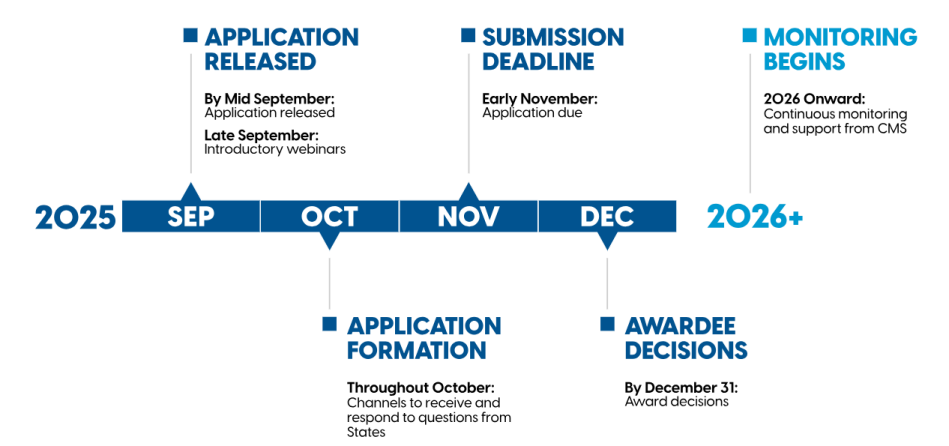
Only the 50 U.S. state are eligible to receive an RHT Program award with the application process as follows:
- Application instructions released Sept. 15, 2025, on the Grants.gov website.
- CMS will engage with States in the application period to answer questions.
- Application submissions close in early November.
- Awards decided by Dec. 31, 2025
The Unique Healthcare Challenges in Tennessee's Rural Communities
Tennessee’s rural communities face unique health care challenges that impact both physical and behavioral health. Rural Tennesseans often experience diminished access to care, in part due to limited availability of health care facilities, long travel times to receive care, workforce shortages for high-demand health care professions, and a high cost of health care.
In recent years, Tennessee has prioritized programs and resources to improve rural health care, including the Health Care Modernization Task Force, Healthy Smiles Initiative, Tennessee Rural Hospital Transformation Act of 2018, Tennessee Broadband Accessibility Act, and the Small and Rural Hospital Readiness Grant Program.
Recognizing the opportunity to build upon these initiatives, Governor Bill Lee established the Tennessee Rural Health Care Task Force, led as a public-private partnership originating in the Tennessee Department of Health and charged with developing a set of recommendations to improve rural health care across Tennessee.
Engaging Partners for the Health of Rural Tennessee
The Tennessee Department of Health expects to meet the RHT grant's application deadline of early November 2025.
Right now, TDH is actively engaging with Tennessee Gov. Bill Lee, members of the Tennessee General Assembly, and Tennessee stakeholders in rural health to gather ideas and input for a meaningful response to this significant grant opportunity.
You can have a lasting impact, too.
If you have comments, feedback, ideas, proposals, or suggestions, even if it's providing a letter of support on behalf of Tennessee's effort, please send an email to Rural.Health@tn.gov.
This Page Last Updated: April 23, 2026 at 1:00 AM