Wildlife Damage Control in Tennessee
General Information for Nuisance Wildlife
Because of the large number of human-animal interactions, the TWRA cannot assist landowners with capturing the nuisance wildlife. Wildlife Officers typically do not trap or remove nuisance wildlife but will provide technical assistance to landowners.
All animals need food, water, and shelter to survive. Loss of habitat, due to urban growth, increases the chance for wild animal/human interactions. Many animals move and find suitable habitats away from these areas. Raccoons, opossums, coyotes, foxes, and skunks thrive in the urban environment.
Landowners have several options for dealing with nuisance wildlife. As a landowner or tenant, you can legally capture some species of nuisance wildlife without a permit if the animal is discovered to be causing damage. Some animals are protected by law.
You may purchase a live box trap at most garden supply or home improvement stores. Once the animal is captured, you must release or euthanize the animal on your
Be careful capturing animals in the spring. Young animals may be involved. Before enclosing any entry points, make sure all animals have exited the structure.
Animal Damage Control (ADC) operators, permitted by TWRA, will assist landowners in trapping and/or removing nuisance wildlife at the landowner’s expense. TWRA does not have regulatory authority over these individuals and does not guarantee the quality of service they perform. Every reasonable effort is made to exclude disreputable individuals during the permitting process.
Animal Damage Control Operators
Apply for the Damage Control Operator Permit
You can access the application until it's been submitted for approval. If your application is approved, you will receive a permit to the email address you used while registering. You may edit this information at any time by going to the update profile after login. After receiving your permit, you will be required to fill out a year-end report to monitor your control measures. At the end of June, you will submit your year-end report, and the application button will reappear for the next fiscal year.
A permit will not be issued to any applicant who does not have a demonstrated knowledge of wildlife and wildlife control techniques as evidenced by training and/or experience.
Rules and Regulations
CHAPTER 1660-1-21 RULES AND REGULATIONS FOR NUISANCE ANIMAL DAMAGE CONTROL
Request more information from the Captive Wildlife Coordinator.
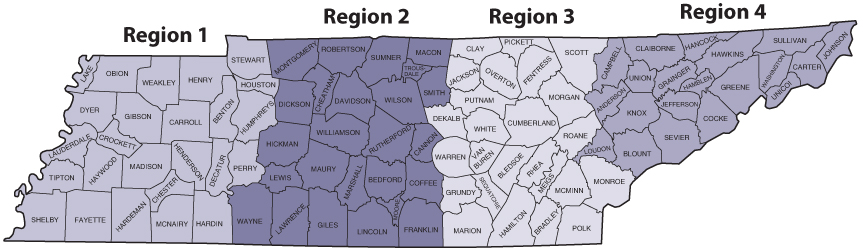
Tennessee Code Annotated 70-4-115 states in part that, the owner of lands may destroy any wild animals, wild birds, or wild fowl when such wild animals, wild birds, or wild fowl are destroying property upon such lands. Any person, before destroying any big game under the conditions provided for in this section, is required to obtain a permit for destroying such big game. Such permit shall be issued by an officer of the wildlife resources agency. Big game is defined as deer, wild turkey and bear. The landowner should contact the TWRA regional office in which the property is located and an officer will be assigned to contact the landowner.
| West Tennessee - Region I | Middle Tennessee - Region II | Cumberland Plateau - Region III | East Tennessee - Region IV |
|---|---|---|---|
| Phone: 731-423-5725 | Phone: 615-781-6622 | Phone: 931-484-9571 | Phone: 423-587-7037 |
| Toll Free: 800-372-3928 | Toll Free: 800-624-7406 | Toll Free: 833-402-4699 | Toll Free: 800-332-0900 |
Non-protected Species, Deemed - Destructive Species and Other Tips
Non-protected Wildlife Species
The following species are not protected by law because they are non-native invasive populations with the potential to damage property, pose a human health risk, and have detrimental effects on native wildlife.
- House (English) Sparrow
- European Starling
- Rock Pigeon
- Nutria
Wildlife Species Deemed Destructive
The following species are deemed destructive to property and may pose a safety or health risk to people, livestock, and other native wildlife.
More Wildlife Species Tips
Wildlife Damage Control FAQ
- Can I take care of the problem myself?
Yes, if you are the landowner.
TCA 70-4-115 Destruction and disposal of wildlife---Permit---Penalty.
(a) The owner of lands may destroy any wild animals, wild birds, or wild fowl when such wild animals, wild birds, or wild fowl are destroying property upon such lands. Any person, before destroying any big game under the conditions provided for in this section, is required to obtain a permit for destroying such big game. Such permits shall be issued by an officer of the wildlife resources agency.
NOTE: If you are experiencing animal damage caused by a federally protected species, you must obtain a permit from USFWS prior to destroying such wildlife.
- Can I relocate an animal I have trapped?
No. Because of illness and disease, it is illegal to transport any live wildlife (TCA 70-4-401) and release said wildlife (TCA 70-4-412) without a permit.
- If I trap a live wild animal, who can I call to relocate the animal?
You may contact any of the Animal Damage Control permit holders. This is NOT a free service. TWRA recommends you contact several permit holders for estimates before hiring.
- If I hire an Animal Damage Control permit holder, are there any mandated charges set by the TWRA or USFWS?
No. TWRA or USFWS does not regulate the business or practices. In the case of bats, we do require that the operator obtain approval prior to any exclusion work. The information we require consists of species, number, and if any young are present. This is a simple task of counting (estimating) the bats. If you are charged for this count and if you feel that the cost of this action is high, please seek other estimates.
- Once I hire an Animal Damage Control operator, who do I contact if I am not satisfied with the work?
You may contact your local Better Business Bureau or the Consumer Affairs Division of the Tennessee Department of Commerce. TWRA does not resolve disputes between Animal Damage Control operators and their customers
- Once wildlife has been trapped, is there a time requirement to remove the animal from the trap?
Yes, Animal Damage Control operators are mandated by law to check each trap within 36 hours. Once the trap is checked, the 36-hour “time clock” begins.
